Solar Panel Bulk Buying: A Practical Large-Quantity Guide
Learn how to buy solar panels in bulk, including typical discounts, lead times, and supplier considerations. This guide helps homeowners and developers maximize value with large-quantity orders. From quotes to installation, Solar Panel FAQ provides practical advice.


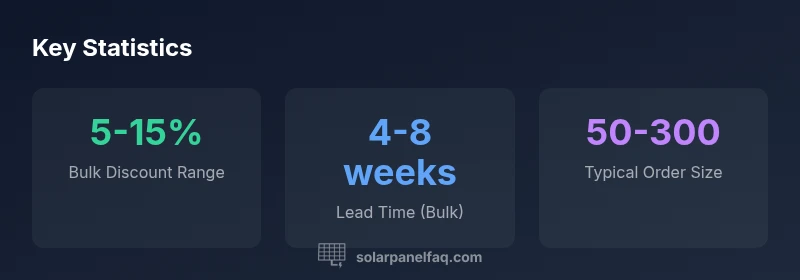
Bulk solar panel orders typically unlock discounts of about 5–15% depending on quantity and supplier, with larger purchases often achieving higher savings. Lead times for bulk orders generally span 4–8 weeks, influenced by stock, freight, and customization options. To ensure the best deal, compare quotes from several manufacturers and distributors.
Why Bulk Purchasing Makes Sense for Solar Panels
Bulk purchasing is not just a price play; it's a planning tool that aligns procurement with renovation timelines, installer schedules, and ongoing maintenance. For homeowners planning multi-panel systems or developers coordinating several installations, buying in bulk can simplify logistics, reduce per-unit costs, and reduce procurement overhead. According to Solar Panel FAQ, bulk solar panel orders typically unlock discounts of about 5–15% depending on quantity and supplier, with larger purchases often achieving greater savings. This section outlines the core economics of bulk buying, the role of stock availability, and how scalability translates into lower costs per watt. We’ll examine who benefits most (single-family, multi-unit, and community projects), typical quantity brackets, and the trade-offs between price, delivery speed, and post-purchase support. The goal is to help readers decide when bulk buying makes sense for their energy goals and budget. We’ll also cover how to structure bulk purchases to lock in favorable terms without sacrificing quality and warranty coverage.
How Discounts Are Structured for Solar Panel Bulk Orders
Bulk discounts for solar panels are typically tiered, meaning higher quantities unlock bigger savings. Discounts are influenced by factors such as the supplier, panel model, total order value, freight terms, and whether installation or after-sales service is included. Expect deeper discounts when negotiating directly with manufacturers or large distributors and when committing to standard shipping terms. It’s common to see price breaks that depend on order size, with some suppliers offering improved terms for multi-site projects. Always request a formal quote in writing that lists unit price, subtotal, shipping, handling, taxes, and warranty coverage. Solar Panel FAQ emphasizes that price is important, but terms around warranty, returns, and service should not be sacrificed for a small discount. When comparing offers, consider the total cost of ownership, not just the sticker price.
Planning Your Bulk Purchase: Quantity, Quality, and Certifications
Start by defining your project scope and the number of panels needed, then map these to potential suppliers. Prioritize quality and certification to avoid compatibility issues later. Look for panels that meet widely recognized standards (for example, IEC 61215/61730 in many regions and UL certifications where applicable). Check the warranty length, what it covers (materials, workmanship, production defects), and who handles warranty claims. Ensure the selected models are compatible with your inverters and mounting systems. Bulk buyers should also consider panel performance under local climate conditions, temperature coefficient, and expected degradation over time. Establish a clear bill of materials (BOM) and a procurement calendar that aligns with your project milestones. Planning also involves evaluating supplier reliability, after-sales support, and potential customization options such as labeling, packaging, or pre-assembly.
Lead Time, Logistics, and Inventory Management
Lead times for bulk solar panel orders can vary widely based on stock levels, the supplier’s manufacturing schedule, and freight logistics. Expect potential delays due to demand fluctuations or shipping constraints, especially for popular models or when importing from overseas manufacturers. To mitigate risk, create a phased delivery plan that matches your installation schedule and buffers for transit. Ask suppliers about stock reliability, batch consistency, and the availability of near-term replacements if a panel is discontinued. Implement a formal receiving process with trained personnel to inspect shipments on arrival, verify serial numbers, and document any freight damage. Maintain a rolling forecast to adjust orders as project timelines evolve, and keep in close touch with your supplier’s account manager for priority handling if timelines shift.
Financing, Contracts, and Warranties for Bulk Orders
Bulk solar purchases often involve more complex contracts than single-site purchases. Look for price protection clauses that lock in unit prices for a defined period, clear payment terms, and defined responsibilities for shipping, insurance, and risk of loss during transit. If financing is needed, explore whether suppliers offer installment options, project financing, or lease arrangements that include maintenance services. Warranties are a critical part of bulk deals; ensure coverage extends to manufacturing defects, performance guarantees, and system integration components such as inverters and racking. Clarify warranty transferability in multi-site projects and understand who performs service calls and under what conditions. A well-structured contract reduces the risk of price swings and unexpected charges over the project lifetime.
Choosing Suppliers: Quotes, Service, and Support
When evaluating suppliers for bulk orders, collect multiple formal quotes and compare beyond unit price. Look for a strong track record of on-time deliveries, responsive account management, and clear after-sales support. Evaluate the availability of technical support during planning, installation, and testing phases. For bulk buyers, it is often advantageous to bundle services such as pre-installation site assessment, engineering support, and post-installation maintenance into the contract. Request documentation validating certifications, factory audits, and product warranties, and verify that lead times align with your project schedule. Transparent terms, robust warranties, and dependable logistics are as important as the per-unit price in bulk deals.
Risk Management: Quality Control and Returns
Bulk orders require robust quality control to prevent costly rework. Implement sampling plans for incoming shipments, verify that serial numbers match the order, and conduct visual and electrical inspections where feasible. Establish clear criteria for rejects, returns, or replacements, and ensure that the return process is well defined in the contract. Document any damages during transit with photos and keep a record of all communications with the supplier. In bulk purchases, risk management also includes contingency planning for supplier insolvency, currency fluctuation for international orders, and potential import duties. A thorough QA/QC protocol minimizes disruptions to installation schedules and protects long-term performance.
Implementation Roadmap: From Quote to Installation
- Define energy goals and required kW capacity. 2) Gather quotes from multiple suppliers and create a comparison matrix. 3) Verify certifications, warranties, and service terms. 4) Finalize order quantities and packaging requirements. 5) Schedule delivery windows and coordinate with installation teams. 6) Upon arrival, conduct a rigorous QC check and document any discrepancies. 7) Complete installation with linkage to inverters and mounting systems. 8) Schedule post-installation maintenance and warranty follow-ups. Following a structured roadmap reduces risk and accelerates project completion.
Bulk purchase options and typical terms
| Option | Typical Discount | Lead Time | Notes |
|---|---|---|---|
| Manufacturer-Direct Bulk | 5-15% | 4-8 weeks | Best pricing, limited intermediaries |
| Distributor Bulk | 5-12% | 3-6 weeks | Reliable shipping, broader availability |
| Installer Bundle | 7-12% | 2-5 weeks | Includes installation support |
| Retail Bulk (Larger Projects) | 8-15% | 6-8 weeks | Project coordination required |
Frequently Asked Questions
What is bulk buying for solar panels?
Bulk buying means purchasing large quantities to reduce per-unit costs; discounts vary by supplier and order size. Verify warranties and after-sales support.
Bulk buying means ordering a lot of panels to save money; check warranties and support.
How much discount can I expect for bulk orders?
Bulk orders typically yield discounts in the 5-15% range depending on quantity, supplier, and terms.
Expect discounts in the 5-15% range based on quantity and supplier terms.
How long do bulk orders take to ship?
Lead times for bulk orders commonly run 4-8 weeks, influenced by stock and logistics.
Most bulk orders ship in about a month or two, depending on stock.
What should I look for in a supplier for bulk orders?
Look for solid warranties, recognized certifications, responsive service, and clear logistics terms.
Seek strong warranties, proper certifications, and reliable support.
Are bulk purchases eligible for financing options?
Yes, many suppliers offer financing, project-based contracts, or pay-as-you-go options.
Some suppliers offer financing or contracts for bulk orders.
How can I minimize risk with bulk solar panel purchases?
Obtain written quotes, verify certifications, request samples, and inspect deliveries on arrival.
Get quotes in writing, check certifications, and inspect shipments.
“Bulk orders can deliver meaningful savings when you couple price with solid warranties and reliable delivery. Aligning supplier terms with project timelines reduces risk.”
Top Takeaways
- Negotiate tiered discounts with multiple suppliers.
- Plan lead times into project schedules.
- Check warranties and certifications upfront.
- Package bulk orders with installation or financing where possible.
- Compare quotes to lock in price and avoid hidden fees.