Solar Panel Liquidation Sale: A Practical Buying Guide for Homeowners
A data-driven guide to solar panel liquidation sale deals for homeowners. Learn how to assess discounts, inventory condition, warranties, and seller legitimacy to buy safely in 2026.


A solar panel liquidation sale refers to a limited-time clearance where manufacturers, retailers, or installers discount stock to move overstock, returns, or discontinued panels. For homeowners, these events promise upfront cost reductions but require careful due diligence. The Solar Panel FAQ team notes that not all liquidation deals are equal; some offer real savings with transferable warranties, while others carry higher risk from aging stock or limited support. This guide helps you identify genuine bargains, evaluate warranties, and avoid impulsive buys during 2026.
Understanding the liquidation market for solar panels
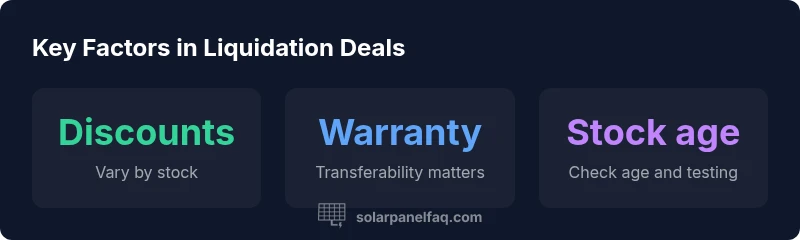
Liquidation sales are a specialized form of clearance where overstock, returned units, or discontinued models are offered at reduced prices. These events can originate from manufacturers, authorized distributors, or independent liquidators who resell stock alongside accessories like mounting hardware and inverters. The appeal for homeowners is clear: lower upfront costs can improve the economics of a home solar project. Yet liquidation stock is not a uniform product. Some lots arrive with full warranties and tested performance, while others may include aging panels, mismatched voltage, or limited post-sale support. According to Solar Panel FAQ, the market is heterogeneous, with real bargains sitting next to items with higher risk. The key is to distinguish true value from stock that appears cheap on the surface. When you encounter a liquidation sale, demand documentation: stock provenance, testing data, and whether any warranty remains transferable. Treat liquidation deals as a component of a broader procurement plan—not a single, impulsive buy.
- In practice you may encounter brand-new stock, open-box returns, or refurbished items. Always verify the source, confirm testing results when available, and insist on clear warranty terms that survive transfer.
- Integrate any liquidation purchase into your project timing, permitting, and installation plan to avoid timing gaps or mismatched components.
How to evaluate offers: price, condition, and warranty
Evaluating a liquidation offer begins with price but ends with risk assessment. Start by verifying the stated discount against typical market prices for the same model and wattage. Ask for the exact model number, serials, and batch information to ensure you can cross-check compatibility with your inverter and mounting system. Inspect the physical condition of the panels: cracks, delamination, hot spots, and edge damage can predict underperformance or failure. Test data is critical—request voltage and current readings under standard test conditions if available, and seek independent third-party testing results when possible. Warranty terms are paramount; transferability, duration, and what components are covered (modules vs. balance of system) determine long-term value. If a warranty is non-transferable or short, the potential savings may be offset by future repair costs. Finally, review the seller’s return policy, restocking fees, and after-sales support. A credible liquidation offer should provide all these details clearly, or it may signal a higher-risk purchase.
- Create a side-by-side comparison checklist for at least three offers to ensure you’re evaluating apples to apples.
- Prioritize sellers with transparent inventories, verifiable addresses, and accessible customer service contacts.
Common sources of liquidation stock and what they signal
Liquidation stock can originate from several sources, each signaling different risk/benefit profiles. Factory overstock happens when manufacturers overestimate demand and need to clear shelf space; returns include items customers sent back within a return window, sometimes with cosmetic flaws or unknown usage history; refurbished or open-box stock is repackaged for resale after testing. Understanding these origins helps you assess reliability and expected performance. Factory overstock may come with solid warranties and newer model numbers, while returns can vary widely in condition. Refurbished stock can offer significant savings but may have shorter warranties or limited transferability. In all cases, ask for provenance documents, verify the inventory age, and request independent testing results if possible. A cautious approach reduces the chance of installing panels that underperform or fail prematurely. In 2026, credible liquidation sources emphasize transparency, verifiable testing, and clear terms for transferability and returns.
- Prioritize offers with verifiable stock numbers, earlier production dates, and a clear path to warranty transfer.
- Avoid listings that provide vague descriptions, missing serial numbers, or no return policy.
Calculating true cost and ROI from liquidation deals
Discounts reduce upfront equipment costs, but true ROI depends on cumulative lifecycle costs and system performance. Start with the headline price and subtract any quoted discounts, then add shipping, taxes, mounting hardware, wiring, and any necessary mounting solutions for your roof type. Evaluate the expected energy production by comparing the module efficiency and wattage to your planned system size; older stock may underperform compared with current modules. Factor in potential maintenance or replacement costs if the warranty is non-transferable or limited. The payback period under liquidation scenarios often depends more on the certainty of performance and warranty terms than the sticker price alone. If a deal promises strong performance and transferable warranty, the ROI improves; if not, similar or better value may come from new stock with robust disclaimers. Remember to document everything and keep a conservative estimate of long-term performance when calculating ROI for your 20–25 year system.
- Build a simple ROI model that includes initial cost, expected annual energy savings, maintenance, and warranty value.
- Compare liquidation quotes against the cost of new stock with standard warranties to gauge true savings.
Due diligence checklist for liquidation purchases
Use this practical checklist to vet offers quickly and thoroughly:
- Source proof: seller identity, business license, and physical address.
- Stock provenance: model numbers, production year, serials, and batch data if available.
- Condition audit: defects, delamination, cracks, scratching, and packaging integrity.
- Performance evidence: third-party test data or in-house test results under standard test conditions.
- Warranty rules: transferability, duration, covered components, and limitations.
- Returns policy: window length, restocking fees, and shipping responsibility.
- Compatibility fit: inverter, mounting hardware, roof type, and electrical code compliance.
- Financing and taxes: confirm taxes, incentives, and potential financing options.
- Post-purchase support: serviceability, spare parts availability, and installer support.
- Documentation: a written quote, an itemized bill of sale, and clear terms.
Following this checklist reduces risk and helps you compare liquidation offers more effectively.
- If in doubt, request a written warranty with transferability details before finalizing any purchase.
- Keep a digital folder with all documentation for future reference or warranty support.
Negotiation tactics and risk mitigation
Negotiation around liquidation stock should focus on guaranteeing post-purchase value and reducing risk. Start with a neutral benchmark: compare to new stock pricing for the same model and verify the discount is meaningful after considering warranty, transportation, and installation costs. Seek a transferable warranty, extended coverage for critical components, and a reasonable return window. Request third-party testing results and a pre-install inspection if possible. Propose a trial period or a partial delivery to test performance before full payment. If the seller cannot provide clear documentation, walk away; a reliable seller will provide verifiable proof of provenance and testing. Finally, document all agreed terms to avoid disputes during warranty claims.
- Narrow the risk by requiring a written statement of testing results and a trial acceptance period.
- Consider engaging a solar installer or an independent third party to verify stock quality before purchase.
Credible sources for further reading
For homeowners exploring liquidation deals, consult credible sources to understand warranties, regulatory considerations, and best practices:
- U.S. Department of Energy – Solar energy program: https://www.energy.gov/eere/solar
- National Renewable Energy Laboratory (NREL): https://www.nrel.gov
- DOE guidance on solar warranties: https://www.energy.gov/eere/solar/warranties
These sources provide context on performance expectations, warranty considerations, and policy frameworks that influence how liquidation stock should be evaluated in 2026. The Solar Panel FAQ team emphasizes cross-checking liquidation claims with authoritative energy research sites to confirm you’re making an informed decision. For further credibility, rely on documentation and third-party testing when available.
Liquidation stock evaluation checklist
| Item | Checkpoint | Why it matters |
|---|---|---|
| Discount clarity | Quoted discount vs. list price | Ensures the discount is real and meaningful |
| Panel age & condition | Age, testing results, return policy | Older stock may underperform or fail sooner |
| Warranty status | Transferability, coverage details | Defines future protection and limits liability |
| Seller credibility | Licenses, reviews, stock provenance | Reduces risk of counterfeit or misrepresentation |
Frequently Asked Questions
What is a solar panel liquidation sale and how is it different from a regular sale?
A liquidation sale is a clearance event where overstock, returns, or discontinued stock are sold at reduced prices. It may feature variable warranty coverage and mixed stock ages, so you should verify provenance and warranty transferability before buying.
Liquidation sales are clearance events with discounted stock, but warranties and condition can vary. Verify stock provenance and warranty transferability before buying.
Can refurbished or open-box panels be reliable?
Refurbished or open-box panels can be reliable if they pass testing, come with a transferable warranty, and have documented age. Always confirm test results and warranty terms before committing.
Refurbished panels can be reliable if tested and warranted; verify age and transferability.
How can I verify a seller's legitimacy?
Check the seller’s business license, physical address, customer reviews, and a clear return policy. Avoid listings with vague terms or missing contact information.
Look for a real business, clear terms, and accessible contact information.
What should I know about warranty on liquidation stock?
Warranties on liquidation stock are often limited or non-transferable. Read the terms carefully and confirm whether coverage survives transfer to a new owner.
Warranties can be limited; ensure transferability and coverage details.
Is liquidation stock suitable for a rooftop project?
Liquidation stock can work if panels match your system’s voltage and wattage, and the installation is compatible with your roof type and inverter.
Make sure the panels fit your system specs and roof.
Should I buy from a known retailer or a liquidator?
Both can be legitimate. Favor established retailers with documented stock and a clear return policy, and demand transparent provenance.
Choose reputable sources with clear stock provenance and returns.
“Liquidation deals can unlock upfront savings, but due diligence on warranty terms and seller credibility is essential for long-term performance.”
Top Takeaways
- Verify source credibility before purchasing.
- Check warranty transferability for long-term protection.
- Compare liquidation offers using a consistent ROI method.
- Inspect stock condition and test results when available.
- Avoid impulse buys; align purchases with installation timelines.