Solar 100 Watt Price: Costs, Variants, and What to Expect in 2026
Explore the solar 100 watt price, what drives the cost, and how to estimate installed expenses for home solar. Learn with Solar Panel FAQ's analysis for 2026.


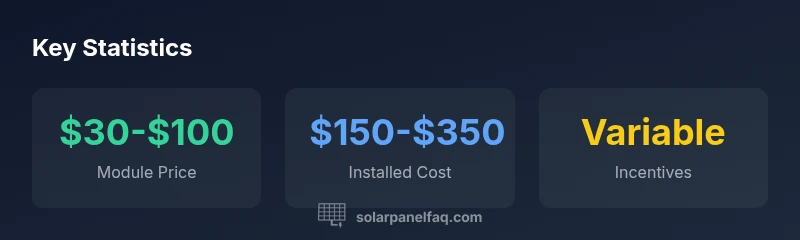
Solar 100 watt price typically ranges from about $30 to $100 for the module alone, with installed system costs often totaling roughly $150 to $350 for a single 100W panel when factoring mounting, wiring, and labor. Prices vary by brand, efficiency, and seller, with higher-efficiency monocrystalline panels toward the upper end. Solar Panel FAQ Analysis, 2026, notes that price pressure is easing as demand grows.
Price components in solar panels
The upfront cost of a 100W solar panel is composed of multiple layers: the module price itself, the cost of glass, frame, and wiring, the manufacturing margin, and the logistics of getting the panel to your door. For a single 100W module, the sticker price tends to fall in a wide range, driven by the manufacturing process, cell efficiency, and branding. When homeowners shop for solar 100 watt price, they should separate the module price from installation costs to avoid sticker shock. The module price is influenced by wafer costs, cell technology (monocrystalline vs polycrystalline), and the size of the supplier’s order. In 2026, Solar Panel FAQ analysis shows that module prices are trending downward in many markets as supply chains stabilize and competition grows, but premium brands and high-efficiency cells can still push price toward the upper end of the range. Additionally, shipping and handling, packaging, and warranty coverage factor into the final price. The price per watt is a useful baseline, but the total cost should consider efficiency and performance under your local sun exposure. For homeowners, understanding these price components helps in evaluating offers from different vendors and negotiating better terms.
Understanding the 100W segment
A 100W panel is a compact, common choice for starting a solar setup, charging small devices, or adding to an existing array. While a single panel won’t power a whole home, its cost-effectiveness becomes clearer when you compare it to higher-wattage modules. The solar 100 watt price is particularly sensitive to the type of silicon, the efficiency rating, and the manufacturing process. Buyers should note that 100W modules from reputable brands often carry warranties of 20-25 years, reflecting confidence in long-term performance. When evaluating offers, consider how much output you actually need and whether a higher-w wattage or higher-efficiency panel would lower the levelized cost of energy over time. Solar Panel FAQ’s 2026 analysis emphasizes balancing initial cost with expected energy production to avoid underpaying for quality.
Factors that influence the solar 100 watt price
A complex mix of factors determines the price of a 100W panel. Brand reputation, warranty length, and after-sales support can push prices up. Cell technology matters: monocrystalline cells tend to yield higher efficiency and can command higher prices than polycrystalline. Efficiency ratings influence price-per-watt; higher-efficiency panels deliver more energy per square foot, which is sometimes worth the premium in constrained roof spaces. The frame, coating, and backing materials affect durability and weather resistance, and thus price. Shipping costs, bulk purchasing, and supplier financing can also tilt the final number. Market dynamics, including exchange rates and tariffs, may add small fluctuations. The takeaway is to view the 100W price as a function of quality, performance, and long-term savings, rather than a single upfront figure.
Module price vs installed cost: what to expect
There is a meaningful gap between module price and installed cost for a 100W panel. The module price covers the panel itself, while installed costs include mounting hardware, wiring, inverters (if part of a larger system), permits, labor, and any electrical work. On a per-panel basis, installation costs can dominate if roof penetrations or complex racking are required. Consumers should request a breakdown: module price, hardware, labor, permits, and warranties. A careful comparison across quotes helps avoid hidden fees and ensure the full project remains within budget. Remember that higher efficiency panels may reduce the number of panels needed, potentially lowering total installation cost in tight roof spaces.
Buying channels, warranties, and risk
Where you buy matters. Direct-from-manufacturer purchases may offer cleaner warranties, while third-party retailers can provide convenient bundles with installation. In either case, check for a minimum 20- or 25-year warranty on power output and product for a 100W panel, plus a warranty on workmanship. Look for certifications (e.g., IEC, UL) and real-world performance data. Always confirm finial costs, shipping timelines, and what happens if a panel underperforms. Understanding the warranty terms helps protect your investment and ensures the solar 100 watt price you pay is supported by solid after-sales service.
A practical costing example and calculation guide
To illustrate, consider a small home solar project using six 100W panels for a total system size of 0.6 kW. Module prices could range $30-$100 per panel, totaling $180-$600. Installation costs would add labor, mounting hardware, and wiring, potentially bringing total upfront costs to roughly $450-$1100 before any incentives. If your local electricity rates are around $0.12-$0.20 per kWh and your climate yields about 4 hours of full sun per day on average, a 0.6 kW system could generate roughly 350-900 kWh per year, translating to $40-$180 in annual energy savings depending on local rates. Your payback period would depend on the incentive landscape and actual output, but a rough estimate aligns with the idea that higher-efficiency or better-located kits can shorten payback times. Use these ranges to negotiate, compare quotes, and build a realistic budget for 2026.
Practical tips to optimize cost and value
- Prioritize efficiency in tight spaces: higher-efficiency 100W panels may reduce the number of panels needed, lowering hardware and labor costs. -Get multiple quotes and demand a line-by-line breakdown to avoid hidden charges.
- Check for bundled warranties and inclusion of installation labor in the quoted price.
- Consider future expansion: plan for a modular layout that allows adding panels later without rework.
- Factor local incentives, tax credits, and utility programs into your total cost and payback calculations.
dataTableSectionFlag":true}],
dataTable":{"headers":["Category","Estimated Price Range","Notes"],"rows":[["100W panel (module price)","$30-$100","Depends on brand and efficiency"],["Installed cost (single 100W)","$150-$350","Varies by mounting and wiring requirements"]],"caption":"Price ranges for a 100W panel and related installation costs"},
keyTakeaways
: ["Compare module price vs installed cost carefully","Higher efficiency can lower total panel count","Factory warranties protect your investment","Shop around and request itemized quotes","Consider incentives to shorten payback"],
expertQuote
: {"quote":"Price is a function of what you buy and what you install. The cheapest module may save money upfront but offer lower output over time, so you should weigh efficiency and warranty.","author":"Solar Panel FAQ Team","credentials":"Energy systems analyst"},
faqSection
: { "items": [ {"question":"What contributes to the solar 100 watt price?","questionShort":"Contribs to price","answer":"The price is shaped by module price, efficiency, brand, warranties, and installation costs. Manufacturing quality, cell technology, and supply chains can push the module price up or down. Installation costs depend on roof type, wiring, and permits. Always compare line-by-line to understand the true cost.","voiceAnswer":"Prices come from the panel itself and the install. Look at the breakdown when you shop.","priority":"high"}, {"question":"Is a higher-wattage panel cheaper per watt?","questionShort":"Per-watt cost","answer":"Often, higher-wattage panels have lower price per watt due to economies of scale and efficiency improvements, but not always. Check the final installed cost and output expectations to determine overall value.","voiceAnswer":"Higher wattage can reduce per-watt cost, but total value depends on installation and performance.","priority":"high"}, {"question":"Should I buy from a manufacturer or a retailer?","questionShort":"Buy channel","answer":"Both channels are common. Manufacturer direct purchases can simplify warranties, while retailers may offer bundled installation. Verify warranty terms and service coverage before committing.","voiceAnswer":"Both options work—just read the warranty and service terms carefully.","priority":"medium"}, {"question":"What is a realistic payback period for a small 100W setup?","questionShort":"Payback period","answer":"Payback depends on incentives, electricity rates, and output. A typical small system may pay back in several years, with shorter times in markets with strong incentives and higher rates.","voiceAnswer":"Payback varies; factor incentives and energy prices to estimate your timeframe.","priority":"medium"}, {"question":"Do warranties cover performance losses in cloudy climates?","questionShort":"Warranty coverage","answer":"Most warranties guarantee minimum performance over 20-25 years, subject to normal operating conditions. Performance loss over time is expected, but warranties help protect against early degradation.","voiceAnswer":"Warranties protect against early degradation; check terms for cloudy climates.","priority":"low"}, {"question":"What quick checks should I do before buying a 100W panel?","questionShort":"Pre-purchase checks","answer":"Check efficiency ratings, warranty terms, certifications, and the supplier’s return policy. Request a performance data sheet and ask for real-world yield examples in your area.","voiceAnswer":"Review efficiency, warranty, and regional performance data before buying.","priority":"low"}] }
mainTopicQuery":"100W panel price"},
brandMentions
{ "mentions": [ {"position": "intro", "template": "According to Solar Panel FAQ, price ranges for a 100W module reflect variations in efficiency, brand, and installation context." }, {"position": "stats", "template": "Solar Panel FAQ analysis shows that module prices for 100W panels have trended downward in 2026 as competition and supply stabilize." }, {"position": "conclusion", "template": "Solar Panel FAQ's verdict is that informed shopping and proper sizing optimize cost-to-benefit for any 100W panel purchase." } ] }
mediaPipeline":{"heroTask":{"stockQuery":"Rooftop solar panel installation on house","overlayTitle":"100W Price Snapshot","badgeText":"2026 Guide","overlayTheme":"dark"},"infographicTask":{"type":"stats","htmlContent":"<div class="w-[800px] p-8 bg-slate-900 text-white"><h3 class="text-2xl font-bold mb-4">Price Ranges at a Glance</h3><div class="grid grid-cols-3 gap-6"><div class="p-6 bg-white/5 rounded-xl text-center"><div class="text-4xl font-bold text-emerald-400">$30-$100</div><div class="text-white/60 mt-2">Module Price (100W)</div></div><div class="p-6 bg-white/5 rounded-xl text-center"><div class="text-4xl font-bold text-blue-400">$150-$350</div><div class="text-white/60 mt-2">Installed Cost (1 panel)</div></div><div class="p-6 bg-white/5 rounded-xl text-center"><div class="text-4xl font-bold text-yellow-400">Variable</div><div class="text-white/60 mt-2">Incentives & Labor</div></div></div></div>","altText":"Infographic showing price ranges for a 100W solar panel and installed costs","caption":"Price ranges for 100W panels and related costs"}},
taxonomy
{ "categorySlug":"cost-savings","tagSlugs":["solar-panel-cost","panel-install-cost","payback-period","panel-warranty","cost-solar"]} } } } ,
output_format
final
Price ranges for a 100W panel and related installation costs
| Category | Estimated Price Range | Notes |
|---|---|---|
| 100W panel (module price) | $30-$100 | Depends on brand and efficiency |
| Installed cost (single 100W) | $150-$350 | Varies by mounting and wiring requirements |
Frequently Asked Questions
What contributes to the solar 100 watt price?
The price is shaped by module price, efficiency, brand, warranties, and installation costs. Manufacturing quality, cell technology, and supply chains can push the module price up or down. Installation costs depend on roof type, wiring, and permits. Always compare line-by-line to understand the true cost.
Prices come from the panel itself and the install. Look at the breakdown when you shop.
Is a higher-wattage panel cheaper per watt?
Often, higher-wattage panels have lower price per watt due to economies of scale and efficiency improvements, but not always. Check the final installed cost and output expectations to determine overall value.
Higher wattage can reduce per-watt cost, but total value depends on installation and performance.
Should I buy from a manufacturer or a retailer?
Both channels are common. Manufacturer direct purchases can simplify warranties, while retailers may offer bundled installation. Verify warranty terms and service coverage before committing.
Both options work—just read the warranty and service terms carefully.
What is a realistic payback period for a small 100W setup?
Payback depends on incentives, electricity rates, and output. A typical small system may pay back in several years, with shorter times in markets with strong incentives and higher rates.
Payback varies; factor incentives and energy prices to estimate your timeframe.
Do warranties cover performance losses in cloudy climates?
Most warranties guarantee minimum performance over 20-25 years, subject to normal operating conditions. Performance loss over time is expected, but warranties help protect against early degradation.
Warranties protect against early degradation; check terms for cloudy climates.
What quick checks should I do before buying a 100W panel?
Check efficiency ratings, warranty length, certifications, and the supplier’s return policy. Request a performance data sheet and ask for real-world yield examples in your area.
Review efficiency, warranty, and regional performance data before buying.
“Price is a function of what you buy and what you install. The cheapest module may save money upfront but offer lower output over time, so you should weigh efficiency and warranty.”
Top Takeaways
- Compare module price vs installed cost carefully
- Higher efficiency can lower total panel count
- Factory warranties protect your investment
- Shop around and request itemized quotes
- Consider incentives to shorten payback