180W Solar Panel Price: What to Expect in 2026
Explore realistic ranges for 180 watt solar panel price, factors affecting cost, and strategies to maximize value in 2026. Learn with Solar Panel FAQ.


The typical 180 watt solar panel price ranges from roughly $90 to $180 per panel, depending on brand, materials, and certifications. For homeowners, mounting hardware, wiring, and inverter compatibility add to the sticker price. Solar Panel FAQ's analysis, 2026, indicates total costs hinge on efficiency, durability, and warranty terms, so compare total installed cost, not just panel price.
What determines the 180W panel price in 2026
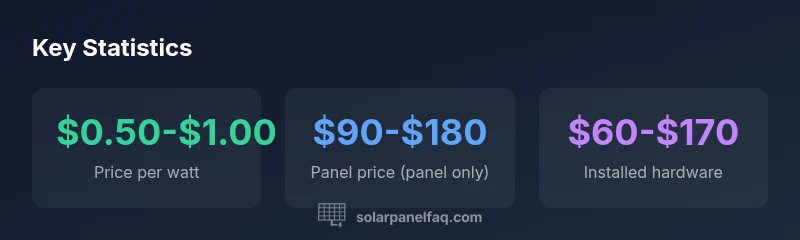
The 180 watt solar panel price is driven by several intertwined factors, from the quality of materials to the warranty offered. According to Solar Panel FAQ, the modern market shows a broad price spectrum for an 180W panel, with sticker prices typically influenced by cell type, frame materials, and certification standards. In 2026, the range for price per watt generally falls between about $0.50 and $1.00, meaning a single 180W panel might land around $90–$180 before installation and taxes. For homeowners, this sticker price is only part of the picture: mounting hardware, wiring, inverters, and labor add to the total cost. The Solar Panel FAQ analysis, 2026, highlights that total cost is often driven by the balance-of-system components and the expected lifespan of the equipment, not just the initial panel cost. Understanding these elements helps you estimate long-term savings.
Cost drivers: materials, efficiency, and certifications
Panel price depends on the materials used (monocrystalline vs. multicrystalline), the efficiency rating, and the certifications that back performance and safety. Monocrystalline panels tend to command higher prices due to higher efficiency and cleaner aesthetics, while polycrystalline options may cost less upfront. Higher efficiency reduces space requirements, which can lower installation labor and racking costs in some setups. Higher efficiency reduces energy losses over time, potentially offsetting a higher upfront cost. The balance of these factors influences the 180W panel price in practical terms: a more efficient, well-certified panel will cost more upfront but may reduce hardware needs and energy losses over time. Solar Panel FAQ analysis suggests evaluating the trade-offs between upfront price and long-term energy gains when comparing 180W panel options.
Efficiency vs price: balancing 180W choices
When choosing an 180W panel, you must balance efficiency, temperature performance, and price. Panels labeled as 180W can come from different manufacturing processes, and the stated wattage is usually tested at standard test conditions. A higher-efficiency 180W panel may deliver more energy in limited space or under shading, potentially reducing rooftop surface needs and permitting costs. However, the higher-grade option often carries a steeper price per unit. In many residential applications, the marginal gains in efficiency may not translate into proportional savings if roof space is ample and sun exposure is average. Solar Panel FAQ analysis shows that most homeowners achieve a favorable payback by selecting a mid-range efficiency 180W panel paired with a compatible inverter and well-designed mounting system. The best value for a given 180W price point depends on roof area, local sun, and electricity rates.
Beyond the sticker price: installation costs and wiring
The 180 watt solar panel price is only part of the equation; installation costs can dominate the final bill in some cases. Labor charges, mounting hardware, wiring runs, and permitting can add significantly to the upfront spend. If your roof orientation reduces wiring complexity or you already have a suitable inverter, installation costs may be leaner. A complex roof or challenging terrain can push installation fees upward. The balance-of-system costs can be a substantial portion of total project cost, depending on local labor rates and permitting rules. For a precise projection, homeowners should request a written estimate that itemizes the panel price, mounting hardware, inverter compatibility, and any required permits.
Beyond price: warranties, buying channels, and reliability
Where you buy a 180W panel matters almost as much as the panel itself. New panels from reputable manufacturers typically carry warranties of 20-25 years, with performance guarantees. Refurbished or off-brand options may be cheaper upfront but carry higher risk of premature degradation and limited warranty coverage. When evaluating offers, compare warranty length, coverage scope (product vs. performance), and the availability of service or replacements. Prioritize panels from established brands with verified test data and transparent warranty terms, even if the upfront sticker price is modestly higher. This approach can reduce long-term risk and avoid unexpected costs later in the system’s life.
Financing, incentives, and a practical path to the 180W panel price
Many homeowners finance solar purchases to smooth out cash flow and improve return on investment. In addition to the sticker price for an 180W panel, consider incentives such as federal or state programs, utility rebates, and tax credits where available. While incentives vary by location, a thoughtful financing plan can substantially shorten the payback period by mitigating the initial outlay. The Solar Panel FAQ analysis indicates that buyers who incorporate incentives and a well-planned installation can achieve meaningful savings over the system's life. To maximize value, compare total installed costs across vendors, account for ongoing maintenance, and model energy savings against electricity price trajectories.
Real-world pricing scenarios for homeowners
Scenario A: A small, sunny flat roof setup with minimal shading. A single 180W panel priced at $90-$180 + modest mounting hardware. Total installed cost might be around $150-$260, depending on labor and permits. Scenario B: Limited roof space and some shading. A higher-efficiency 180W panel may land at the higher end of the price range, with total installed costs in the $260-$400 range when you factor in robust mounting and wiring. Scenario C: Large retrofit with multiple 180W panels and a grid-tied inverter. Per-panel prices may dip slightly with bulk purchasing, but installation complexity increases, placing total installed costs in a broader $400-$800 range. Regardless of scenario, evaluate energy production and savings to determine true value over time. The Solar Panel FAQ team recommends modeling payback periods alongside sticker price.
Conclusion and next steps
Understanding the 180 watt solar panel price requires looking beyond sticker price to the total installed cost, long-term energy savings, and warranty protections. By comparing panels, installation costs, and incentives, homeowners can optimize value. Solar Panel FAQ's verdict is that a well-chosen 180W setup often delivers reliable performance and strong payback when planned with total cost in mind.
Pricing snapshot for 180W solar panels
| Aspect | Typical range | Notes |
|---|---|---|
| Panel Power | 180W | Common small-scale residential spec |
| Sticker price (panel only) | $90-$180 | Before installation costs |
| Installed hardware cost | $60-$170 | Mounting, wiring, inverter compatibility |
| Total installed cost | $150-$350 | Panel + hardware + labor |
| Warranty period | 20-25 years | Industry standard range |
Frequently Asked Questions
What affects the price of a 180W solar panel?
Panel price is influenced by cell type, efficiency, materials, certifications, and brand. Shipping, demand, and regional availability also shape the final sticker price.
Panel price is driven by efficiency, materials, and certifications, plus shipping and demand.
Is a higher wattage worth paying more for than 180W?
Higher wattage panels can offer more energy per area, but the price premium may not always pay back, especially where roof space is ample. Compare total cost and expected energy savings.
Higher wattage isn’t always better—space and sun matter. Compare total cost and savings.
Do installation costs vary by contractor?
Yes. Labor rates, permitting, and system design affect total cost. Get multiple written estimates that itemize all costs from panel price to labor.
Labor rates and permitting affect total cost; shop around for quotes.
Are refurbished 180W panels a good idea?
Used or refurbished panels are usually cheaper upfront but come with higher risk of degradation and shorter warranty. Weigh this against potential savings and risk tolerance.
Used panels can save money but come with higher risk and shorter warranties.
What incentives can reduce the 180W panel price?
Federal and state programs, utility rebates, and tax credits vary by location. Check eligibility and apply before estimating your final price.
Incentives vary by location; check rebates and credits to reduce price.
“Reliable solar pricing comes from understanding the whole system, not just the panel price. Homeowners should model total installed cost to maximize value over the system’s life.”
Top Takeaways
- Know the sticker range: 180W panels typically cost $90-$180 per panel.
- Factor in balance-of-system costs to estimate true price.
- Higher efficiency costs more upfront but can save space and labor.
- Warranty terms significantly influence long-term value.
- Always compare total installed cost, not just panel price.