Leasing Solar Panels: A Practical Guide for Homeowners
Learn how leasing solar panels works, compare with buying and PPAs, and evaluate offers to maximize savings while avoiding common pitfalls.


Leasing solar panels lets you use solar-powered electricity with little or no upfront cost. You sign a contract with a solar company to rent the system and pay a monthly lease, while the company remains the owner and handles maintenance. Savings come from reduced electric bills, but depend on your usage, lease terms, and local incentives.
What is leasing solar panels and who owns it?
Leasing solar panels is a form of third-party ownership where a solar provider installs panels on your home and you pay a fixed monthly lease. You typically pay nothing upfront, the provider remains the owner during the term, and you receive the energy produced by the system. Maintenance, monitoring, and repairs are usually covered by the lease. According to Solar Panel FAQ, this arrangement can be attractive for homeowners who want the benefits of solar without large upfront costs or taking on ownership responsibilities. The decision hinges on your energy usage, local electricity prices, and the specifics of each lease offer. Leasing shifts the financial risk away from you, but it can also limit long‑term upside if electricity prices rise significantly or if you plan to stay in your home for a short period.
How solar leases are structured
Most solar leases follow a similar framework. The solar company owns the panels and equipment, while you pay a predictable monthly lease payment for the term of the contract, typically 15 to 25 years. There is usually an annual escalator built into the payment—often a fixed percentage—that adjusts your cost over time. Maintenance, performance monitoring, and system repairs are commonly included, reducing out-of-pocket expenses. At the end of the term, you’ll face a buyout option, a lease extension, or removal of the system, depending on the contract. Read the terms carefully to understand who bears responsibilities for roof repairs, permits, and insurance.
Leasing vs Buying vs PPAs
- Leasing: Low or no upfront cost, predictable monthly payments, owner is the leasing company, maintenance covered by the provider. Long-term savings depend on terms and escalation.
- Buying (with cash or loan): Ownership from day one, eligibility for tax credits and incentives, longer-term value, but higher upfront cost and responsibility for maintenance.
- PPA (Power Purchase Agreement): You pay only for the electricity generated, typically at a set rate per kWh; ownership remains with the provider, with different risk and reward profiles than a lease. Each option affects home value, tax incentives, maintenance, and resale, so compare total cost of ownership over the system lifetime.
Financial considerations without numbers
Leases often promise monthly bill reductions, but the actual savings depend on your energy usage, the system’s output, and local electricity rates. Tax incentives usually flow to the system owner, which can influence value. Some leases include maintenance and monitoring, reducing surprise repair costs, while others pass specific service costs to the homeowner. Consider the total cost of the contract, including escalators, buyout options, and potential penalties for early termination. In all cases, model several scenarios—higher electricity prices, increased usage, or selling your home—to understand the true financial impact.
Common terms to watch in a lease
Key terms to scrutinize include:
- Ownership: Confirm that the lessor owns the panels and equipment throughout the term.
- Escalator: Note the annual increase to lease payments and cap if any.
- End-of-term options: Buyout price, renewal terms, or system removal.
- Maintenance and warranties: Which pieces are covered and for how long.
- Transferability: What happens if you sell the home or move before the term ends.
- Performance guarantees: Any guarantees on solar output or energy savings.
- Insurance and permitting: Responsibility for insuring the panels and obtaining necessary permits.
How to evaluate offers: a step-by-step checklist
- Gather all lease proposals and read the fine print. Ensure each offer clearly states ownership, term length, monthly payment, escalator, end-of-term options, and maintenance commitments. 2) Build a simple savings model: compare current electricity bills with expected lease payments, including escalators and any maintenance fees. 3) Check transferability if you plan to move; a smooth transfer is essential. 4) Negotiate escalator caps and the buyout price; request fixed-rate components if possible. 5) Review warranties, service levels, and response times. 6) Have a professional review the contract to spot ambiguities or unfavorable clauses. 7) Verify incentives arrangements, since benefits often go to the system owner. 8) Decide based on total cost of ownership, home plans, and comfort with a third-party owner.
Real-world scenarios: two typical outcomes
Scenario A: Homeowner with long stay A couple plans to stay in their home for 15+ years. A lease offers a low upfront cost and provides predictable energy reductions, but the escalator slightly raises payments over time. Over the long term, their total cost may approach or exceed the price of ownership, depending on energy growth and incentives. However, the lack of upfront costs and maintenance responsibility makes it appealing for cash-flow management.
Scenario B: Short-term stay or resale risk A family anticipates a move within 5–7 years. A lease may still yield monthly savings, but the end-of-term buyout could be a surprise expense if they plan to take the system with them or want a new installation. If they sell the home, a lease transfer adds complexity and requires the buyer’s approval. This path benefits buyers who want a low-commitment solar option but requires clear transfer conditions.
Alternatives to leasing: other paths to solar
If leasing doesn’t fit your goals, explore: buying a system with a loan or cash to maximize long-term savings and tax incentives; PPAs for a fixed per-kWh rate that may undercut future electricity costs; community solar programs if rooftop installation isn’t feasible; and solar leases with transfer-friendly terms or buyer-friendly buyouts. Each option has unique implications for home value, maintenance, and resale, so run a side-by-side comparison before deciding.
Tools & Materials
- Recent electricity bills (last 12 months)(To model usage and savings accurately.)
- Lease proposals from at least two providers(Compare base payments, escalators, and end-of-term options.)
- Draft contract documents(Look for ownership, maintenance, transferability, and permits.)
- Spreadsheet or online calculator(Model scenarios with energy price growth and usage changes.)
- Pen for signing(If you plan to sign in person.)
Steps
Estimated time: 2-6 weeks
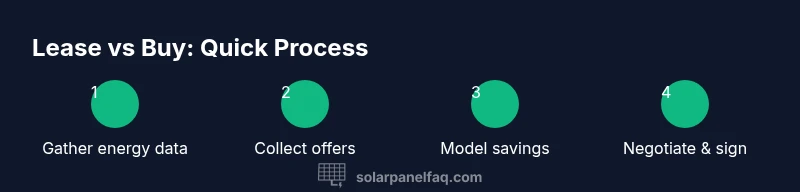
- 1
Gather your energy data
Collect your last 12 months of electricity bills and average monthly usage. Note your current rate and any demand charges. This data anchors your savings analysis and helps you compare lease offers.
Tip: Have digital copies ready and compile them into a single folder for easy reference. - 2
Collect lease offers
Request at least two lease proposals. Ensure each includes the monthly payment, contract length, escalator rate, end-of-term options, and maintenance coverage.
Tip: Ask for a sample contract language to spot ambiguous terms. - 3
Read the master contract carefully
Identify who owns the system, who is responsible for maintenance, and what happens at the end of the term (buyout, renewal, or removal). Check transferability if you sell your home.
Tip: Note any termination penalties or early exit fees. - 4
Run a savings analysis
Create a simple model comparing current bills to lease payments over time, including escalators. Consider future energy price growth and the value of any incentives to the owner.
Tip: Model best-, worst-, and most likely scenarios for a realistic view. - 5
Negotiate key terms
Push for a reasonable escalator cap, transparent buyout price, and favorable transfer terms. Clarify who covers roof repairs and what happens if the system underperforms.
Tip: Ask for performance guarantees or minimum output guarantees if available. - 6
Decide and finalize
Choose the offer that provides the best total value for your situation, sign, and schedule installation. Confirm transfer options if you move or sell within the lease period.
Tip: Coordinate with your utility and the installer to ensure permits are in place.
Frequently Asked Questions
What is a solar lease and how does it work?
A solar lease allows you to use a solar energy system without owning it. The lessor installs and maintains the system, and you pay a fixed monthly lease for the term. Ownership stays with the provider, and you typically benefit from reduced electricity costs.
A solar lease lets you use a solar system without owning it; the provider owns and maintains it, and you pay a monthly lease for the term.
Who owns the solar panels in a lease?
In a lease, the solar company owns the panels and equipment throughout the contract. You receive the energy output and pay for the right to use it.
The leasing company owns the panels for the contract duration.
Are there risks with solar leases?
Risks include escalator increases, end-of-term buyout, and transferability if you sell your home. Read terms carefully and verify maintenance commitments and performance guarantees.
Watch for cost escalators and what happens if you sell or move.
Can I still get incentives with a lease?
In most cases, incentives like tax credits go to the system owner, not the lessee. Some programs may offer benefits if negotiable, but check local rules and contract specifics.
Usually incentives go to the owner, so check your lease terms.
How does a lease affect my home sale?
A lease can complicate a sale unless the contract is transferable or there is a favorable buyout. Ensure the offer allows an easy transfer to the new homeowner or discuss termination options.
Transfers can be tricky; confirm if buyers can assume the lease.
What should I look for before signing?
Look for ownership rights, maintenance coverage, any caps on escalators, end-of-term options, transferability, and whether there are penalties for early termination.
Check ownership, maintenance, and what happens at the end of the term before you sign.
Watch Video
Top Takeaways
- Leases shift ownership and maintenance to the provider, with ongoing monthly costs.
- Evaluate end-of-term options and transferability before signing.
- Model multiple scenarios to assess true savings and financial risk.