Is Leasing Solar Panels a Good Idea? A 2026 Comparison
Explore whether leasing solar panels makes sense for homeowners in 2026. Compare lease vs buy, costs, incentives, and long term value with Solar Panel FAQ.


Is leasing solar panels a good idea? The short answer depends on your goals. Leasing can reduce upfront costs, simplify maintenance, and let you start saving soon. However, you won’t own the system, may face escalators and fees, and long term value depends on contract terms. According to Solar Panel FAQ, many homeowners find leasing attractive for predictable costs, but it is not universal. The Solar Panel FAQ team found that decisions hinge on how you value ownership, risk, and flexibility.
What leasing solar panels means in 2026
For many homeowners, is leasing solar panels a good idea is evaluated through payoff timing, ownership rights, and risk. A solar lease typically lets you pay a fixed monthly amount while a third party owns the system and handles installation, monitoring, and maintenance. You still receive solar energy and lower utility bills, but your savings depend on contract terms and energy usage. The Solar Panel FAQ team emphasizes that leases are most attractive for buyers who want simplicity and predictable costs rather than maximizing long term energy independence. In 2026, the decision to lease hinges on how you value control, cost certainty, and when you plan to move. Before signing, understand what happens at end of term and whether an upgrade or transfer is possible.
How leases are structured: payments, terms, and escalators
A typical lease outlines a 15 to 20 year term with monthly payments that cover operation and service. Some contracts include escalators that increase the payment amount each year or at periodic intervals, which can affect long term savings. You may also see options for a buyout at term end or a transfer clause if you move. It is critical to read the fine print on maintenance responsibilities and monitoring obligations. The structure matters because it determines how much of your electricity is effectively prepaid and how much flexibility you retain if energy prices rise or fall. This section breaks down common terms and what they mean for your bottom line.
Financial factors: upfront costs, monthly payments, and incentives
If you are asking is leasing solar panels a good idea, up front costs are usually minimal or zero, with most of the financial burden shifted to monthly payments. This can improve cash flow and reduce the barrier to solar adoption. However, the long term cost may exceed buying when you factor in escalators and service fees. Incentives like tax credits typically go to the system owner rather than the lessee, which can influence your value proposition. It helps to model scenarios under different energy price forecasts to see how monthly payments compare with expected savings over the contract life. The Solar Panel FAQ analysis suggests that sensitivity to electricity rate increases is a key driver of perceived value for leases.
The role of incentives and the ITC in leases
In a lease, incentives are often claimed by the lease provider, not the customer who signs the contract. This means your personal tax credit may not apply, which changes the effective economics of the arrangement. Some regions offer state or utility programs that can indirectly benefit lessees through reduced rates or performance incentives, but the ownership controls distribution of benefits. If your primary goal is to maximize incentives captured, leasing is usually less favorable than owning. Still, for households that want predictable savings without the burden of ownership, a lease can be appealing in the right market conditions.
Maintenance and service obligations
Leases frequently include routine maintenance, warranty coverage, and system monitoring as part of the package. This can simplify upkeep and reduce unexpected repair costs. Make sure the contract clearly specifies who pays for parts, who handles service calls, and what response times look like. If you value hands off management, this can be a strong plus. On the other hand, limited maintenance control means you may not be able to customize alerts or pursue weightier energy efficiency upgrades independently. Consider how important autonomy is to you before committing to a lease.
Risks you should assess before signing
All contracts carry risk, and solar leases are no exception. Look for high escalator rates, heavy early termination penalties, and restrictive transfer terms if you move. Some leases also tie you to a specific system or vendor, which can complicate future home improvements or the sale of your property. Understand what happens if the provider goes bankrupt, if performance deteriorates, or if you wish to upgrade to a newer panel technology. By identifying these risks, you can negotiate terms that protect your interests as a homeowner and avoid later regret.
Leasing vs buying: a side-by-side comparison
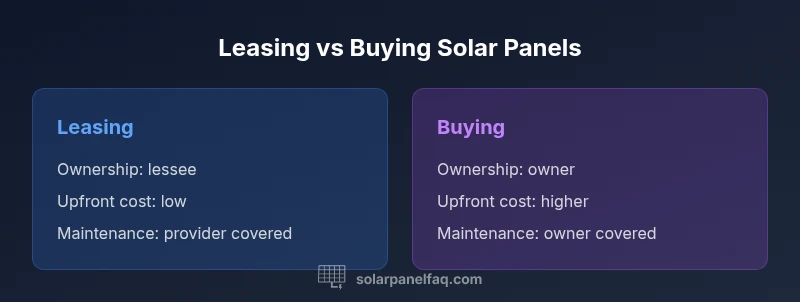
When asking is leasing solar panels a good idea, the core distinction is ownership. Leasing offers low upfront costs and predictable payments, while buying yields ownership, potential tax incentives, and higher long term savings. The choice depends on your financial situation, how long you plan to stay in the home, and your appetite for risk. Leasing is often best for homeowners who prioritize cash flow and convenience, whereas buying suits those seeking maximum return on investment and energy independence over time. It is essential to run a detailed financial comparison that includes escalators, maintenance, and end of term options.
Lease transferability and contract end options
A key practical consideration is what happens if you move or want to upgrade. Some leases allow transfer to a new homeowner, which can preserve savings for the buyer but may trigger lender approval or fees. Others require you to buy out the system or surrender it at the end of the term. If you anticipate mobility or a desire to upgrade to newer technology, prioritize flexible end options and straightforward transfer processes. Always verify that your real estate agent or lender can accommodate lease assumptions without delaying closing.
Real-world scenarios: best cases for leasing
Leasing shines for homeowners who want to avoid upfront costs, dislike maintenance tasks, or plan to stay for a shorter term. If you live in a rising electricity rate area, predictable monthly costs may outperform the savings from immediate purchase. Leasing can also be attractive for renters who cannot install a system themselves but want to access solar energy without a major investment. Realistic expectations about performance, maintenance schedules, and contract escalators are essential to avoid disappointment.
Real-world scenarios: best cases for buying
Buying solar panels typically makes sense for homeowners who plan to stay in their property long enough to recoup the investment and fully benefit from tax credits. Ownership provides the strongest potential for long term savings, system customization, and possible home value enhancement. If you anticipate frequent moves, a purchase may tie up capital you would prefer to allocate elsewhere. Buyers should compare installed system quality, warranty coverage, and financing terms to determine the true lifetime value of ownership, without assuming external lease terms.
How to evaluate a solar lease contract: a practical framework
Start with a clear cost baseline, including monthly payments, escalators, and end of term options. Next, assess maintenance coverage, response times, and what is excluded from service. Inspect transferability rules if you plan to sell or move, and verify whether any performance guarantees are included and how they are measured. Finally, model several scenarios using energy price forecasts to compare against a standard ownership model. Use this framework to decide if is leasing solar panels a good idea for your household given your climate, energy usage, and long term plans.
Decision checklist: next steps for homeowners
Create a side by side comparison of lease vs buy with a focus on cash flow, ownership, and energy independence. Gather contract copies, request a cost breakdown, and ask for a vendor to provide a no obligation sensitivity analysis. If you have questions about incentives, consult a tax professional to understand ITC implications. Before you sign, seek clarity on transfer rights, maintenance scope, and what happens if the system underperforms. This checklist will help you move from uncertainty to a confident decision.
Common mistakes and red flags
Avoid signing before you verify maintenance coverage, escalator rates, and end of term options. Watch for overly aggressive language around guarantees or performance metrics that are not enforceable. Be wary of contracts that restrict your device or home automation upgrades without consent. Red flags include long minimum terms with heavy exit fees and vague transfer procedures. By spotting these early, you can negotiate a more balanced lease that aligns with your home energy goals.
Final thoughts: making the call
Ultimately is leasing solar panels a good idea depends on your personal priorities and your local market conditions. If you crave low upfront costs and predictable bills, a lease could be appealing. If you want to maximize long term savings and own the asset, buying remains the stronger route. Use the comparison framework, include the right incentives, and align the contract with your long term plans to arrive at the best decision for your home and your family.
Comparison
| Feature | Leasing | Buying |
|---|---|---|
| Ownership | Lessee | Owner |
| Upfront Cost | Low or zero down | Full cost or financed |
| Monthly Payments | Fixed lease payments | Loan payments or cash purchase |
| Maintenance | Typically included | Customer responsibility or separate warranty |
| Tax Incentives | Usually claimed by lease provider | Claimed by owner if eligible |
| End of Term Options | Renew lease or upgrade | Keep system with payoff or sell |
| Impact on Home Value | Depends on lease terms and transferability | Typically increases value with ownership |
| Contract Escalators | Possible annual increases | Uncommon or capped increases |
Strengths
- Low upfront cost and fast solar access
- Maintenance often included or simplified
- Predictable monthly payments
- No system ownership risk for the homeowner
Drawbacks
- Higher long term cost due to escalators and fees
- No ownership or equity in the solar asset
- Potential transfer complications if you move
- Limited ability to customize or upgrade hardware
Leasing can be a good idea for cash flow and hassle free solar access, but ownership yields stronger long term value and flexibility.
Choose leasing if you value predictable costs and minimal maintenance. Choose buying if you want ownership, tax incentives, and the best long term value; run a detailed financial model before deciding.
Frequently Asked Questions
What is a solar lease and how does it work?
A solar lease is an agreement where a landlord or solar provider owns the solar system while you pay a fixed monthly amount to use the generated electricity. Maintenance and monitoring are often included. Ownership remains with the provider for the lease term.
A solar lease means you rent the system and pay monthly. Maintenance is usually covered, but you don’t own the panels.
What determines if a solar lease is right for me?
Your decision should consider upfront costs, long term savings, reliability of the provider, transferability if you move, and how incentives are allocated. Run a side by side with buying to see which offers better value for your situation.
Look at costs, how easy it is to transfer if you move, and who benefits from incentives.
Can I transfer a solar lease if I sell my home?
Many leases can be transferred to the new homeowner, but terms vary. Confirm transfer feasibility, any fees, and whether credit checks or approvals are required before listing the home.
Check if the lease can be transferred to the buyer and what fees apply.
Do solar leases qualify for tax credits or incentives?
Generally, tax credits and incentives go to the system owner, not the lessee. This can affect your effective savings, so understand who benefits from incentives before signing.
Usually the owner claims the incentives, not you as the lessee.
Is leasing better for renters or homeowners?
Leasing is often better for renters or homeowners who cannot or prefer not to own the system. For long term home ownership and maximum return, buying is typically preferable.
Renters and property owners who want low upfront costs may prefer leasing.
What should I watch for in a lease contract?
Look for escalator details, end of term options, maintenance boundaries, transfer rules, and any penalties for early termination. Ensure performance guarantees and monitoring commitments are clear.
Read the fine print on escalators and end of term options.
Top Takeaways
- Assess total cost over the lease term before signing
- Check transfer options if you plan to move
- Compare escalators vs buyout costs carefully
- Understand who claims tax incentives and how that affects savings
- Model scenarios with rising energy prices to gauge value
- Ensure maintenance and performance guarantees are clearly stated