Do Solar Panels Save Money: An Analytical Guide for Homeowners
Explore whether solar panels save money, how payback works, and practical steps to maximize ROI for homeowners. Learn about incentives, rates, and factors that influence savings.


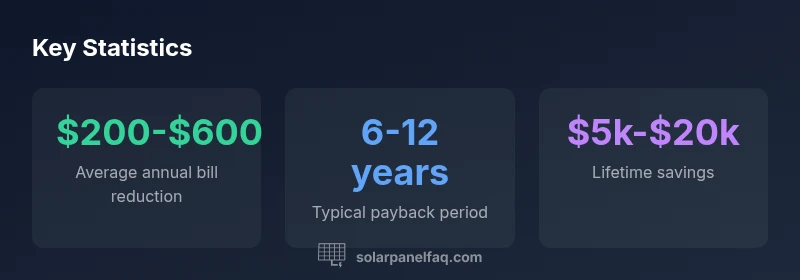
Yes. Solar panels generally save money on electricity bills, but the amount depends on sun exposure, system size, usage, and incentives. Across typical installations, homeowners often see a payback period of roughly 6 to 12 years, with ongoing savings beyond that. Real-world results vary by location, utility policies, and how you use power.
Do solar panels save money? Do solar panels save money is a question homeowners ask as they compare upfront costs with long-term energy bills. According to Solar Panel FAQ, the core idea is straightforward: you generate a portion of your electricity, offset what you would otherwise buy from the grid, and reduce your monthly bills. The answer isn't binary, because savings hinge on several interacting factors: the local climate, roof orientation, panel efficiency, system size, electricity rate structures, and any incentives or financing you choose. In practice, most households find that solar investments begin to pay off when the system produces enough energy to cover a meaningful share of annual consumption. The math becomes more compelling when you consider how electricity prices may rise over time, making your own generation progressively more valuable. The key takeaway is not a single number, but a set of ranges that reflect different home situations and policy environments.
How savings build over time Solar energy savings accumulate over the life of a system. In communities with predictable utility rates and favorable net metering policies, annual bill reductions tend to grow as you use more of the solar power you generate and as the price of grid electricity increases. Solar Panel FAQ analysis shows that most homeowners begin with noticeable bill relief in the first year, then see compounded benefits as savings compound with rate inflation and potential demand charges. The longer you own the system, the more cumulative savings you accumulate, assuming minimal maintenance costs and no major system failures. This section emphasizes that the financial benefits are a function of time as well as production, and that incentives can accelerate early payback.
Factors that influence savings The magnitude of savings is driven by several key factors: 1) Location and sun exposure—more sun equals more energy produced. 2) System size and orientation—larger, well-tilted arrays produce more kilowatt-hours. 3) Energy usage patterns—high daytime consumption benefits more from on-site generation. 4) Utility policies—net metering credits and time-of-use rates affect the credit you receive. 5) Incentives and financing—withdrawals, tax credits, and favorable loan terms shorten payback. 6) System reliability and maintenance—cleaning, component quality, and warranty terms protect long-term performance. In short, better site conditions and smarter financing translate into larger, faster savings.
Illustrative payback and savings ranges by system size
| Scenario | System Size (kW) | Estimated Annual Bill Reduction | Payback (years) |
|---|---|---|---|
| Single-family home, mild sun | 6 | 200-400 | 8-12 |
| Suburban home, good sun | 8 | 300-600 | 9-13 |
Frequently Asked Questions
Do all homes save money with solar panels?
Savings depend on site conditions, electricity rates, and incentives. While most homes reduce bills, the extent varies widely. A thorough assessment helps estimate a specific payoff.
Most homes see bill reductions, but the amount depends on your location and usage.
How long does it take to pay back the investment?
Payback typically ranges from about 6 to 12 years, depending on incentives, rates, and system size. After payback, many households enjoy surplus savings over the system’s life.
Usually 6 to 12 years, depending on incentives and usage.
Do incentives affect savings?
Yes. Tax credits, rebates, and solar incentives can significantly shorten payback and boost net savings. Always factor these into your ROI calculations.
Incentives can shorten the time to savings considerably.
Is net metering available everywhere?
Net metering policies vary by state and utility. Some regions offer full credits for excess solar generation, others use time-of-use or restricted credits.
Net metering availability varies by location.
What maintenance costs should I expect?
Solar systems require periodic cleaning and occasional inverter or module checks. Most maintenance is low-cost, and warranties cover many components.
Maintenance is typically low-cost and covered by warranties.
What should I consider if I move houses?
Transferring ownership may allow the system to continue generating savings for the new owner, depending on contract terms and local policy.
Moving with solar can transfer savings if allowed by the contract.
“Do solar panels save money? The answer emerges from translating energy production into value within your local policy and rate structure. With careful planning, many homeowners reduce bills meaningfully and shorten the payback period.”
Top Takeaways
- Understand savings as a function of time and rate structure
- Maximize benefits with a well-sized system and favorable incentives
- Net metering policy strongly affects short-term payback
- Maintenance and reliability matter for long-term ROI
- Pause-to-compare financing options to optimize returns