Will Solar Panel Prices Go Down in 2026? A Practical Guide for Homeowners
Explore whether solar panel prices will go down in 2026, with analysis of drivers, regional variations, and practical tips for homeowners seeking reliable cost-saving strategies.


Across major markets, will solar panel prices go down? In broad terms, yes. Prices have trended lower over the past decade due to scale, improved manufacturing, and policy incentives, and that downward trajectory is likely to continue in the near term, though regional factors can cause short-term bumps. Homeowners should expect gradual declines with occasional volatility tied to supply chains.
Will solar panel prices go down in 2026 and beyond?
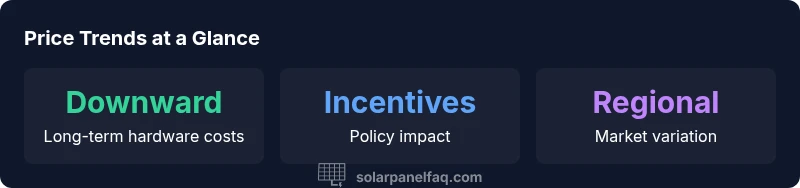
The question will solar panel prices go down is one homeowners often ask as they plan upgrades or complete sun-powered homes. From a macro perspective, hardware costs have trended downward as manufacturers expand capacity, adopt more efficient production lines, and benefit from scale. Additionally, policy incentives in many regions continue to reduce net installed costs for customers who install panels. That said, price movements are not perfectly smooth. Short-term volatility can occur due to supply chain disruptions, tariff changes, and shifts in raw material markets. Solar Panel FAQ's analysis shows the long-run trajectory remains downward, but local conditions—such as permitting delays or labor availability—can mute or accentuate the effect. If you’re evaluating a project, consider both hardware costs and non-hardware components, including soft costs and financing, to get a true sense of what prices will do in your market.
What drives price changes: costs, policy, and demand
Prices move on several intertwined forces. Hardware costs (panels, inverters, racking) have historically driven major shifts; improvements in cell efficiency and manufacturing yield help push per-watt costs lower over time. Policy incentives—cash rebates, tax credits, and net metering rules—shape the final price homeowners pay after incentives are applied. Demand is another lever: higher volume leads to economies of scale, while sudden spikes in interest can temporarily strain supply and raise quotes from installers. Finally, installation costs—labor, permitting, and interconnection—often determine the real out-of-pocket price, even when hardware costs decline. Solar Panel FAQ Team stresses evaluating all cost components in a single quote to understand true price trends for your home.
Regional variations you should expect
Regional differences are a major factor in price trajectories. Some regions enjoy aggressive incentives and streamlined permitting, which lowers the effective price for homeowners even if sticker prices for hardware change slowly. Other markets face higher labor costs or longer interconnection timelines, which can offset hardware savings. Because of these frictions, two neighboring homes can see noticeably different payback periods and total installed costs. Solar Panel FAQ Analysis emphasizes asking local installers for itemized quotes and referencing regional incentive programs to compare apples-to-apples cost structures.
How to estimate and plan your solar investment
To gauge how prices will move for your project, start with a clear cost baseline that includes hardware, inverters, mounting hardware, and electrical upgrades. Ask installers for price per watt and a breakdown of soft costs such as permitting and inspections. Use this baseline to run a simple forecast: if hardware costs are expected to decline modestly and incentives remain stable, your net price should trend downward over several years. Consider financing options, tax credits, and solar rebates to estimate the actual cash outlay today versus over the system’s life. Finally, account for future maintenance and potential upgrades (like battery storage) that could alter long-term costs and energy savings.
Potential disruptors that could change prices
Several scenarios could alter the expected price path. A sustained supply chain disruption or a tariff re-adjustment could push hardware costs higher temporarily. Conversely, breakthroughs in module efficiency or new large-scale manufacturing facilities could accelerate price declines. Shifts in policy—such as changes to net metering rules or solar tax incentives—also have the potential to modify the affordability equation. Solar Panel FAQ Team recommends staying informed about policy announcements and market news to anticipate how such factors might impact your project quotes.
Practical scenarios and homeowner takeaways
- Moderate decline scenario: Hardware costs fall gradually, incentives stay consistent, and regional installers compete on price, leading to a modest decrease in installed costs over time. Homeowners should reprice quotes every 6–12 months to capture new offers. Will solar panel prices go down in this scenario, yes, but the timing varies by region.
- Flat or volatile scenario: Supply chain hiccups, or tariff changes, produce price volatility. In this case, delaying a project for a season or two might yield a lower price once the market stabilizes. Always compare multiple quotes and consider lock-in options where feasible.
- Accelerated decline scenario: Large-scale manufacturing capacity comes online, and policy incentives expand, driving faster cost reductions. If you plan a project within this window, secure quotes that reflect future price expectations and lock in favorable financing terms now to maximize savings.
Price trend scenarios for residential solar panels
| Scenario | Prices trend | Key drivers |
|---|---|---|
| Baseline | Moderate downward | Hardware costs decline, incentives stable, steady demand |
| Downward trend accelerates | Significant downward | Economies of scale, new capacity, stronger global supply |
| Flat to volatile | Little change | Policy uncertainty, supply shocks, regional permitting delays |
Frequently Asked Questions
Will solar panel prices continue to drop in 2026?
Yes, overall prices are expected to trend downward, though regional differences can create pockets where prices hold steady or dip more slowly. Hardware costs are a factor, but installation and policy incentives shape the final price.
Yes—prices should trend downward overall, with regional nuances.
What is the main driver of price changes?
Hardware costs, policy incentives, and installation labor costs are the primary price drivers. Improvements in manufacturing efficiency and scalable production push prices lower, while incentives improve the net cost to homeowners.
Hardware costs and incentives are the big levers driving prices.
Is leasing or financing a better option given price trends?
Financing can reduce upfront costs and let you start saving sooner, while leasing transfers most maintenance risk to the provider. Compare total lifetime costs and ensure incentives are captured regardless of financing.
Financing can be smarter if you plan to stay in the home long term.
How long is the typical payback period today?
Payback varies by location and incentives, but many homeowners see a payback in the range of several years to over a decade. Local electricity rates and system size heavily affect this.
Payback length depends on where you live and what incentives you have.
Do tariffs affect solar panel prices?
Tariffs can cause short-term price fluctuations by impacting imports. Keep an eye on policy announcements and supplier communications for potential price adjustments.
Tariffs can push prices up temporarily.
Are there regions where prices are rising instead of falling?
Yes. Regions with high labor costs, permitting delays, or limited competition can experience slower price declines or modest increases even as hardware costs drop.
Regional costs can offset hardware savings.
“The Solar Panel FAQ Team notes that while hardware costs are likely to keep drifting downward, installation economics and policy shifts will determine the actual out-of-pocket price homeowners pay.”
Top Takeaways
- Expect gradual price declines with regional variation
- Factor in installation costs and incentives
- Monitor policy changes that affect net pricing
- Shop multiple quotes to capture the best deals