Solar Panel 2025: Trends, Costs, and Guidance
Explore 2025 solar panel trends, efficiency gains, installation costs, and practical guidance for homeowners. Learn what to expect in 2025 and beyond with Solar Panel FAQ.


By 2025, homeowners can expect solar panels with higher efficiency, better storage options, and more attractive economics. New module technologies, streamlined financing, and stronger warranties are driving lower net costs over the system lifetime. The combination of higher output, improved inverters, and expanding solar incentives means larger savings and faster payback in many regions.
2025: A Year of Efficiency Gains and Cost Reductions
In 2025, homeowners are seeing meaningful improvements in how much energy a standard residential solar system can generate. Module efficiency improvements, better inverter technology, and more effective shading strategies contribute to higher annual energy production with less space. Across markets, the combination of manufacturing scale and competition is driving down net system costs. This shift is especially evident in regions with strong solar incentives and high retail electricity rates. According to Solar Panel FAQ, these dynamics are accelerating the adoption curve, making solar more accessible to a broader audience. When evaluating quotes, look beyond the sticker price and consider the total cost of ownership over 25 years, including maintenance, warranty, and potential storage integration.
- Consider the long-term savings, not just the upfront price.
- Look for warranties that cover modules, inverters, and racking for at least 25 years.
- Compare financing options (cash, loan, lease, or PPA) to identify the lowest cost over time.
The broader market context for 2025 also includes expanding installer networks and improved permitting processes in many jurisdictions, reducing lead times and smoothing the path from quote to installation.
Advances in Panel Technology and Materials
By 2025, several technology trends are now mainstream: hi-efficiency silicon cells such as PERC, bifacial panels that capture reflected light, and improved anti-reflective coatings. Microinverters or power optimizers mitigate partial shading, delivering more consistent output across roof planes. Lighter frames, stronger glass, and enhanced encapsulants improve durability in diverse climates. Solar Panel FAQ notes that while the pace of breakthrough labs is steady, the cumulative effect translates to meaningful gains in annual production per watt and lower system degradation over time. Homeowners benefit from more reliable performance, better warranty coverage, and clearer performance expectations with every new model.
- Expect better shade tolerance and greener production processes.
- Storage-friendly configurations are becoming standard rather than optional upgrades.
- Check the warranty terms for both modules and inverters to understand real-world longevity.
Storage-ready designs and smarter inverters are now common, enabling seamless integration with home energy management systems and demand-response programs.
Financing, Incentives, and Total Cost of Ownership in 2025
In 2025, financing options are broader and more competitive, including traditional loans, leases, and power purchase agreements (PPAs). Incentives vary by location but are increasingly stackable with federal credits and utility rebates, improving after-tax returns. When calculating total cost of ownership, homeowners should factor in permitting fees, roof condition, electrical upgrades, and potential backup storage. Solar Panel FAQ emphasizes modeling scenarios with and without incentives to reveal true lifetime costs and savings. A well-structured plan can shorten payback and maximize savings even for homes with modest electricity usage. It’s wise to run an energy audit and size the system to your actual needs, avoiding over- or under-sizing.
- Use a 25-year horizon to compare lifetime costs.
- Bundle incentives where permitted to maximize value.
- Consider storage as a tool to unlock demand-based savings and resilience.
Installation Considerations: Roof Type, Orientation, and Warranties
Roof characteristics determine how much you can gain from solar in 2025. South-facing or optimal-tilt orientations in the Northern Hemisphere maximize energy capture, while shading, roof age, and surface condition influence performance and warranty reliability. Tile and metal roofs require specialty mounting that preserves roof integrity and minimizes leaks. Newer racking systems reduce installation time and weight, which can lower labor costs and future roof-replacement risk. Modules typically come with 25-year performance warranties and 10- to 25-year inverter warranties, depending on brand and configuration. Solar Panel FAQ advises homeowners to verify local permit requirements early and to examine panel degradation rates and warranty transferability when evaluating bids.
- Get a roof assessment before signing a contract.
- Ensure permits and inspections are clearly scheduled in the project plan.
- Prioritize warranties that are transferable on sale of the home.
Storage, Smart Home Integration, and Grid Interaction
Modern solar setups increasingly include battery storage and intelligent inverters. Storage enables you to store daytime energy for use during the evening and to participate in time-of-use programs. Smart inverters and home energy dashboards provide real-time visibility into generation, consumption, and storage status. Grid interaction is evolving with bidirectional inverters and net metering policies that can influence your savings. If you have a smart thermostat or energy management system, you can automate charging and discharging to optimize electricity costs. Solar Panel FAQ highlights that storage is not just an add-on; for many households it’s a core element of a resilient, cost-effective solar strategy.
- Plan storage capacity based on your daily usage and backup needs.
- Ensure compatibility with your home energy management system.
- Be aware of net metering rules and how they affect your credits.
Maintenance, Monitoring, and Longevity Expectations
Maintenance remains straightforward: periodic cleaning of panels, checks on mounting hardware, and inverter health monitoring. Many failures stem from loose bolts, degraded wiring, or microcracks in modules, which are typically caught through monthly monitoring. Modern systems include remote health checks and alerting, enabling proactive service rather than reactive repairs. Degradation rates are generally gradual, with most systems retaining a sizable portion of expected output over 25 years. The Solar Panel FAQ team notes that staying on top of inspections and promptly addressing any warranty-covered issues can preserve performance, reliability, and resale value over the long term.
- Schedule annual inspections with your installer.
- Use monitoring dashboards to catch performance drops early.
- Plan for inverter replacement windows within the warranty timeline.
Overview of 2025 solar panel basics
| Aspect | Typical Range (2025) | Notes |
|---|---|---|
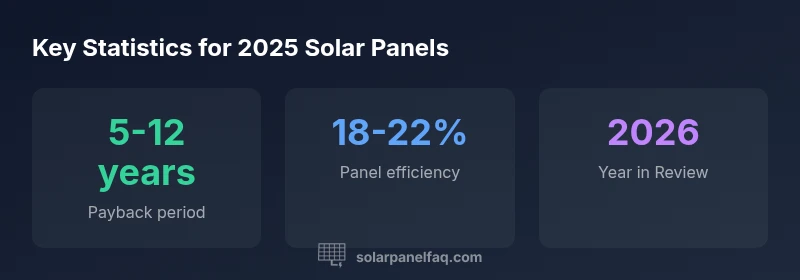
| Panel efficiency | 18-22% | Varies by material and temperature |
| System cost per watt | $1.00-$2.50 | Region and installer dependent |
| Payback period | 5-12 years | Assumes standard incentives |
Frequently Asked Questions
What are the main efficiency improvements expected in 2025?
In 2025, expect higher module and system efficiencies due to advances in cell designs, anti-reflective coatings, and improved inverters. These gains translate into more energy produced per sun exposure and better performance in real-world conditions. Always verify performance guarantees in your bid.
In 2025, expect better panels and inverters, so you’ll get more energy from the same roof.
Are there new financing options for solar panels in 2025?
Yes. Financing now ranges from traditional loans to leases and PPAs, with many programs stacking incentives. Compare total costs over 25 years, not just monthly payments, to determine the best option for your home and energy usage.
There are new financing choices, so compare plans carefully to maximize long-term value.
What should homeowners know about storage in 2025?
Storage is becoming a standard part of solar setups, enabling daytime energy use at night and resilience during outages. Look for compatible storage with your inverter and ensure the system is sized for your peak usage and any TOU rates.
Storage is now a common upgrade that boosts savings and resilience.
How long do solar panels last in 2025?
Most panels carry 25-year performance warranties, with successful installations lasting well beyond that. Degradation rates are modest, and inverters may require replacement within the warranty window. Always review warranty transferability and service terms.
Panels last a long time with a good warranty and ongoing monitoring.
Is it worth upgrading older panels in 2025?
If your existing system underperforms or you’re paying high electricity rates, upgrading to newer panels with a modern inverter and storage can yield faster payback and higher reliability. Run a cost-benefit analysis that includes permits and potential roof upgrades.
Upgrading can be worth it if it cuts costs and boosts reliability.
“Solar technology in 2025 is more reliable, affordable, and accessible, thanks to efficiency gains, smarter energy management, and broader incentives.”
Top Takeaways
- Take total cost of ownership into account, not just upfront price
- Expect efficiency gains and better storage options in 2025
- Shop for transferable warranties and robust inverters
- Compare financing options to find the lowest long-term cost
- Plan storage integration as a core part of savings strategy