Solar Panel Specs Comparison: A Practical Guide
A thorough, objective solar panel specs comparison that helps homeowners choose panels based on efficiency, warranty, and price, with a practical step-by-step approach to maximize long-term energy savings.


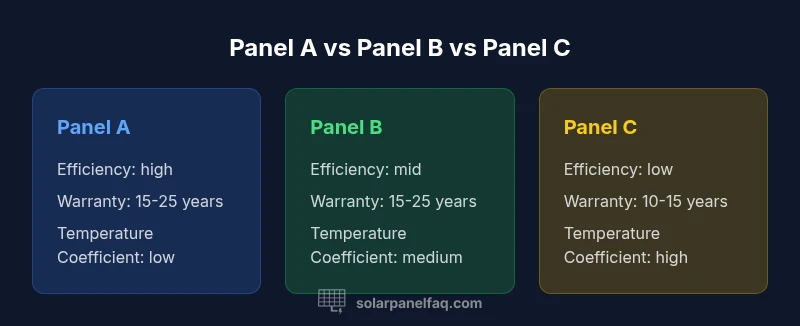
In a solar panel specs comparison, Panel B (high efficiency, solid price) offers the best balance for typical roofs, delivering strong output without excessive cost. Panel A is best for tight budgets, while Panel C prioritizes upfront price but provides lower long-term energy yield. Your choice depends on roof space and savings goals.
Understanding the Core Specs You’ll Compare
When performing a solar panel specs comparison, it helps to start with a simple map of the most impactful factors: efficiency, real-world output, degradation, warranty, temperature performance, and the quality of the datasheet. This section explains what each spec means for a homeowner: how much energy a panel can generate in peak sun, how its performance changes with heat and shade, how long the manufacturer backs the product, and whether the datasheet uses standard testing conditions. A clear definition of terms reduces confusion when you read vendor brochures and solar quotes. You’ll encounter terms such as module efficiency, NOCT versus STC, and linear degradation rate. Understanding these metrics helps you translate technical jargon into practical expectations for your roof. The main idea is to separate marketing claims from measurable performance. By the end of this section, you’ll have a framework to compare panels based on real-world results, not just lab numbers, which is essential for a reliable solar panel specs comparison.
How Efficiency Drives Real-World Output
Efficiency is the headline spec in most solar panel specs comparison, but it does not tell the whole story. A panel with higher nominal efficiency may deliver more energy per square meter under ideal conditions, yet real-world output depends on factors like temperature, shading, and system design. In this section, we explore how efficiency translates into daily production for typical rooftops. We discuss that the same watt rating can yield different results on different installations because of orientation, roof angle, and inverter sizing. Readers will learn to compare panels using a practical frame: efficiency class, expected energy yield per installed kilowatt, and how the site context changes the equation. The goal is to move beyond a single number and toward a holistic view of how a given panel performs in your home’s climate. This approach is central to a credible solar panel specs comparison that guides smart investment.
The Role of Temperature Coefficients and Angles
Temperature affects photovoltaic cells more than most homeowners expect. As the module temperature rises, the voltage declines and the overall power output can drop. The temperature coefficient quantifies this behavior, and it varies across panel designs. In this section, we break down what the coefficient means for your location—hot sunny summers versus cool mornings—and how roof angle and mounting height influence airflow and cooling. We also discuss real-world adjustments you can apply when planning your system, such as choosing an installer who models expected losses based on climate data. A clear grasp of temperature effects helps you interpret a solar panel specs comparison with precision, rather than assuming all high-efficiency claims translate into higher daily yields in your climate.
Durability, Warranty, and Degradation
Beyond peak efficiency, durability and warranty terms determine long-term value. Panels are designed to withstand wind, hail, and thermal cycling, but the level of protection varies. This section explains typical warranty structures—product warranty versus performance warranty—and how degradation rates affect output after 10, 15, or 25 years. Because visible wear does not always equate to reduced performance, it is important to read the fine print about lines of coverage, exclusions, and service commitments. We discuss how to compare degradation assumptions used by manufacturers, and why a lower guaranteed degradation rate can translate into higher expected energy production over the life of the system. A thoughtful solar panel specs comparison considers both immediate quality and long-term reliability.
Shading, Orientation, and System Losses
Real-world performance is often governed by shade patterns, panel orientation, and micro-inverters or optimizers. Even a panel with excellent lab numbers can underperform if a neighbor’s tree or a chimney blocks sun for a portion of the day. This section covers practical shading analysis, the impact of east–west vs. south-facing orientations, and how to calculate potential losses from wiring, inverters, and mismatched strings. We also address the common misconception that shade-tolerant panels automatically outperform shade-intolerant ones; in many cases, the balance between shading tolerance and efficiency matters more for total energy collected than peak spec sheets alone. A solid solar panel specs comparison should reflect these site realities.
How to Normalize Spec Sheets: STC vs NOCT
Manufacturers report under standardized testing conditions (STC) or under NOCT, which simulates real outdoor temperatures. A fair solar panel specs comparison requires converting different test conditions into a common frame of reference. This section explains the differences between STC and NOCT, why NOCT numbers typically deliver lower outputs than STC, and how installers normalize data to your climate. We provide practical steps to compare panels on a like-for-like basis, including asking for post-install energy estimates, and using reputable third-party performance data. By aligning test conditions, you avoid misinterpreting marketing claims during a solar panel specs comparison.
Reading Manufacturer Datasheets: Pitfalls and Tips
Datasheets contain crucial details, but they can be dense, lengthy, and filled with industry jargon. This section offers a checklist: verify the test conditions, examine the spectral response curves, and understand the rate of degradation under real use. We highlight common pitfalls—overreliance on peak wattage, ignoring temperature coefficients, and assuming warranties cover all scenarios—and explain how to extract practical takeaways. The goal is to empower homeowners to perform a rigorous solar panel specs comparison without getting overwhelmed by the documentation. We also discuss how to corroborate datasheet claims with independent tests from agencies or laboratories.
Cost Considerations: Upfront vs Long-Term Value
Price is an obvious factor, but a true solar panel specs comparison considers total value over time. This section explains how to measure payback period, levelized cost of energy (LCOE) in plain terms, and how to balance upfront costs with expected lifetime energy production. We discuss the role of incentives, warranty duration, and compatibility with inverters and mounting hardware. Because local installation conditions influence cost, the goal is to produce a transparent framework that helps homeowners estimate what a given panel choice will mean for monthly energy bills over the system’s life. A thoughtful approach reveals that the cheapest panel upfront may not always yield the best long-term value.
Making the Final Decision: A 3-Step Process
To conclude your solar panel specs comparison, follow a simple three-step workflow: 1) define your site constraints and goals, 2) compare panels using a standardized rubric (efficiency, temperature performance, warranty, and site fit), and 3) validate claims with a test quote or performance projection. This process turns a crowded datasheet into a clear recommendation aligned with your needs. The final choice should balance current budget with projected savings, roof space, and confidence in service life. Throughout, keep in mind common trade-offs in solar technology and avoid over-prioritizing a single metric at the expense of overall system performance. The result is a well-supported decision that stands up to future changes in energy prices and climate conditions.
Feature Comparison
| Feature | Panel A | Panel B | Panel C |
|---|---|---|---|
| Efficiency | high efficiency (space-optimized) | mid efficiency with strong performance | lower efficiency and budget-friendly |
| Warranty | 15-25 years product warranty | 15-25 years product warranty | 10-15 years product warranty |
| Temperature Coefficient | low coefficient (better heat tolerance) | medium coefficient | high coefficient (more sensitive to heat) |
| Best For | Roof-space constrained homes | Balanced performance and cost | Budget installations |
| Degradation | low degradation rate | mid degradation rate | higher degradation rate |
Strengths
- Balances performance and price across three main segments
- Provides a structured, objective framework for comparison
- Reduces decision fatigue by standardizing criteria
- Helps homeowners plan for long-term savings
Drawbacks
- May not capture installation-specific factors (inverter choice, wiring)
- Does not reflect site-specific shading or orientation on day-to-day energy
- Datasheets may still be dense or confusing to non-technical readers
Panel B offers the best overall value for typical homes.
Panel B balances efficiency, cost, and durability, making it the most versatile option for a standard installation. Panel A suits tight budgets, Panel C is better for the lowest upfront cost; consider your roof space and climate to finalize.
Frequently Asked Questions
What is a solar panel specification, and why does it matter?
A solar panel specification describes the panel’s expected electrical performance and physical durability. It helps you predict energy production, service life, and compatibility with your system.
Specs tell you how a panel should perform and how long it should last, which is essential for a reliable plan.
What is the difference between efficiency and real-world output?
Efficiency is a lab measure of how much sunlight is converted to electricity per area. Real-world output depends on climate, shading, and installation. Both matter, but context guides interpretation.
Efficiency is a lab number; real-world output depends on your site.
How do shading and orientation affect performance?
Shading reduces energy; orientation toward the sun matters, with south-facing typically ideal in the northern hemisphere. Use optimizers or microinverters to mitigate uneven shading.
Shade and where you face the sun matter a lot.
Is higher efficiency always better?
Not always. Higher efficiency panels save space but can cost more and have different temperature responses. Consider your roof size and budget when comparing.
Higher efficiency isn’t always best if you have space or a tight budget.
What warranty should I expect?
Look for a 15-25 year product warranty and a 25-year performance warranty. Read exclusions and service terms carefully.
Check both product and performance warranties and what’s covered.
How should I factor cost and payback?
Estimate upfront costs, energy savings, incentives, and roof life. Use payback or LCOE to compare long-term value.
Add up all costs and savings to see when you recoup your investment.
Top Takeaways
- Define roof space and energy goals before comparing panels
- Prioritize panels with favorable temperature coefficients for hot climates
- Consider long-term warranties as part of value
- Read datasheets for real-world performance, not just peak watts
- Use a standardized rubric to avoid bias