Compare Solar Panels Side by Side: A Practical Guide
Learn how to compare solar panels side by side with a practical, data-driven framework. This guide covers performance, cost, warranties, installation, and climate considerations for homeowners.


To decide quickly, compare efficiency, wattage, cost, warranty, and roof compatibility. This quick answer helps you compare solar panels side by side and identify the best value for a typical home. For precise numbers, refer to the detailed table in the main article. It flags top differences you should verify on datasheets and in person.
What "Compare solar panels side by side" means for homeowners
In the context of solar purchasing, to compare solar panels side by side means evaluating candidate models across a consistent rubric: efficiency, rated output, price, warranty, and installation fit. According to Solar Panel FAQ, a practical comparison starts with clear criteria and a plan to collect datasheet details from each model. By using a standardized rubric, homeowners avoid apples-to-apples errors when shopping for solar panels. You’ll also account for roof type, shading, tilt, and local climate, which can materially affect value. This article helps you build a structured, apples-to-apples comparison that translates complex technical specs into actionable buying criteria. The goal is to identify the best overall value for your home, not just the lowest sticker price.
This approach is particularly useful for a home with limited roof space or unusual shading patterns, where high efficiency can unlock more production without expanding the installation footprint. Remember to compare panels using the same test conditions and to verify on-site performance with a trusted installer. Solar Panel FAQ’s framework keeps the focus on long-term value rather than short-term discounts.
Core performance metrics to compare
The most meaningful metrics for a side-by-side evaluation are stability, efficiency, and how panels perform under real-world conditions. In practical terms, you should look at:
- Efficiency and temperature tolerance (lower derating in heat often translates to more energy on hot days)
- Real-world output versus nameplate rating (in practice, shading, orientation, and age matter)
- Datasheet indicators (degradation rate, warranty scope, and service network)
- Durability and warranty (coverage for modules and labor matters as much as the upfront price)
- Climate suitability (some panels are optimized for hot climates, others for cooler, sunnier environments)
The Solar Panel FAQ analysis shows that using a consistent rubric improves decision quality and helps homeowners quantify trade-offs across different panel technologies. Build a comparison table that tracks these metrics identically for each model to avoid biased judgments and to surface true value.
Reading datasheets and what to look for
Datasheets are the primary source of truth about a panel’s performance. When comparing, extract a consistent set of data points for every model: model name, rated power class (without numbers), efficiency band (qualitative), temperature coefficient (how performance changes with heat), warranty coverage, and mechanical specs. Check whether the rating is given under standard test conditions (STC) or other testing conditions, and note any degradation provisions. Look for labor coverage and on-site service terms inside the warranty. Cross-check product reviews and installer notes to validate the datasheet claims. The goal is to assemble a reliable, apples-to-apples dataset you can reference when you run your own numbers, rather than relying on marketing claims alone.
How climate and roof type impact results
Your local climate and roof configuration change outcomes significantly. Panels that perform well in warm, sunny environments may exhibit different results in high-shade or low-sun scenarios. Tilt and orientation (for example, a south-facing roof in the Northern Hemisphere) maximize production, but real homes vary, and roof space may be limited. When you build your side-by-side, adjust expectations based on climate data and shading assessments. An installer’s site evaluation is invaluable for translating generic panel specs into expected real-world performance. These adjustments help ensure your comparison reflects the actual value you’ll receive in your location.
Cost, value, and payback in a side-by-side view
Costs are multi-faceted and include upfront price, financing, insurance, maintenance, and potential replacement parts. A robust comparison evaluates not just sticker price but long-term value: higher efficiency can reduce required area and hardware, potentially lowering total system costs, while a lower-efficiency option may be more economical upfront but require more space. Warranty length and degradation rate influence lifetime value, especially if you plan to stay in your home for many years. When you compare, translate efficiency and wattage into expected energy production (without numbers) and weigh this against installation costs and local incentives. The goal is to identify panels that deliver the best balance of upfront cost and long-term savings for your roof and climate.
Step-by-step: building your own side-by-side table
A practical method to build a side-by-side comparison:
- Shortlist models that meet your space, budget, and climate needs.
- Create a uniform rubric with the same criteria for every model.
- Fill a table with model names in columns and criteria in rows.
- Capture caveats (installation constraints, shade, maintenance access).
- Gather independent installer feedback and warranty terms.
- Validate with real-world performance estimates and a simple payback framework. This process helps you move beyond marketing hype to a practical decision.
Common myths and mistakes when comparing panels
Beware of myths that can derail your decision. Three common errors include assuming higher efficiency always means better value, focusing only on the lowest upfront price, and ignoring installation limits or roof space constraints. Another mistake is treating every panel as interchangeable; small differences in temperature performance, shading tolerance, or degradation rate can affect long-term output. The best practice is to compare on a standardized rubric, include an installer’s real-world inputs, and evaluate total cost of ownership rather than sticker price alone. This disciplined approach minimizes buyer’s remorse and aligns panel choice with home-only constraints.
Putting it all together: a sample scenario
Imagine a home with a modest roof area and some tree shading. A side-by-side evaluation would highlight that a higher-efficiency panel enables greater production within a small footprint, potentially reducing the number of modules and racking needed. Another model with moderate efficiency but lower upfront cost might deliver similar long-term value if it aligns with available incentives and the homeowner’s budget. By compiling these models in a consistent rubric, you can visually compare trade-offs and decide which panel provides the best balance for your home. The exercise makes the decision tangible and transparent.
Guides for different homeowner profiles
Different homeowners have different priorities. A vacation home owner may prioritize reliability and a predictable service network; a busy professional might favor a compact, low-maintenance installation; a budget-conscious buyer may focus on upfront cost and long-term savings. A one-size-fits-all recommendation rarely works because climate, roof orientation, energy usage, and renovation plans differ. A structured side-by-side helps you map your priorities to panel choices and select the model that best meets your specific needs.
Feature Comparison
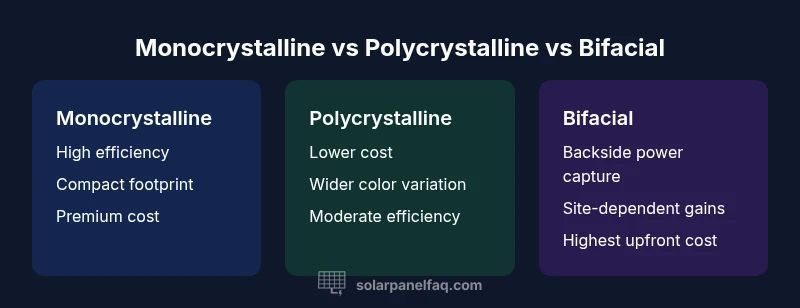
| Feature | Monocrystalline | Polycrystalline | Bifacial |
|---|---|---|---|
| Efficiency (qualitative) | high efficiency (best-in-class) | moderate efficiency | high efficiency with backside capture |
| Cost implication (upfront) | typically higher upfront cost | lower upfront cost | premium option with variable pricing |
| Warranty durability (scope) | often longer warranty with solid labor terms | standard warranty with limited labor coverage | comprehensive warranty with extra outputs |
| Shade/temperature tolerance | excellent performance under heat with uniform appearance | decent performance with more color variation | strong shade harvesting from backside in suitable settings |
| Weight/installation considerations | generally heavier; uniform mounting | midweight; easy retrofit | may require specialized mounting for backside exposure |
| Aesthetics and appearance | uniform dark appearance | bluish tones with visible cells | distinctive look from back-side design |
Strengths
- Facilitates apples-to-apples comparisons across models
- Reveals long-term value beyond upfront price
- Helps plan space requirements and system sizing
- Highlights warranty coverage and service network
Drawbacks
- Does not guarantee real-world performance due to shading and orientation
- Requires access to reliable datasheets and installer input
- Can feel overwhelming for beginners without a clear rubric
- May not capture evolving technologies or regional incentives
A side-by-side comparison is essential for finding the best value for your home.
Using a consistent rubric to compare performance, cost, warranty, and installation fit helps homeowners choose panels that maximize value rather than chase the lowest price. The Solar Panel FAQ team recommends starting with a mono-crystalline option for efficiency when space is limited, provided climate and roof support that choice.
Frequently Asked Questions
What does it mean to compare solar panels side by side in practice?
It means evaluating candidate panels using the same criteria and test conditions so you can directly compare their performance, cost, warranty, and installation needs. This approach reduces marketing bias and reveals true value for your home.
It means using the same criteria for every panel so you can compare apples to apples and pick the best option for your roof.
Which panel type is best for small roofs or limited space?
High-efficiency mono-crystalline panels are often favored for limited space because they maximize output per square foot. However, the best choice depends on your roof area, budget, and shading conditions.
In tight spaces, high-efficiency panels usually give you more power per inch of roof.
How does climate affect panel performance?
Climate affects temperature, sun exposure, and shading; some panels handle heat better than others. Adapt your comparison by considering climate-specific efficiency and degradation characteristics to estimate real-world output.
Climate changes how much energy you actually get, so pick panels that perform well where you live.
What should I look for in a datasheet?
Look for rated power, efficiency band, temperature coefficient, degradation rate, warranty coverage, and whether the rating is under standard testing conditions. Check claims against independent reviews and installer feedback.
Study the datasheet for the numbers it actually guarantees, then cross-check with installers.
Do higher efficiency panels always mean more savings?
Not always. Higher efficiency can reduce roof area and hardware, but upfront cost and climate factors influence payback. A side-by-side helps determine whether the extra efficiency translates into real savings for your home.
Higher efficiency helps only if you’re constrained by space or climate; otherwise, consider total system value.
How long do solar panels last and how does warranty compare?
Most panels come with long warranties and gradual degradation assumptions. Compare what the warranty covers (parts and labor) and whether it includes on-site service to understand long-term reliability.
Panels usually last many years; check the warranty for what’s covered and for how long.
Top Takeaways
- Define a uniform comparison rubric
- Prioritize real-world performance over nameplate ratings
- Account for roof, shade, and climate in your assessment
- Balance upfront cost with long-term value and warranty
- Use a structured table to avoid marketing bias