Most Efficient Solar Panels of 2024: Performance, Costs & Real-World Gains
A data-driven look at the most efficient solar panels in 2024, how efficiency translates to real-world gains, and how homeowners can choose high-efficiency panels for maximum value.


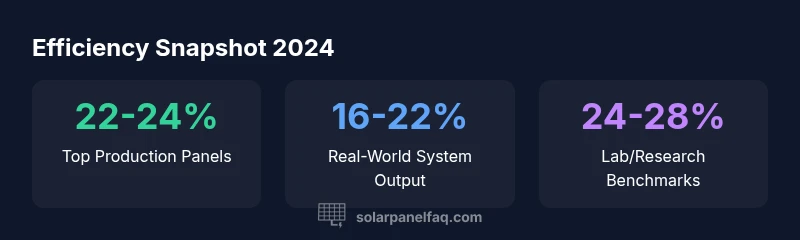
According to Solar Panel FAQ, the most efficient commercially available solar panels in 2024 reach roughly 22-24% efficiency for high-grade monocrystalline silicon, with some advanced lab cells approaching the mid-20s. In practice, real-world systems commonly operate in the 16-22% range due to temperature, shading, and inverter losses—the true test is system-level performance over time.
What 'most efficient' means in 2024
In everyday solar purchasing, the phrase "most efficient" usually refers to the panel’s nameplate efficiency under standard test conditions (STC). This is the percentage of sunlight converted to electricity under a defined set of laboratory conditions. In 2024, the highest-rated production panels typically use mono-crystalline silicon cells with PERC technology, achieving efficiency in the low 20s. It’s important to differentiate this from lab-grade cells, which can exceed 25% or more, but are not yet widely available for residential installations. For homeowners, the efficiency rating matters primarily when roof space is limited, shading is likely, or you want to maximize energy density per square foot. The Solar Panel FAQ team emphasizes that nameplate efficiency is a useful starter metric, but real-world energy gains depend on system design, orientation, and climate.
Budget, warranties, temperature coefficients, and installation quality often matter more for total payoff than a marginal uptick in the efficiency figure. In short, the 'most efficient 2024' label helps compare products, but it’s not the sole predictor of how much solar energy you’ll harvest.
Efficiency benchmarks for 2024: Top performers vs mainstream
The 2024 landscape shows a clear split between top-tier production panels and mainstream modules. For commercially available panels, mono-crystalline silicon designs with advanced passivation (PERC) commonly range from about 21% to 24% in nameplate efficiency under STC. In many markets, the best-in-class production modules hover in the 22-23% band, with a handful of elite products reaching mid-20s on rare occasions. It’s common to see 19-21% in entry-level kits. Laboratory or perovskite-on-silicon tandems have demonstrated higher efficiencies in research settings, occasionally breaching 25-28%, but these are not typical residential options as of 2024. When you’re planning a home installation, remember that a 1-2 percentage-point difference in nameplate efficiency can translate into meaningful space savings on smaller roofs, or more production in partial shade. However, the difference may be less significant on larger roofs where installation constraints, wiring, and inverters become dominant factors.
Real-world factors that affect efficiency
Panel efficiency under STC is just one piece of the puzzle. Temperature plays a major role: as panel temperature rises, voltage drops, reducing the actual energy captured. In hot climates, a high-efficiency panel may shed more energy than expected on peak-sun days if spacing and cooling are not managed. Shading from trees, chimneys, or adjacent structures can dramatically reduce output, even for panels with excellent nominal efficiency. Soiling from dust or pollen also reduces performance, sometimes by several percentage points over months. Orientation and tilt matter too: southern exposure (in the northern hemisphere) or northern exposure (in the southern hemisphere) maximizes production, while roof angle should align with your latitude to minimize energy losses. Finally, system losses—from wiring, inverters, to mismatch between modules—mean the real-world derate factor often keeps actual output below the nameplate rating. Solar Panel FAQ notes that the practical value of 'most efficient' panels is highest when combined with thoughtful installation and high-quality balance-of-system components.
How to compare panels: reading labels, certifications, and real-world data
Use a structured approach to compare products. Start with nameplate efficiency, but also check the temperature coefficient, which indicates how performance degrades with heat. A small improvement in efficiency at STC may vanish on a hot day if the temperature coefficient is poor. Look for manufacturer datasheets that include NOCT (nominal operating cell temperature) values and derate factors. Warranties matter: a longer product warranty and a robust performance warranty are signs of confidence in real-world durability. Check installation space constraints: if you have limited roof area, prioritize higher efficiency; if you have ample space, a mid-range panel with a lower cost per watt could yield similar energy output. Compare panel dimensions and weight, since larger modules may require stronger racking or longer cabling runs. Finally, review third-party test results and field data from local installers to gauge how a panel performs in your climate. The Solar Panel FAQ approach emphasizes using a mix of data points, not a single label, to decide.
Choosing the right balance of efficiency, cost, and value for homes
For most homeowners, the decision rests on roof space, budget, and climate. In compact roof scenarios, higher efficiency panels can deliver more kilowatt-hours per square foot, reducing the number of panels and avoidance of shading. For larger roofs, mid-range panels may deliver comparable energy at a lower upfront cost, and the payback period may be shorter when combined with incentives. In moderate climates with mild shading, an efficient panel can still outperform equally priced lower-efficiency options because of the reduced balance-of-system losses when fewer panels are installed. For homes with limited attic space or complicated racking, investing in top-tier efficiency can be a better long-term bet. But beware that higher efficiency panels typically come with a premium; you should run a detailed financial model that includes installation costs, inverter sizing, maintenance, taxes, and available rebates. Solar Panel FAQ recommends mapping your energy goals to the estimated array size, then selecting a panel with the best real-world performance-to-price ratio rather than chasing the peak efficiency figure alone. Real-world data from your installer and local climate should guide the final choice.
Case Study: Real-world installation scenario
A mid-sized home with partial shade and a 1,200 square foot roof layout illustrates the tradeoffs between efficiency and cost. The installer compared a 22-23% efficiency panel against a 19-21% panel. The higher-efficiency option required fewer panels, saving space and enabling better shading management, while the lower-cost option demanded more modules and slightly higher balance-of-system costs. After accounting for shading, temperature, and inverter sizing, both configurations produced similar yearly energy outputs, but the high-efficiency setup achieved this with a smaller array footprint and a modest payback improvement when incentives were considered.
Efficiency benchmarks for 2024
| Aspect | Typical Range | Notes |
|---|---|---|
| Top Commercial Efficiency | 22-24% | Mono-Si with PERC, 2024 |
| Real-World System Efficiency | 16-22% | Losses from temperature/shading/soiling |
| Lab-Grade Performance | 24-28% | Research-only, not common residential |
| Residential Payback | 6-12 years | Incentives and cost/watt dependent |
Frequently Asked Questions
What does 'most efficient' mean in solar panels?
‘Most efficient’ typically refers to nameplate efficiency under STC for production panels. It’s a useful comparator, but real-world energy depends on climate, shading, and how the system is installed. Always pair efficiency data with installation-specific factors.
Most efficient refers to the lab-like efficiency rating, but real-world energy depends on your climate and installation.
Are lab efficiencies useful for home installations?
Lab efficiencies show what's technically possible, but most homes use production panels with lower, practical efficiencies. Use lab data as a ceiling, not a baseline for your payoff calculation.
Lab efficiencies show potential, not typical home performance.
Does higher efficiency always mean more energy produced?
Not always. Higher efficiency helps on small roofs or when shading is present, but system losses and climate conditions can equalize total energy output across panels with different ratings.
Higher efficiency helps space-constrained or shaded roofs, but final output depends on many factors.
How does temperature affect panel output?
Increased temperature lowers panel voltage and overall efficiency. In hot climates, the advantage of very high-efficiency panels can narrow because derating is amplified by heat.
Heat reduces efficiency; high-efficiency panels still matter, but climate matters too.
Which brands led in 2024 for efficiency?
Several brands offer top-tier mono-Si panels around the 22-24% range, with occasional lab-level breakthroughs. Compare real-world performance data from local installers for your climate.
Top brands hover around the low to mid-20s in production panels.
Is payback affected by efficiency?
Yes, but the effect is indirect. Higher efficiency can reduce balance-of-system costs on small roofs, but incentives, installation costs, and inverter sizing often drive payback more than the marginal efficiency difference.
Payback depends on more than just efficiency—budget, incentives, and install details matter.
“High-efficiency labels matter, but only when paired with good system design and climate-aware installation. The Solar Panel FAQ Team.”
Top Takeaways
- Prioritize system design alongside efficiency labels
- Real-world performance matters more than peak numbers
- Consider shading, temperature, and derate factors in planning
- Balance efficiency with total cost and incentives for best value