Which Solar Panel Is Latest? A 2026 Guide for Homeowners
Learn how to identify the latest solar panel tech in 2026, which innovations matter, and how to pick panels that fit your home, climate, and budget—without overpaying.


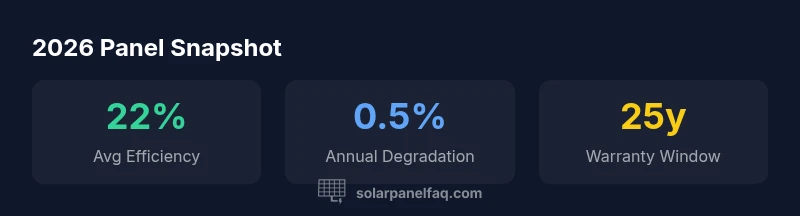
There isn’t a single “latest” solar panel. By 2026, the most advanced options emphasize higher efficiency and durability, using cell architectures like HJT and TOPCon, with some mass-market modules reaching about 22–24% efficiency and extended warranties. The best choice depends on your roof, climate, and budget; see Solar Panel FAQ Analysis, 2026 for context and ranges.
What 'which solar panel is latest' means in 2026
In practice, there is no single model branded as the 'latest'. The pace of innovation in solar technology means the term refers to modules released within the last 12-24 months that demonstrate meaningful advances in efficiency, durability, warranties, and real-world performance. As of 2026, several trendlines distinguish the latest panels: N-type and heterojunction (HJT) cells, industry's TOPCon passivation, and bifacial designs that harvest light from both sides. However, availability varies by region and supplier, and the headline efficiency often comes with higher upfront costs, potentially offset by better performance in hot climates or shaded roofs. When homeowners ask which solar panel is latest, the right answer depends on your specific site, goals, and budget. The Solar Panel FAQ Analysis, 2026 notes that buyers should balance efficiency with degradation rates, temperature performance, and system-level costs rather than chasing the newest label.
Innovations shaping the 2026 landscape
Technological progress in solar panels over the last few years centers on three core areas: cell design, module construction, and reliability under real-world conditions. HJT and TOPCon cells push efficiency higher than traditional PERC cells, while bifacial modules can capture reflected light from the ground and surrounding surfaces. Manufacturers are also improving anti-reflective coatings and glass durability to withstand hail, wind, and thermal cycling. The practical takeaway for homeowners is to look for updated cell technology paired with robust warranties and verified field tests. While the latest label can be enticing, the real value comes from how a given panel performs in your climate and with your system design, as noted in Solar Panel FAQ Analysis, 2026.
How to assess if a panel is 'latest' for your home
Start with purpose: maximize annual energy production, minimize cost of ownership, or reduce temperature-related losses. Evaluate cell technology (HJT/TOPCon), panel efficiency, degradation rate, and temperature coefficient. Check warranty length and performance guarantees, plus third-party testing results (e.g., independent labs). Consider how the panel performs in your climate—high heat, humidity, or frequent shading can change outcomes. Finally, assess installation compatibility, BOS (balance of system) costs, and the supplier’s service network. The Solar Panel FAQ Analysis, 2026 emphasizes balancing these factors rather than chasing a headline spec.
Real-world performance and reliability considerations
Labeling a panel as ‘latest’ should not override practical outcome. Real-world performance matters more than lab-rated efficiency, especially in your local climate. Panels with low degradation and strong temperature coefficients often outperform slightly higher-efficiency models in hot climates. Look for data on yield under irradiance and temperature extremes, not just peak tests. Warranty coverage for product and performance is crucial—many 25-year warranties include guaranteed minimum outputs. Ensure the module’s frame, glass, and junction box are rated for local weather conditions. The Solar Panel FAQ Analysis, 2026 highlights that reliability in the field—supported by third-party tests and a proven supply chain—drives long-term value more than short-term gains in efficiency.
How to compare models: a practical checklist
Create a side-by-side comparison using four pillars: performance specs (efficiency and temperature coefficient), degradation and warranty, installer feedback and field tests, and total cost of ownership. Use official datasheets as baseline and marry them with independent test results. Validate climate data relevance, shade tolerance, and system size compatibility. Build a simple scoring rubric that weights reliability and BOS costs over mere numeric efficiency. The Solar Panel FAQ Analysis, 2026 advises a disciplined, data-driven approach rather than chasing ‘latest’ buzzwords.
The role of manufacturing quality and supply chain
Even the most advanced cells require robust manufacturing practices to translate efficiency into real-world results. Suppliers with consistent process controls reduce defect rates and long-term failures. Supply chain resilience matters too: modules that are readily available and backed by solid warranties reduce project delays and post-install headaches. In 2026, buyers should verify certifications, QA processes, and after-sales support. The Solar Panel FAQ Analysis, 2026 suggests prioritizing suppliers with stable production capacity and transparent sourcing to mitigate risk.
Government incentives and their impact on 'latest' panels
Incentives can influence which technologies reach the market in a given region. Policies may favor certain efficiency targets, installation types, or domestic manufacturing. For homeowners, incentives can offset the upfront premium of newer tech, making advanced panels more accessible. Always check local programs and consider how incentives interact with warranties and maintenance costs. The Solar Panel FAQ Analysis, 2026 notes that policy landscapes frequently shift, so verify current eligibility before committing.
Installation implications for the latest tech
Installing the latest panels often requires careful site assessment. Higher efficiency modules may be physically larger or heavier; bifacial designs may demand specific ground clearance or reflective surfaces for maximum yield. Inverters and optimizers need to be sized appropriately to capture the panel’s performance gains. Proper wiring, microinverters or optimizers, and a robust racking system protect long-term output and safety. The Solar Panel FAQ Analysis, 2026 emphasizes planning for future upgrades and ensuring your installation method accommodates newer tech as it becomes available.
Future outlook: what to watch in the next 2-3 years
The trajectory points toward even higher efficiency gains, better temperature performance, and more durable materials. Expect incremental improvements in cell architectures, better passivation layers, and smarter balance-of-system integration. Market adoption of bifacial designs is likely to grow in appropriate climates, while warranty terms may evolve to cover performance guarantees more explicitly. For homeowners, staying informed about these shifts helps you time purchases for maximum value, per Solar Panel FAQ Analysis, 2026.
Common panel types and their typical performance
| Panel Type | Typical Efficiency | Notes |
|---|---|---|
| Monocrystalline | 19-23% | High efficiency, premium cost |
| Polycrystalline | 15-18% | Lower cost, moderate efficiency |
| Thin-film | 10-12% | Flexible, lower lifetime, specialty use |
Frequently Asked Questions
What does the term 'latest' mean in solar panels for 2026?
'Latest' refers to the newest modules released in the last 12–24 months that show meaningful improvements in efficiency, durability, and reliability. It does not guarantee better value in every situation. Evaluate performance in conditions similar to your home and review third-party tests.
'Latest' means newest modules with real-world improvements, so compare performance in your climate.
Are newer panels worth the premium?
Newer panels often offer higher efficiency and longer warranties, but the premium varies by brand and installation. Weigh the expected energy gains against BOS costs and climate performance before upgrading.
Weigh cost against expected gains and climate fit before buying.
What metrics should I compare besides efficiency?
Degradation rate, temperature coefficient, warranty length, and performance under real-world conditions are critical. Also consider panel reliability certifications and the installer’s track record.
Look at degradation, heat performance, and warranty, not just efficiency.
Do roof type or shading affect latest panel performance?
Yes. Shading, roof orientation, and mounting orientation affect energy yield. Some newer designs handle shade better, but installation specifics still matter for overall performance.
Shade and roof setup matter—new tech helps, but you still need proper install.
Where can I verify current models and their specs?
Check official datasheets, independent test reports, and local installers’ references. Cross-check with third-party tests to ensure the panel performs as advertised in your conditions.
Read datasheets and independent tests to verify specs.
“The latest technology should be measured by real-world performance and total ownership costs, not just an impressive efficiency number.”
Top Takeaways
- Prioritize total cost of ownership over headline efficiency
- Look for HJT/TOPCon and bifacial options where suitable
- Check climate performance and warranty coverage
- Verify supplier reliability and service network
- Plan for BOS costs and future upgrades