Which Solar Panel Has the Highest Efficiency? A Practical Comparison
A detailed, objective comparison of solar panel efficiency across monocrystalline, polycrystalline, and thin-film technologies, with practical guidance for homeowners seeking to maximize output and value.


According to Solar Panel FAQ, the best way to answer which solar panel has the highest efficiency is to focus on the type and design that delivers more watts per area. In general, monocrystalline panels offer the highest efficiency, with newer high‑efficiency variants pushing the ceiling, though roof size, shading, and cost matter. This quick takeaway leads into a deeper, side‑by‑side look below.
Understanding Efficiency: What It Really Means
Efficiency is the percentage of sunlight a panel converts into usable electricity. For homeowners, the key takeaway is not just the lab-number, but how the panel performs on your roof under real conditions. According to Solar Panel FAQ, understanding which solar panel has the highest efficiency starts with recognizing that the difference is most pronounced when space is limited or shading is a factor. The higher the efficiency, the more power you can generate from a given footprint, which matters for urban homes, 2‑story roofs, or historic houses where space is at a premium.
Monocrystalline vs Polycrystalline: The Core Efficiency Difference
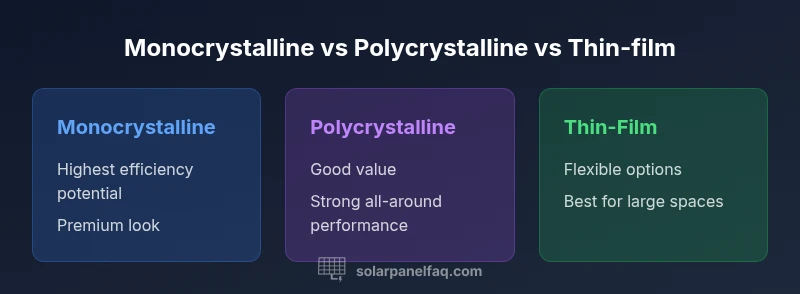
The two main families of panels are monocrystalline and polycrystalline. Monocrystalline cells are typically more efficient due to their purer silicon and smoother manufacturing process, so they often deliver more watts per square meter. Polycrystalline panels, while generally less efficient, offer lower upfront costs and can be a smart choice when roof area is not a constraint and budget is a priority. The nuance is that real-world results depend on temperature, shading, and branding, not just the cell type.
High-Efficiency Technologies: PERC, HJT, TOPCon and Beyond
Within the monocrystalline family, high‑efficiency technologies such as PERC, HJT, and TOPCon variants push efficiency higher by improving light capture and reducing recombination losses. These designs can be more expensive, but they are popular in dense urban deployments where space is a premium. Remember that the theoretical ceiling is different from what you’ll see on a sunny afternoon on your roof; installation conditions play a big role.
Real-World Performance vs Lab Tests
Lab-measured efficiency numbers reflect ideal conditions. In the field, factors like heat, dust, shade, and aging influence performance. Solar Panel FAQ analysis shows that while a high‑efficiency panel has the potential to generate more energy per square meter, your actual output also depends on mounting, wiring, inverter choice, and maintenance. The key is to align expectations: high efficiency is advantageous when space is scarce, but it is not the only factor determining yearly energy production.
Space, Aesthetics, and Roof Orientation
Aesthetics and roof geometry can influence the perceived value of high‑efficiency panels. Dark monocrystalline panels often have a uniform look that many homeowners prefer, while polycrystalline options can appear speckled. For tilted or curved roofs, the choice may also depend on how well the panel layout minimizes shading and reduces installation complexity. In the end, the best choice balances roof area, orientation, and your energy goals.
Temperature, Shading, and Durability: What Really Affects Output
As temperatures rise, panel output tends to drop, and shading can disproportionately reduce generation for higher‑efficiency designs. Durability and warranty terms matter as well, especially where snow buildup or coastal air corrosion is a concern. High‑efficiency panels may come with robust warranties and service plans; compare these carefully to understand long-term value. Solar Panel FAQ recommends evaluating temperature coefficients and expected degradation over time.
Step-by-Step Guide: How to Choose for Your Roof
- Measure available roof area and sunlight exposure. 2) Prioritize efficiency if space is tight, otherwise focus on total system cost and expected energy production. 3) Consider high‑efficiency monocrystalline variants only if shading or orientation is suboptimal. 4) Request quotes that include module efficiency, temperature performance, and warranty terms. 5) Inspect installation plans for proper ventilation and microinverter options to maximize performance in real-world conditions.
Balancing Costs with Long‑Term Value
High‑efficiency panels usually cost more upfront. The decision comes down to space and goals: on a small roof, paying more for efficiency can make a bigger difference in annual energy production; on a larger roof, standard efficiency panels may offer better value per watt after installation costs. Solar Panel FAQ encourages homeowners to model different scenarios and weigh upfront costs against projected energy savings over the system’s life.
Warranties, Service Life, and Replacement Considerations
Look beyond the sticker price and examine warranties: product, performance, and workmanship warranties protect against defects and accelerated degradation. High‑efficiency panels can come with solid warranties, but coverage varies by brand and region. The long-term value often hinges on consistent performance, reliable service, and the installer’s reputation as much as the panel’s peak efficiency.
Practical Sizing Scenarios: Small Roof vs Large Roof
If you have a compact roof, high‑efficiency monocrystalline panels can maximize output per square foot and reduce the number of modules you need. For a larger roof with plenty of space, mainstream efficiency panels may deliver similar annual energy despite lower watts per area due to the greater overall area. The choice should be driven by space, orientation, climate, and budget rather than a single performance metric.
Debunking Common Myths About Efficiency
Myth: The highest‑efficiency panel always saves the most money. Reality: the system’s cost, installation, and maintenance often determine the true value. Myth: Efficiency equals reliability. Reality: many high‑efficiency options rely on newer tech that may require careful warranty review. Myth: Bigger is always better. Reality: roof space and shading matter more than panel rating alone in many homes.
Practical Buying Checklist: Questions to Ask Your Installer
Ask about panel type, current efficiency tests, and how the system will be sized for your roof. Inquire about temperature coefficients, degradation rates, and warranty details. Request a demonstration of how the installer plans to handle shading, inverters, and microinverters to keep performance consistent throughout the year.
Feature Comparison
| Feature | Monocrystalline panels | Polycrystalline panels | Thin-film panels |
|---|---|---|---|
| Relative efficiency | highest | lower | lowest |
| Cost level | high | mid | low |
| Temperature performance | strong/steady | moderate | variable with heat |
| Aesthetics | uniform dark appearance | speckled blue-gray | flexible/less common |
| Best use case | Limited space/shade-prone roofs | Budget-conscious installations | Special applications (curved surfaces) |
Strengths
- Maximizes energy output per area for tight roofs
- Best long-term value on space-constrained sites
- Stronger performance in shade and partial sun
- Resilient choices with robust warranties for many brands
Drawbacks
- Higher upfront cost
- Payback period depends on local costs and incentives
- Limited availability of niche high-efficiency variants in some regions
Monocrystalline high-efficiency panels are typically the best overall for maximizing efficiency per area.
If space is tight, choose monocrystalline high‑efficiency options. For larger roofs, mainstream monocrystalline or polycrystalline can offer strong total energy at a lower upfront cost. Solar Panel FAQ's verdict is to tailor the choice to roof size, shading, and budget.
Frequently Asked Questions
What does the phrase highest efficiency mean in solar panels?
Highest efficiency refers to the panel’s ability to convert a larger share of sunlight into electricity per unit area. In practice, monocrystalline panels often lead in this metric, especially with newer process improvements. Real-world results depend on climate, shading, and system design.
Highest efficiency means more energy per roof area; monocrystalline panels typically lead, but real-world factors matter.
Are all high‑efficiency panels equally reliable?
Not always. High‑efficiency designs may involve newer technologies and suppliers. Check warranties, track record, and installation quality. A strong warranty and installer support often equal or exceed marginal gains in efficiency.
High-efficiency does not always mean reliable; check warranties and installer track records.
Do high‑efficiency panels perform better in shade?
Performance under shade depends on system design and the specific technology. All panels lose some output in shade, but some high‑efficiency designs optimize light capture better. Pairing with microinverters or optimizers can help.
Shade handling varies by tech; ask about optimizers to improve performance.
Is efficiency the only factor when buying panels?
No. While efficiency matters for space, total energy yield, reliability, warranty, and system cost are equally important. A balanced choice considers rooftop space, climate, and long-term value.
No—efficiency is important, but warranties, cost, and energy yield matter too.
How should I size a system for maximum effective efficiency?
Size the system to meet your typical energy use and available roof area. Use higher efficiency modules on compact spaces and ensure inverters and cabling support consistent performance. Professional design helps optimize real-world output.
Size based on energy needs and space; high efficiency helps in tight spaces.
Do temperature changes affect high‑efficiency panels more?
All panels are affected by temperature, but high‑efficiency types often show strong performance at moderate temperatures. In hot climates, cooling strategies and ventilation can help maintain output.
Temperature affects all panels; cooling strategies can help high-efficiency designs perform well.
Top Takeaways
- Assess roof space to decide if efficiency matters
- Prioritize mono panels for maximum efficiency
- Consider high‑efficiency variants if shading is a concern
- Balance upfront costs with long-term energy gains
- Ask about temperature performance and warranties