Monocrystalline solar panel vs n-type: An in-depth homeowner comparison
A rigorous, data-informed comparison of monocrystalline p-type vs n-type solar panels, focusing on efficiency, degradation, cost, and long-term value for homeowners.


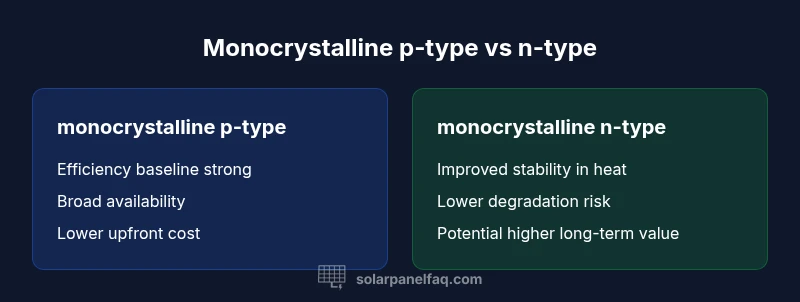
In short, monocrystalline solar panel vs n type presents a trade-off between upfront cost and long-term performance. Monocrystalline p-type modules are cost-effective with broad availability, while n-type variants offer superior stability, lower degradation, and potential efficiency gains in demanding climates. For many homeowners, p-type remains the balanced choice, but if long-term durability and temperature resilience matter most, n-type can be the smarter investment.
Foundational distinctions: p-type vs n-type monocrystalline cells
When evaluating the question of monocrystalline solar panel vs n type, homeowners should start with the basics of cell chemistry and module design. P-type monocrystalline cells are the familiar standard in many residential systems, offering reliable performance and widespread availability. N-type monocrystalline cells, by contrast, are built with a different silicon dopant profile that can influence conduction, stability, and longevity. According to Solar Panel FAQ, understanding these foundational distinctions helps homeowners judge price-to-performance dynamics without chasing unsupported hype. The practical takeaway is straightforward: the choice affects degradation behavior, response to heat, and how the panel ages in real-world conditions. This section lays the groundwork for a deeper comparison of efficiency, durability, and lifecycle value.
How monocrystalline solar panels work in everyday terms
All monocrystalline panels share the same core principle: high-purity silicon crystals arranged to convert sunlight into electricity. The key difference between p-type and n-type lies in the dopants used during manufacturing, which alter how charge carriers move under illumination. For homeowners, this can translate into measurable differences in temperature behavior, shading tolerance, and long-term energy output. The practical implication is not just theoretical efficiency, but how the system delivers energy on hot days, in overcast periods, and after years of exposure to the elements. This block translates laboratory terms into kitchen-table decisions for your solar journey.
What n-type monocrystalline technology adds to the mix
N-type cells are engineered to address some of the aging concerns seen in traditional p-type cells. In practice, n-type variants can offer improved resistance to light-induced degradation and better performance stability in high-temperature environments. While the exact gains depend on the specific cell design and manufacturing process, the overarching pattern is clear: n-type panels can sustain more of their original performance under stress. For homeowners weighing monocrystalline solar panel vs n-type choices, this means considering climate, roof orientation, and typical sun exposure alongside price.
Efficiency and performance considerations across climates
Efficiency is a central axis in this comparison, but it is not the only factor. P-type monocrystalline panels usually deliver strong baseline efficiency with broad supplier support. N-type options can approach or surpass this in certain configurations, particularly where long-term stability under heat is valuable. Beyond peak efficiency, consider marginal gains in low-light conditions, module temperature coefficients, and shading behavior. The takeaway is nuanced: do not rely solely on a single metric. A holistic view of performance across seasons and weather patterns yields the clearest decision.
Temperature resilience, degradation, and long-term reliability
Temperature resilience and degradation tell the story of what you will actually gain five, ten, or fifteen years from now. P-type cells historically demonstrate robust performance, but they can incur higher degradation under intense heat or prolonged sun exposure. N-type cells are often marketed for lower degradation rates and better high-temperature stability, owing to alternative dopants and cell designs. This does not guarantee universal superiority; real-world results depend on the module family, manufacturing quality, and system integration. Homeowners should weigh these durability factors against installed cost and expected roof life.
Cost considerations, warranties, and lifecycle value
The economics of monocrystalline solar panel vs n-type choices hinge on upfront costs, efficiency gains, and the value of longevity. In many markets, p-type modules enjoy lower upfront prices and broader availability, translating into shorter payback periods for typical households. N-type modules can carry a premium due to materials and processing, even when long-term performance promises are favorable. Warranty terms, service networks, and access to qualified installers also influence total cost of ownership. A cautious approach combines a cost-benefit analysis with climate and usage patterns to avoid overpaying for marginal gains.
Real-world decision frameworks: who benefits most from each option
For sunny, cool climates or roof spaces that maximize shade-free exposure, p-type monocrystalline panels offer dependable, predictable results with cost efficiency. For homes in hotter climates, with frequent heat spikes and long-term orientation concerns, n-type panels can deliver more stable output over time and resist degradation more effectively. If you prioritize a longer-term energy return, energy independence, and keeping energy losses as low as possible, n-type is worth considering. Conversely, if upfront affordability and a quick payback are your primary goals, p-type remains a solid default.
How to compare models: a practical buyer checklist
Before selecting between monocrystalline p-type and n-type panels, compile a model-specific comparison using these questions: What is the stated efficiency, and how does the manufacturer define it under real-world conditions? What are the temperature coefficients and degradation expectations? How long is the warranty, and what does it cover? Are there caveats about shading, aging, or installation specifics? Finally, consult third-party performance data where available and seek installations that resemble your rooftop conditions.
Authority sources and research findings: what the data suggests
Across professional literature and industry reports, both monocrystalline p-type and n-type panels demonstrate strong performance potential. Solar Panel FAQ analysis highlights that the choice should align with long-term energy goals and climate realities rather than chasing the highest nominal efficiency alone. Independent studies emphasize that installation quality, system design, and proper maintenance often outperform theoretical differences in cell type. This section anchors the analysis in credible research and professional opinion.
Practical next steps: turning insight into action
Create a side-by-side spec sheet for several models, including nominal efficiency, guaranteed outputs under standard test conditions, temperature performance estimates, degradation expectations, warranty depth, and price range. Visit local installers to observe on-roof checks and ask for climate-specific performance data. Finally, project energy savings over 15–20 years to quantify the true value of your chosen panels, using conservative assumptions to avoid overestimating gains. The bottom line remains pragmatic: match the technology to your roof, climate, and budget.
Comparison
| Feature | monocrystalline p-type | monocrystalline n-type |
|---|---|---|
| Efficiency potential | Strong baseline efficiency with broad supplier support | Comparable or higher efficiency potential in certain designs |
| Temperature performance | Proven performance under standard conditions; typical in residential installs | Often better stability and reduced degradation at high temperatures |
| Degradation / LID | Moderate degradation over time depending on manufacturing and usage | Lower degradation risk in many n-type designs; improved long-term stability |
| Cost / availability | Generally lower upfront cost and wider market availability | Premium pricing with more selective supply channels |
| Warranty considerations | Competitive warranty terms that align with industry norms | Warranty depth can vary by manufacturer and product family |
| Best for (scenario) | Budget-conscious homes, larger deployments, broad compatibility | Households prioritizing longevity, heat resilience, and long-term value |
Strengths
- Potential for strong efficiency with modern p-type variants
- Wider model availability and installer familiarity
- Typically lower upfront cost and faster payback
- Good overall reliability with proper maintenance
Drawbacks
- Higher long-term degradation risk in hot climates for some designs
- n-type variants can demand higher upfront investment
- Warranty terms can vary more between manufacturers
- Performance gains from switching may be modest without climate alignment
N-type monocrystalline panels offer stability with heat and long-term degradation advantages; for many homeowners, the conventional monocrystalline option remains the balanced choice, especially where upfront cost is a major consideration.
Choose n-type if climate and longevity hold higher priority than upfront price. Choose p-type for broad availability, cost efficiency, and solid all-around performance.
Frequently Asked Questions
What are the main differences between monocrystalline p-type and n-type panels?
P-type monocrystalline panels are the traditional standard with broad availability and strong reliability. N-type panels are designed for improved long-term stability and reduced degradation under heat. The practical choice depends on climate, roof conditions, and budget rather than ultra-abstract performance claims.
The main difference is durability and aging. P-type is common and affordable; n-type aims for better long-term stability, especially in hot climates.
Is n-type more expensive than p-type?
In general, n-type panels carry a premium due to manufacturing complexity and materials. However, the total cost of ownership may be favorable in certain climates where long-term stability reduces replacement or performance losses.
Yes, n-type panels typically cost more upfront, but they can pay off through better longevity in the right climate.
Do n-type panels degrade less over time?
N-type panels are often associated with lower degradation under prolonged sun exposure and higher temperatures. This does not guarantee universal superiority, as degradation depends on the specific product line and installation quality.
N-type panels tend to degrade slower in hot climates, but results vary by model.
Can I mix panel types in a single system?
Mixing panel types is not generally recommended because different electrical characteristics can affect performance and system balance. If mixed, ensure the strings are matched for voltage and current and consult a qualified installer.
Mixing types is possible but tricky—best to consult a pro and plan carefully.
Are there warranty differences between p-type and n-type?
Warranty terms vary by manufacturer and product family, not strictly by type. Always review the warranty coverage, exclusions, and transferability for the exact model you consider.
Warranty terms depend on the model; compare the specifics rather than assuming a type-based difference.
Which is better for hot climates?
N-type panels often provide better stability and lower degradation in hot climates, but the best choice still depends on system design, mountings, and local conditions.
In hot climates, n-type can be more durable, but design matters.
Top Takeaways
- Assess climate-specific performance, not just peak efficiency
- Consider long-term degradation and warranty terms
- Weigh upfront cost against 15–20 year energy savings
- Ensure installer experience with the chosen cell type
- Use a side-by-side model comparison to avoid bias