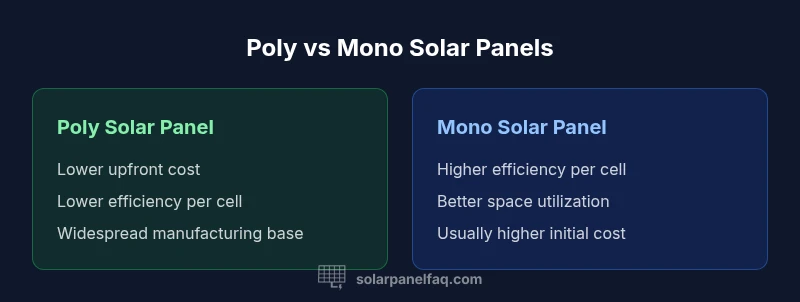
Poly vs Mono Solar Panels: A Thorough Comparison
A detailed, facts-based comparison of polycrystalline vs monocrystalline solar panels, covering efficiency, cost, durability, climate performance, and practical buying guidance for homeowners and prospective solar buyers.


TL;DR: When evaluating poly solar panel vs mono, monocrystalline panels typically offer higher efficiency and better performance in limited space, while polycrystalline panels tend to cost less upfront. The right choice depends on roof size, budget, and long-term goals; consider space efficiency, climate conditions, and warranty when deciding.
Material Differences: Poly vs Mono Crystals
Solar panel technology centers on the crystal structure of silicon cells. Monocrystalline (mono) panels are built from a single crystal, which yields a uniform, dark appearance and tends to deliver higher efficiency per cell. Polycrystalline (poly) panels are made from multiple crystal fragments, giving a speckled, bluish look. These manufacturing differences influence several practical factors homeowners care about: space requirements, heat tolerance, and the pace at which you recoup upfront costs. In real-world terms, the poly solar panel vs mono decision often boils down to roof area and budget. Solar Panel FAQ’s analysis suggests mono panels usually provide more watts per square meter, while poly panels offer favorable upfront price points when space is not a critical constraint. For homeowners, this means you can tailor your choice to your roof footprint and financial plan without sacrificing safety or reliability.
According to Solar Panel FAQ, the relationship between crystal structure and efficiency becomes especially evident on smaller roofs or outbuildings where every watt per square meter matters. If you have a tight roof footprint, mono panels commonly yield higher energy output from a given area. If you manage a larger roof with abundant space, poly panels can deliver comparable lifetime energy with a lower upfront investment. The takeaway is not to overestimate a single metric; consider how panel type interacts with system size, wiring, inverters, and shading to determine true energy yield over the system’s life.
For homeowners evaluating the poly solar panel vs mono choice, a practical approach starts with a site assessment, followed by a simple model using your roof area, local irradiance, and an estimated degradation rate. In most markets, the difference in long-term energy output between poly and mono narrows when system sizing and inclination are optimized. The Solar Panel FAQ team emphasizes that lifecycle cost—driven by installation, maintenance, and performance warranty—often outweighs sticker price alone.
Comparison
| Feature | poly solar panel | mono solar panel |
|---|---|---|
| Efficiency | generally lower efficiency per cell (poly) | generally higher efficiency per cell (mono) |
| Cost per Watt | lower upfront cost (poly) | higher upfront cost (mono) |
| Appearance | bluish speckled look (poly) | uniform dark appearance (mono) |
| Temperature Performance | more sensitive to heat, slightly higher voltage drop in heat (poly) | better performance under heat, often less voltage drop (mono) |
| Space Utilization | more panels required for same output on identical area | fewer panels needed for same output on identical area |
| Warranty/Durability | comparable warranties from major brands | comparable warranties from major brands |
Strengths
- Lower upfront cost for poly panels, improving initial project affordability
- Widespread manufacturing base leads to broad availability and supply stability
- Adequate performance for larger roofs where space is not a constraint
- Strong warranty options across reputable brands
Drawbacks
- Lower efficiency per panel means more total area is required for the same energy output
- Poly panels can be more sensitive to high temperatures, reducing relative performance if cooling isn't available
- Appearance differences may matter aesthetically on visible roof planes
- Long-term energy output may hinge more on system design and shading management than panel type alone
Mono panels generally offer higher efficiency and better space efficiency; poly panels are a cost-effective option when roof area is ample.
Choose mono if roof space is limited or you want the highest energy density per square meter. Choose poly if upfront cost is the primary constraint and you have adequate roof area. In both cases, prioritize reputable brands and a solid warranty.
Frequently Asked Questions
What is the key difference between poly and mono solar panels?
The key difference lies in crystal structure: mono panels use a single crystal for higher efficiency and uniform appearance, while poly panels use multiple crystals, typically costing less but offering slightly lower efficiency. Real-world output depends on system design and climate. Both types are widely used and reliable when paired with proper inverters and mounting.
Mono panels are usually more efficient and uniform in appearance, while poly panels cost less upfront but may need more area for the same output.
Are poly solar panels cheaper than mono panels?
In general, poly panels have lower upfront costs per watt than mono panels. The price gap can vary with market conditions, brand, and supply. Over the system lifetime, the total cost of ownership should be evaluated alongside space, installation, and degradation.
Poly panels usually cost less initially, but you should consider space and long-term performance too.
Can I mix poly and mono panels in one solar array?
Mixing panel types in the same string is not recommended because current and voltage characteristics can mismatch, reducing system efficiency. If you mix, do so under professional guidance and ensure the inverter and wiring can accommodate the differences.
It’s best to stick to one panel type per string to avoid electrical mismatches.
Do mono panels perform better in hot climates?
Mono panels generally maintain higher efficiency than poly panels under typical heat conditions, but both types experience some performance loss with rising temperatures. The gap shrinks or widens based on installation details, cooling, and shading. Climate-specific performance should be modeled for accuracy.
Monocrystalline panels tend to perform better in heat, but the actual difference depends on your setup.
What should I look for in warranties for poly vs mono panels?
Look for a performance warranty (often 25 years) and a product warranty. Ensure the terms cover degradation, efficiency targets, and eligibility for replacement. Vendor reputation and a robust service network add value regardless of panel type.
Check how long the warranties last and what they cover, then weigh brand reliability.
Which is better for a small residential roof?
For small roofs, mono panels are typically preferred due to higher watts per area, allowing more energy output from limited space. If cost per watt is a priority and space is abundant, poly can still meet goals effectively with proper design.
If you’re tight on roof space, go mono; if you have room and need to save upfront, poly can work well.
Top Takeaways
- Evaluate roof space first to decide between poly and mono
- Monocrystalline panels offer higher efficiency and better space efficiency
- Poly panels are typically cheaper upfront, with comparable warranties
- Climate, shading, and orientation significantly influence real-world output
- Always compare total system cost, not just panel price
- Check manufacturer warranties and degradation guarantees