Solar Panel Or: Mono vs Poly — A Practical Comparison
A thorough, objective comparison of monocrystalline and polycrystalline solar panels, focusing on efficiency, cost, climate response, and value to help homeowners choose the best option for their roof and budget.


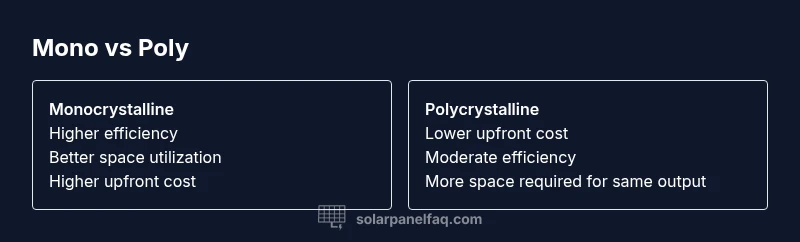
Solar Panel Or: Mono vs Poly is a practical trade-off. Monocrystalline panels typically deliver higher efficiency and better space utilization, but at a higher upfront cost. Polycrystalline panels are usually cheaper and reliable, though slightly less efficient and dense in output. Your decision should hinge on roof area, budget, and long-term energy goals.
Setting the stage: the solar panel or decision
When homeowners start planning a solar installation, the question often begins with a simple phrase: solar panel or. In practice, the choice usually centers on two silicon-based options: monocrystalline and polycrystalline. These terms describe how the silicon cells are manufactured and how that affects performance, cost, and space requirements. For many roof configurations, the decision isn’t about whether to go solar, but which panel type makes the most efficient use of the available roof area. The goal is to maximize energy output while aligning with budget and installation constraints. This section lays out a practical framework for comparing mono and poly panels, including how each type responds to real-world conditions such as heat, shading, and aging. By the end, you’ll have a clearer picture of which path is best for your home and your long-term energy goals. According to Solar Panel FAQ, this inquiry helps homeowners decide whether mono or poly solar panels fit their roof and budget.
How mono and poly differ in design and performance
Monocrystalline panels are manufactured from a single crystal of silicon, which yields higher electron mobility and therefore higher efficiency. In practical terms, you get more watts per square foot, which matters if you have a limited roof area or want a sleeker array. Polycrystalline cells are formed from multiple silicon crystals, which lowers production costs and typically results in a slightly lower efficiency. The trade-off is that to achieve the same output, a poly panel often requires more surface area. In terms of performance, mono panels generally hold up better in high-temperature conditions, whereas poly panels can experience a more noticeable drop in output in the heat. Shade tolerance is another practical factor: modern panels incorporate bypass diodes, but the layout and string design influence how much shadow reduces energy. Overall, mono is usually the go-to when space, aesthetics, and long-term energy density matter most; poly remains a solid option for budget-conscious installations with ample roof real estate.
Cost considerations and long-term value
Cost is a major driver in the solar panel decision, but it isn’t the only factor. Monocrystalline panels tend to have a higher upfront price per watt, reflecting their higher efficiency and superior performance in smaller footprints. Polycrystalline panels typically cost less upfront, which can be appealing for larger roofs or for homeowners with tight budgets. When evaluating value, consider the total system design: a higher-efficiency panel may require fewer panels, less mounting hardware, and simpler wiring, potentially reducing balance-of-system costs. Incentives, financing options, and local electricity rates can substantially alter the payback period. Even without precise price data, the principle holds: a better capacity per roof area often translates into faster energy payback, especially where shade or limited space is a constraint. Remember to compare warranties and expected lifespan to understand long-term return. Solar Panel FAQ’s analysis shows that efficiency and space utilization drive long-term value, particularly on smaller roofs.
Climate, temperature, and shading impacts
Climate and local conditions significantly influence the mono vs poly decision. In hot, sunny climates, monocrystalline panels tend to maintain higher efficiency due to superior performance at elevated temperatures and better heat tolerance. In cooler or milder climates with ample roof space, polycrystalline panels can deliver solid energy output at a lower initial cost, making them attractive for larger installations. Shading and soiling are universal considerations; neither type is immune to energy loss when portions of the array are shaded. Modern systems mitigate this through microinverters or power optimizers, which help preserve output even under partial shade. The practical takeaway is that climate, roof space, and maintenance practices together determine the optimal panel choice more than a single factor. For most homes, mono remains favored when space is tight, while poly can be appealing in oversized installations where space is less of a constraint.
Aesthetics, installation space, and roof planning
Aesthetics can influence the decision, especially on visually exposed roofs. Monocrystalline panels typically have a uniform, darker appearance that some homeowners prefer for a clean, cohesive look. Polycrystalline panels display a lighter hue with a speckled appearance, which some observers find less seamless but not unattractive. Installation space considerations are practical: if you have a shallow roof or want to minimize the number of panels, mono’s higher efficiency helps you reach the necessary output with fewer modules. For projects with abundant space and a need to minimize upfront cost, poly may be the more economical route. Regardless of type, ensure correct mounting, proper sealing, and a layout that minimizes shading by nearby structures. A thoughtful roof plan can significantly influence energy production over the life of the system.
Durability, warranties, and reliability
Durability and warranty support are critical components of a solar investment. Both mono and poly panels typically come with similar manufacturer warranties, often covering 25-30 years for performance and product coverage. In practice, expected lifespan hinges more on the quality of panel materials, frame construction, and installation quality than the silicon type alone. Temperature cycling, UV exposure, and mechanical stress from wind can affect long-term reliability; choosing reputable brands and experienced installers mitigates these risks. When reviewing quotes, look for standardized warranties, clear performance guarantees, and the credibility of the installer. Monitoring options and post-install service are additional layers of value that influence long-term satisfaction.
Practical scenarios: when mono is best vs when poly makes sense
Scenario A: You have a small roof with limited space and a desire to maximize energy density. Mono is likely the better choice, as it delivers more watts per panel and a streamlined appearance. Scenario B: Your roof is large, budget is a primary consideration, and you can accommodate more panels. Poly may provide the lower upfront cost while still delivering solid energy output over the system lifetime. Scenario C: You live in a hot climate or have shading concerns in the afternoon. Mono’s heat tolerance and higher efficiency can help preserve output during peak sun hours. Scenario D: You’re installing on a new roof with a long horizon for return. Evaluate not only panel type but also the quality of installation, balance-of-system components, and available incentives to optimize payback.
How to evaluate a real-world quote
When you receive quotes, compare on a like-for-like basis. Start with system size in kilowatts (kW) and the predicted annual energy production, then examine panel efficiency claims and the power output per dollar. Check the warranty terms for both the product and the installation workmanship. Request performance data under real-world conditions, including temperature coefficients and degradation rates. Ask about the installer’s experience with the chosen panel type and whether they use optimization strategies like microinverters to maximize output under shade. Finally, model your payback using local electricity rates, available tax credits, and maintenance costs to determine which option offers the best financial balance in your climate and roof context.
Decision framework and next steps
To decide, map your roof space, budget, and energy goals against three decision criteria: space efficiency, upfront cost, and long-term value. If space is tight and you want the maximum output per square foot, lean toward mono; if upfront budget is the main constraint and you have ample roof surface, poly is a viable option. Use a transparent comparison table, verify warranties, and request quotes that include all major components—panels, racking, wiring, inverters, and monitoring. Finally, plan for regular maintenance and screening for shading from future growth or renovations. The outcome should be a clear, data-driven choice that aligns with your home’s energy needs and financial plan.
Comparison
| Feature | monocrystalline | polycrystalline |
|---|---|---|
| Efficiency | higher efficiency (mono) | moderate efficiency (poly) |
| Cost (upfront) | higher upfront cost | lower upfront cost |
| Temperature performance | better performance in heat | slightly affected but acceptable in heat |
| Aesthetics & space | uniform appearance, space-efficient | varied appearance, more space for same output |
| Warranty & durability | strong, widely available warranties | strong warranties, similar lifespan |
Strengths
- Monocrystalline offers higher efficiency and better space utilization
- Long-term value due to higher output per area
- Uniform appearance for streamlined roofs
- Strong warranty options across brands
Drawbacks
- Higher upfront cost compared to polycrystalline
- Budget-focused installs may prefer lower upfront cost
- Performance varies with temperature and shading; proper system design is essential
Monocrystalline is the generally superior all-around choice for most homes; polycrystalline remains a solid budget-friendly alternative.
Choose mono if roof space is limited or you want maximum energy density. Choose poly if upfront cost is a priority and space is ample.
Frequently Asked Questions
What is the main difference between monocrystalline and polycrystalline solar panels?
Monocrystalline panels are made from a single-crystal silicon, offering higher efficiency and better performance in limited space. Polycrystalline panels use multiple silicon crystals, typically costing less but delivering lower efficiency.
Monocrystalline panels are sleeker and more efficient, while polycrystalline panels save you money upfront. Your roof size and energy goals matter.
Which panel type lasts longer and is more durable?
Both types have comparable warranties and lifespans, typically 25-30 years, with durability largely tied to the brand and installation quality.
Both last many years; durability depends on installation and warranty, not the type alone.
Does climate affect the choice between mono and poly panels?
Yes. In hot climates and limited roof space, mono's higher efficiency and better heat tolerance can be advantageous. In cooler climates with ample space, poly may offer good value.
Climate matters: mono tends to perform better in hot sun, while poly offers good value in larger installations.
Are there other panel types I should consider?
Thin-film and emerging technologies exist, but they are less common for residential roofs due to efficiency and longevity trade-offs.
There are other types, but for most homes mono and poly are the main choices.
How should I compare quotes from installers?
Focus on system size (kW), panel efficiency, total cost, warranties, and expected payback period rather than price alone.
Ask about efficiency, warranty, and output per dollar when comparing quotes.
What is the payback period difference between mono and poly?
Payback depends on local incentives and energy usage; the panel type typically affects output per area but not dramatically the payback when space is ample.
Payback varies by incentives and usage; panel type matters mainly for space and output density.
Top Takeaways
- Assess roof space before choosing panel type
- Mono panels offer higher efficiency and density
- Poly panels are cheaper but require more roof area
- Consider climate and shading in your decision
- Check warranties and supplier reliability