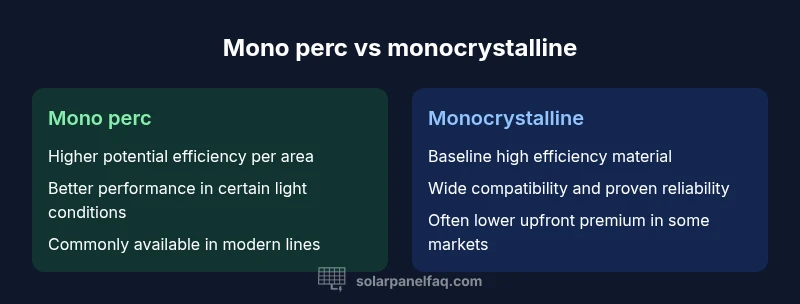
Mono perc solar panel vs monocrystalline: An analytical comparison
A detailed, analytical comparison of mono perc solar panel vs monocrystalline, exploring efficiency, cost, durability, climate performance, and practical guidance for homeowners and solar buyers.


According to Solar Panel FAQ, the key differences in mono perc solar panel vs monocrystalline come down to cell design and process steps. Mono perc panels employ passivation tweaks on monocrystalline cells to improve light capture, while standard monocrystalline cells serve as the baseline. For most homeowners, mono perc offers a small efficiency boost with similar durability, making it a popular choice for new installs.
What mono-PERC means in practice
Mono perc refers to a monocrystalline solar cell that uses the Passivated Emitter and Rear Cell (PERC) technology. In simple terms, PERC adds a dielectric layer on the back of the cell, which reduces light that would otherwise escape and redirects it back into the absorber. This can lead to higher energy production in real-world conditions, especially at higher operating temperatures and under diffuse light. The baseline material remains monocrystalline silicon, known for its uniform crystal structure that supports higher efficiency and better longevity than many alternatives. When homeowners hear the phrase mono perc solar panel vs monocrystalline, they are comparing a manufacturing enhancement (PERC) layered on top of a monocrystalline substrate versus a older, traditional mono cell. In practice, this means you’re typically looking at a more efficient panel without changing the fundamental physics of a silicon wafer. The Solar Panel FAQ team emphasizes that the practical difference often comes down to quality control, cell passivation quality, and how the module is built, not simply the presence of rear-contact technology alone.
For homeowners evaluating options, it’s important to ask for cell efficiency ratings, temperature coefficients, and the warranty terms. The mono perc vs monocrystalline distinction matters most when you are space-constrained and need higher output per square meter, or when your roof orientation and shading reduce potential panel area. The broader market uses the term mono-PERC as a standard in newer monocrystalline families, so you’ll often see this feature marketed as the default rather than a niche upgrade. The Solar Panel FAQ research shows that most installers and manufacturers now standardize PERC technology in new monocrystalline lines, which helps ensure consistent performance improvements across brands.
In summary, mono perc is a manufacturing enhancement layered on monocrystalline silicon, aimed at extracting more energy from the same wafer size. While the concept is straightforward, the real-world results depend on cell quality, panel build, and system design. This is why homeowners should evaluate not only the chemistry but also the supplier’s track record and post-sale support when choosing between these options.
wordCountBlock1: null}
How mono-PERC technology affects efficiency and performance
PERC technology changes how photons are converted into electrical energy by increasing the amount of light captured and reducing losses that occur at the back surface of the cell. The rear contact design reduces parasitic absorption and can improve short-circuit current under certain light conditions. In temperatures where standard cells lose efficiency, mono perc cells often retain a higher percentage of their rated output, due to reduced back-surface recombination. The practical takeaway for homeowners is that while the theoretical efficiency boost can be meaningful, the actual gains depend on module quality, installation, and climate.
Performance under high irradiance and partial shading is also a factor. Because PERC cells rely on back-surface reflectance, shading on a portion of a panel can disproportionately affect overall string output if the design doesn’t employ bypass diodes or microinverters to mitigate shade-induced losses. In many residential installations, the difference between mono perc and traditional monocrystalline can translate into a few percentage points of annual energy yield, with the exact delta varying by module quality, mounting angle, temperature, and regional sun exposure. The Solar Panel FAQ team notes that the practical gains are most noticeable in systems that maximize panel density on the roof and in arrays where space is at a premium.
Another nuance is manufacturing variance. Not all mono perc panels are created equal; some vendors integrate more aggressive rear surface passivation or higher-quality anti-reflective coatings. Buyers should compare the full spec sheet—not just the labeled technology. This includes the rated efficiency, temperature coefficient, and lateral resistance of the module. In many cases, the advertised efficiency difference between mono perc and older mono crystalline panels can be modest, but the reliability of the module’s construction can tilt the decision one way or another depending on the project priorities.
wordCountBlock2: null}
Efficiency and real-world output: decoding the numbers
When comparing efficiency, it is essential to separate the math of cell efficiency from the system-level performance. A higher cell efficiency means that a single solar cell converts a greater share of sunlight into electricity under standardized test conditions. However, the way a panel is packaged, the number of cells in series, and the overall module design all influence how this efficiency translates to real-world energy production. In mono perc vs monocrystalline comparisons, the efficiency gap is often modest at the module level but can be meaningful for installations with limited roof space.
Temperature effects also matter. Solar panels experience a drop in output as temperature rises. Panels with better temperature coefficients will lose less energy on hot days, which can favor mono perc designs in warmer climates where roof temperatures peak. Conversely, in cooler climates with frequent morning fog or shade, the marginal gains from PERC may be more modest. The bottom line is that efficiency is a multi-variable metric, and the top-line numbers rarely tell the full story without considering the installation context, wiring, and inverter choices.
For the typical homeowner, the practical takeaway is that mono perc performance is often a blend of the base monocrystalline material and the manufacturing choices behind the panel. The same model line may have some boards with stronger passivation and others with standard back-surface processing. As a result, you should compare the specific panel model’s performance metrics, rather than relying solely on the generic label of mono perc or monocrystalline.
wordCountBlock3: null}
Cost considerations and payback: what investors should know
Cost is a central consideration whenever evaluating mono perc solar panel vs monocrystalline. In many markets, the cost delta between mono perc and standard monocrystalline panels is moderate, and some manufacturers price mono perc lines very competitively due to economies of scale and widespread adoption. The premium, if any, is often justified by potential gains in energy density per roof area, accelerated payback on smaller installations, and improved performance in certain weather scenarios. Homeowners should also weigh ancillary costs such as installation fees, mounting hardware compatibility, and potential differences in warranty coverage.
From a financial planning perspective, calculate the levelized cost of energy (LCOE) by considering the system size, anticipated energy generation, local sunlight, and any applicable incentives. Because regional incentives vary, the premium for mono perc may be more or less favorable depending on location. The Solar Panel FAQ analysis indicates that for many residential projects, the decision comes down to roof space constraints and long-term energy goals rather than a simple sticker price. In practice, ask for a total installed cost per watt and compare quotes from multiple installers to ensure you capture the real value proposition of mono perc panels in your particular context.
In short, mono perc may offer a favorable balance of efficiency gains and cost in many cases, but it is not an automatic upgrade for every installation. A careful cost-benefit analysis—tailored to your roof, climate, and electricity prices—will reveal whether mono perc is the right fit for your project.
wordCountBlock4: null}
Durability, warranty, and lifecycle expectations
Durability remains a core strength of both mono perc and traditional monocrystalline technologies. Both are built to withstand typical residential weather conditions, including wind loading, temperature cycling, and UV exposure. Warranty terms in the industry commonly span two or more decades for the product and performance, with many manufacturers offering linear performance warranties that guarantee a minimum degradation rate over time. While mono perc technology can add resilience in certain operating conditions thanks to improved light capture and reduced recombination losses, the long-term reliability is largely dependent on the quality of materials, the encapsulant, the frame, and the bypass diodes used in the module.
If warranty terms are similar, your decision may hinge more on the supplier’s service reputation and the availability of local support. Solar Panel FAQ highlights that some manufacturers include enhanced warranty terms for newer mono perc lines, which can translate into lower maintenance risk over the panel’s lifecycle. When evaluating warranties, ask specifically about coverage for micro-cracks, potential hotspot vulnerability, and the terms for replacement or recalibration if performance falls below expectations in certain climates. A smooth post-sale experience often matters nearly as much as the stated warranty length.
In sum, durability is robust for both options, and choosing a reputable brand with solid after-sales support remains a critical factor for long-term solar system reliability.
wordCountBlock5: null}
Installation and roof-compatibility considerations
Installation considerations for mono perc vs monocrystalline largely center on roof space, mounting compatibility, and electrical design. Both technologies are compatible with common mounting systems, racking approaches, and standard inverters, but installers may favor one approach based on module frame thickness, weight distribution, and spacer requirements. For roofs with limited space, the higher efficiency potential of mono perc can translate into more watts per square meter, enabling a smaller array to achieve the same output as a larger, lower-efficiency alternative. In contrast, systems with ample roof area may not require the incremental gains of PERC technology. The Solar Panel FAQ team notes that installers often balance panel density with ideal tilt, shading mitigation, and aesthetic considerations.
Shading, dirt on the surface, and snow can influence module performance. PERC-based modules can exhibit improved performance under partial shading due to design optimizations, but the overall system response still depends on the configuration of strings, optimizers, or microinverters. When planning installation, request a shading analysis and ask the installer to simulate energy yield for mono perc and non-PERC options in your specific roof orientation. This helps ensure the chosen technology aligns with your roof geometry, climate, and energy goals.
Finally, look for robust encapsulation and edge sealing, as these factors influence longevity when exposed to rain, wind-driven debris, and temperature swings. While mono perc and monocrystalline offer similar baseline durability, the real-world resilience comes from the entire module stack and the installation quality rather than the technology label alone.
wordCountBlock6: null}
Real-world performance scenarios and climate effects
Climate is a major driver of solar performance, and understanding how mono perc solar panel vs monocrystalline behaves in your area helps set expectations. In hot climates, panels with strong temperature coefficients retain more of their rated output as ambient temperatures rise, which can make the marginal gains from PERC more meaningful. In cooler climates with frequent overcast days, the relative advantage of PERC can depend on diffuse light conditions and panel mounting. The ability of PERC cells to better utilize diffuse light may yield modest gains on cloudy days, improving overall annual energy production in some locations.
Shading tolerance is another practical factor. If a roof has partial shading due to chimneys, vents, or nearby trees, the choice of module can influence how quickly the string is affected. Some buyers find that mono perc panels paired with modern inverters or optimizers provide better shading resilience, while others experience limited differences. The key takeaway is that climate and shading interact with panel design in ways that are case-specific. Your best bet is to run a credible energy yield estimate using local sun data and the exact panel models you’re considering, rather than relying solely on general claims about technology.
Another real-world factor is system integration. A modern solar system often combines panels with an optimizer or microinverter to maximize output under real conditions. Whether you choose mono perc or monocrystalline should be considered in the context of these broader design choices. In many cases, the difference in annual energy production between the two technologies is smaller than differences caused by installation quality, wiring losses, and inverter efficiency. Homeowners who prioritize consistent performance under variable conditions should weigh these integration choices as part of the overall system design.
In practice, the right answer varies by roof, climate, and energy goals. The best approach is to obtain multiple quotes that include shading analysis, performance simulations, and a breakdown of expected energy yield for both technologies in your specific site. This provides a data-driven basis for decision-making rather than relying on general claims about mono perc or monocrystalline performance.
wordCountBlock7: null}
Environmental impact and lifecycle considerations
Manufacturing footprints and end-of-life considerations are increasingly part of the homeowner decision. Mono perc and monocrystalline cells share the same base material and many upstream supply chain characteristics, but PERC-specific processing can influence energy use and chemical usage during manufacturing. The environmental impact of a solar panel extends beyond production; it includes installation, operation, and end-of-life recycling. Solar Panel FAQ emphasizes looking for modules with responsible sourcing, transparent supply chains, and clear recycling programs. In practical terms, this means evaluating the vendor’s environmental disclosures and any third-party certifications they hold.
From a lifecycle perspective, the difference between mono perc and standard monocrystalline often narrows when you consider the complete system. If mono perc panels enable higher energy output per roof area, the required system size could be smaller for the same energy goal, potentially reducing material usage and installation labor. On the other hand, if the efficiency gains are marginal in your climate and roof constraints, the environmental advantage of one technology over the other may be less pronounced. Buyers should weigh manufacturing ethics, supply chain transparency, and end-of-life plans alongside performance metrics when forming a holistic view of sustainability.
wordCountBlock8: null}
Practical guidance and a homeowner decision checklist
To translate the mono perc solar panel vs monocrystalline comparison into a practical choice, use this decision checklist: 1) Assess roof space and shading; 2) Compare a like-for-like panel model in terms of efficiency, temperature coefficient, and warranty; 3) Request a shading analysis and a local yield simulation for both technologies; 4) Compare installed cost per watt and expected payback in your region; 5) Check availability of local service and warranty support. The final recommendation should align with your energy goals, climate, and budget.
For many homeowners, mono perc is a sensible choice when space is limited or when a slightly higher energy density is desired without a substantial upfront cost premium. If roof area is abundant and the price delta is modest, mono perc may still be the safer bet due to better performance in varied light. The Solar Panel FAQ team suggests engaging with experienced local installers who can translate these factors into a field-ready plan, ensuring that the selected technology delivers on its promised gains over the panel’s lifetime.
wordCountBlock9: null}
Comparison
| Feature | mono perc solar panel | monocrystalline panel |
|---|---|---|
| Efficiency potential | higher potential due to PERC enhancements | baseline monocrystalline efficiency |
| Production cost | possible small premium or competitive pricing | typical baseline price for mono panels |
| Temperature performance | often improved retention with PERC tech | similar temperature coefficient expectations |
| Durability/warranty | comparable warranties; depends on brand | comparable warranties; depends on brand |
| Best for | space-constrained installs; premium efficiency gains | cost-focused projects; straightforward replacement |
Strengths
- Potentially higher efficiency per area with PERC technology
- Strong durability and long-term reliability across brands
- Growing installer familiarity and product availability
- Good long-term value in space-limited roofs
Drawbacks
- Possible upfront cost premium in some markets
- Efficiency gains depend on manufacturing quality
- Benefits may be marginal in large rooftops with abundant space
- Performance varies with climate and installation specifics
Mono perc panels are a prudent upgrade for space-constrained homes where every watt matters; monocrystalline panels remain a solid, cost-conscious choice for standard installs.
Choose mono perc when you need higher wattage density per roof area and are comfortable with a potentially small price premium. Choose monocrystalline if upfront cost and broad availability drive your decision, or if roof space is ample and you want a straightforward, reliable option. The best path is to compare specific panel models, not just the technology label.
Frequently Asked Questions
What is mono perc solar panel vs monocrystalline, and how do they differ in practice?
Mono perc solar panel vs monocrystalline refers to enhanced monocrystalline cells using PERC technology. The practical difference is a potential, but not guaranteed, improvement in efficiency and performance under real-world conditions, depending on manufacturing quality and system design.
Mono perc uses PERC tech on monocrystalline cells, which can boost efficiency in real conditions; the actual gains depend on the panel quality and system setup.
Are mono perc panels worth the extra cost over standard mono panels?
The value depends on roof space, climate, and electricity costs. If you have limited space and high sun exposure, mono perc can offer better energy density. In larger roof projects, the difference may be smaller, so compare quotes and yield estimates.
It depends on your roof and climate; get yield estimates to see if mono perc pays off for your home.
Will mono perc panels work with existing solar inverters?
Yes, mono perc panels generally work with standard inverters, but it’s important to confirm compatibility with your specific inverter model and any optimization hardware you use.
Yes, they usually work with standard inverters, but check your exact model.
Do mono perc panels perform better in hot or cold climates?
PERC enhancements can help maintain efficiency in hotter conditions, but the difference is context-dependent. In cold, sunny climates, gains may be less pronounced but still present depending on system design.
Temperature matters, and gains depend on the overall setup, not just the tech label.
What should I look for in a mono perc panel warranty?
Look for duration, coverage for performance degradation, and what triggers replacement or repair. Also review the manufacturer’s service network and whether there are any conditions that void coverage.
Check duration and what the warranty covers, plus service availability.
Does shade affect mono perc panels differently than standard mono panels?
Shade affects all panels, but PERC-based cells can sometimes be more forgiving due to improved light management. However, shading still reduces output, so proper placement and possibly microinverters or optimizers matter.
Shade hurts all panels; PERC can help a bit, but design and optimization are key.
Top Takeaways
- Prioritize roof space and shading when choosing panels
- Compare model-level specs, not just the technology name
- Ask for yield simulations to reflect your climate
- Evaluate total installed cost per watt and warranty terms
- Consider installer expertise and after-sales support
- Balance efficiency gains against price in your region