Is East or West Better for Solar Panels? A Practical Comparison
Explore whether east or west roof orientation yields better solar production. This objective comparison explains sun path, shading, tilt, and system design for homeowners evaluating rooftop solar.


Is east or west better for solar panels? The short answer depends on your energy use and roof layout. East-facing roofs capture more morning sun, while west-facing roofs favor afternoon generation. According to Solar Panel FAQ, orientation interacts with daily load shape far more than a single direction guarantees optimal results. This comparison helps homeowners balance production, shading, and tilt for practical outcomes.
Is east or west better for solar panels? A data-informed look at roof orientation
The question is fundamental for many homeowners evaluating rooftop solar: is east or west better for solar panels? The short answer depends on your energy usage pattern, roof geometry, and local sun exposure. According to Solar Panel FAQ, orientation interacts with daily load shape far more than a single direction guarantees optimal results. This guide uses an analytical framework to compare east- and west-facing installations, avoiding hype and focusing on practical, actionable advice for your home.
Understanding sun path and what it means for your roof
The sun's arc across the sky shapes how much energy your panels can capture at different times of day. In the morning, east-facing roofs receive stronger irradiance as the sun climbs from the horizon; in the afternoon, west-facing roofs benefit from the sun's later position. For a fixed tilt, this means the timing of peak production shifts. While total annual production may end up similar with proper tilt and shading management, the distribution of production across the day changes, which affects how you use solar energy and how you pair it with storage or grid export.
East-facing vs West-facing: daily production patterns
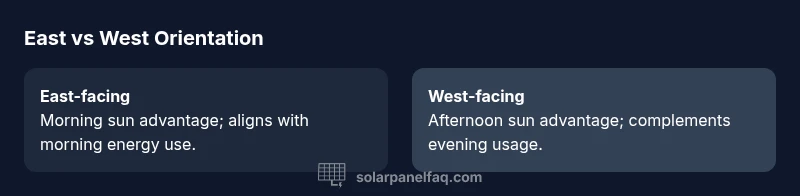
For many homes, the timing of electricity use matters as much as the total volume. East-facing panels tend to generate more energy in the morning hours, which can align with early-evening load growth as people start devices and small appliances. West-facing installations commonly produce more in the late afternoon and early evening. When you map your typical daily usage—breakfast, commutes, kitchen chores, streaming—the orientation that aligns production with your highest-need windows can reduce imported power and improve bill savings, even if the overall daily production is similar.
Tilt, shading, and roof geometry: why orientation isn't the only factor
Orientation matters, but it is not the sole determinant of performance. The panel tilt angle interacts with direction to shape the insolation you receive. If a roof has a steep pitch or limited south exposure, east or west can still deliver strong energy if the tilt is optimized and shading from chimneys, vents, or trees is minimized. Shading is the silent efficiency killer; a morning shade that touches east-facing panels can disproportionately reduce morning output, while afternoon shade can hit west-facing arrays harder. Careful site assessment helps separate direction from delivery.
Geographic and climate considerations by region
Different regions enjoy different sun patterns. In higher latitudes, the sun's path is low in the sky for a larger portion of the year, which can amplify the value of a well-tilted east or west array to capture sun when it is available. In hot, sunny climates, reducing peak afternoon heat load on the roof can be advantageous, making east-facing arrays appealing for morning cooling and energy use profiles. Coastal and windy areas may also present shading challenges from nearby structures or gusts that affect panel performance.
Case studies: typical homeowner scenarios
Case A: A two-story home with a long east-facing slope and a shaded west side. A design that uses a primary east-facing string with a smaller west-facing partial array balances morning generation with afternoon demand and can preserve roof space for ventilation and maintenance access. Case B: A single south-facing roof with limited space but heavy morning usage. Adding a secondary west-facing row can shift some production into the afternoon, improving overall alignment. Case C: A home equipped with a small battery and microinverters to smooth out the diurnal production curve across orientations.
Hybrid approaches: mixing orientations or using microinverters
If your roof geometry or shading profile makes a pure east or pure west design suboptimal, hybrid configurations offer a practical path forward. Split inverters or microinverters let each orientation perform independently, avoiding losses from mismatched strings. A hybrid layout can balance morning and afternoon production while still prioritizing key usage windows. Hybrid approaches also enable ongoing optimization as usage patterns change with seasons and lifestyle shifts.
Economic implications: cost, payback, and incentives
Orientation choice subtly influences economics by shifting when you generate electricity and how you use or export it. While the total annual production may be similar with a well-tuned tilt, the value of that energy depends on time-of-use rates, net metering policies, and local incentives. Homeowners should calculate not just upfront installation costs but also long-term savings from reduced grid purchases, potential storage, and any region-specific solar incentives. Solar Panel FAQ analysis notes that thoughtful orientation planning can improve value without a dramatic price premium.
How to assess your roof: a practical evaluation checklist
Start with a roof map: identify east-facing and west-facing surfaces, check for shading from trees or chimneys, and measure roof angles. Evaluate your daytime electricity usage—does it spike in the morning or evening? Consider whether a mixed orientation or a single-axis tracker might suit your space. Finally, plan a professional site assessment that includes inverter choice (string vs microinverters) and panel mounting options to optimize the expected energy profile.
The role of panel technology and mounting systems
Technology choices influence how effectively east or west orientations perform. Microinverters or power optimizers improve balance when multiple orientations share a system, while string inverters can still work with balanced layouts. Mounting hardware, including adjustable tilt rails and roof-penetration strategies, affects both performance and roof longevity. Some systems incorporate integrated optimizers to mitigate mismatches, helping maintain stable output across the day regardless of sun direction.
Common myths and misconceptions about east vs west orientation
Myth: East is always better because it captures the morning sun. Reality: West can be better for homes with heavy afternoon/evening usage. Myth: You must choose one direction for maximum output. Reality: Many homes benefit from a hybrid approach or optimized tilt to balance production. Myth: Orientation alone determines payback. Reality: System size, shade, panel efficiency, and storage options interact with direction to shape overall value.
Next steps for homeowners: decision framework and questions to ask installers
Create a decision framework that includes your daily energy usage, roof constraints, climate, and local incentives. Ask installers about recommended tilt, potential shading, and whether a mixed-orientation approach is viable. Request a detailed production profile for typical days in your climate, and discuss storage or demand-response options if you want to shift production to off-peak periods. A thorough site visit will align your roof orientation with your energy goals.
Comparison
| Feature | East-facing | West-facing |
|---|---|---|
| Sun exposure pattern | Morning sun predominance | Afternoon sun predominance |
| Best for energy-use alignment | Higher morning energy use | Higher afternoon/evening energy use |
| Total daily production (with optimized tilt) | Typically similar | Typically similar |
| Shading sensitivity | Morning shading impact more critical | Afternoon shading impact more critical |
| Best-in-class financial outcome | Dependent on usage and rate plans | Dependent on usage and rate plans |
| Installation considerations | Similar installation effort; guided by roof geometry | Similar installation effort; guided by roof geometry |
Strengths
- Flexible orientation options can fit irregular roof shapes
- Aligns production with user energy patterns to maximize savings
- Works well on roofs with limited south-facing exposure
- Allows design flexibility for mixed roof geometries
Drawbacks
- Potentially lower peak production in some climates compared to a pure south-facing setup
- May require more complex inverter configurations to balance output
- Shading and tilt optimization become more critical when mixing directions
East or West can be the right choice depending on home energy patterns and roof layout
When morning usage dominates, east shines; when evenings dominate, west performs better. In many cases, total annual output is similar with proper tilt and shading control. The Solar Panel FAQ team recommends a professional roof assessment to tailor orientation to your specific home.
Frequently Asked Questions
Is east or west better for solar panels?
It depends on energy usage patterns, roof geometry, and climate. Neither direction is universally superior; the best choice aligns production with the home's energy needs.
Depends on how you use electricity and your roof; neither direction is universally better.
Can I install both east and west facing panels on the same roof?
Yes, you can mix orientations to balance production across the day. This approach often requires a more flexible inverter setup, like microinverters or optimizers.
Yes—mixing orientations is common and can help balance daily production.
How does shading affect east vs west orientation?
Shading reduces output; the time of day shading occurs matters. East-facing panels can be more affected by morning obstructions, while afternoon shading can hit west-facing arrays harder.
Shading hurts output; morning shade hits east arrays first, afternoon shade hits west arrays.
Does latitude affect which side is better?
Latitude changes sun angle and the daily sun arc. In many regions, the traditional south-facing setup is prime, but east or west can complement that exposure depending on your usage and roof.
Latitude changes the sun angle; climate matters for direction choice.
Are microinverters helpful for east-west setups?
Yes, microinverters or optimizers help balance outputs when panels point in different directions, improving overall energy harvest.
Yes—microinverters can balance mixed orientations.
Is a tracking system worth it compared to fixed east/west?
Tracking systems can boost production but cost more and require maintenance. For most homes, fixed east or west with proper tilt and shading control is the more practical choice.
Tracking can increase output but costs more; fixed east/west is usually practical.
What if my roof is small?
Even small roofs can benefit from optimized tilt and a hybrid orientation, or adding microinverters to maximize the available area.
Small roofs can still be optimized with tilt and hybrid layouts.
Top Takeaways
- Analyze daily energy usage to pick orientation
- East=captures morning energy; West=afternoon energy
- Total annual production often similar with proper tilt
- Consider hybrid designs or microinverters for balance
- Consult a pro for roof-specific guidance