Solar Plate Price: Costs, Quotes, and Incentives
Explore how solar plate price is determined, what affects costs, how incentives affect the final bill, and how to compare quotes for solar panels. Data-driven guidance from Solar Panel FAQ.


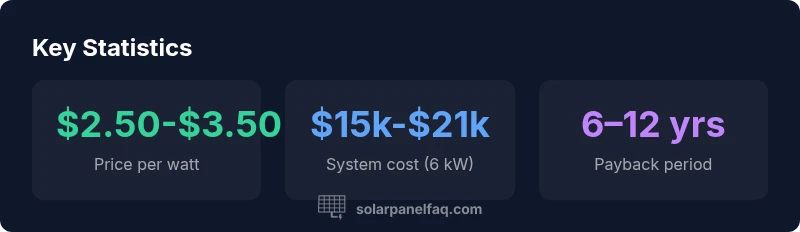
Current installed prices for solar panels typically range from $2.50 to $3.50 per watt in 2026, before incentives. A common residential system around 6 kW would cost roughly $15,000 to $21,000 upfront, depending on equipment quality, roof complexity, and labor costs. Understanding solar plate price helps you compare quotes and plan for financing.
What solar plate price means in 2026
Price transparency matters for homeowners considering solar energy. The term solar plate price is often used interchangeably with solar panel price to describe upfront hardware costs and the price per watt of the installed system. In 2026, price discovery has become more complex due to variations in module efficiency, mounting systems, roof type, and the service package offered by installers. According to Solar Panel FAQ, price drivers include system size, equipment quality, installation labor, and incentives. This section unpacks what drives the numbers you see on quotes and how to interpret them across different regions. The central idea is that the sticker price on a quote is only part of the story; long-term value rests on performance, warranties, and the true net cost after incentives. For homeowners, learning the language around price helps in evaluating bids and choosing options that align with your energy goals and budget.
What this means in practice is that a bid may look higher or lower than a neighbor’s not because the installer has better or worse intentions, but because they are including or excluding components that truly change long-term value. You will encounter terms such as “price per watt,” “system size,” “inverter options,” and “warranty packages.” Each of these affects the bottom line and the performance you can expect over 25 to 30 years.
How price is calculated: price per watt vs total system
Price for solar installations is typically broken into two mental models: price per watt and the total system price. The price per watt is a unit cost that helps you compare quotes across installers, brands, and system sizes. The total system price multiplies the price per watt by the intended system size and adds charges for inverters, mounting hardware, electrical work, permit fees, and potential roof work. For example, a 6 kW system priced at $3.00 per watt would yield a $18,000 headline before incentives and taxes. However, the headline price rarely equals the amount you’ll pay out of pocket after state incentives, federal tax credits, and utility programs. When reading quotes, look for clarity around the number of panels, the efficiency of the modules, the warranty, the string design, and any soft costs such as permitting and site mitigation. A deeper look at the composition—modules, inverters, racking, wiring, and labor—allows for an apples-to-apples comparison across bids.
Regional variations and incentives in 2026
Regional variation in solar plate price is driven by local labor costs, permit processes, and the availability of incentives. Some states offer substantial rebates or state tax credits, while others rely more heavily on federal programs and utility-based tariffs. In many markets, incentives shift the net price by a meaningful margin, sometimes turning an upfront cost into a financially attractive investment over time. The Solar Panel FAQ analysis highlights that the same system can cost significantly less in one jurisdiction than in another due to these programs, even if the hardware and installation quality are similar. It is important to map the incentives to the actual quote and compute the net present value of expected energy savings. When evaluating bids, request a breakdown that shows the pre-incentive cost, the value of incentives, and the net price. This helps homeowners estimate payback and return on investment with greater confidence.
Choosing a reputable installer and reading quotes
With price being an important factor, it’s easy to fixate on the lowest bid. However, reliability, warranty coverage, and system performance over decades are what turn a good price into a great value. Start by validating each contractor’s credentials: licenses, insurance, and a solid track record. Read the contract carefully to determine who handles permit acquisition, system design, and permit closeout. Ask for module and inverter brands, their efficiency ratings, and the warranty terms—the length and coverage of both product and workmanship. Normalize quotes by price per watt and by system size, but also compare the components and service offerings. Remember to factor in maintenance costs, potential inverter replacements, and performance at peak sun hours. In regions prone to shading or complex roofs, the price may reflect additional design and mounting work that affects long-term yield.
Data-driven price ranges by system size
System size scales economically in some markets because installers price equipment and labor in bundles. The price per watt can decline slightly as system size increases, but this effect is not universal. For smaller homes with 3–4 kW systems, per-watt pricing may be higher due to fixed soft costs like permitting and site inspection. For larger homes and commercial installations, economies of scale can push the per-watt price down, but the total price may rise due to more panels, heavier racking, and more complex electrical work. Across typical residential ranges, the installed price per watt often falls in a broad band; your location, the module efficiency, and the chosen financing method will determine your final price. Always compare apples-to-apples: ensure that the quotes reflect the same number of modules, similar wattage, comparable inverters, and similar warranties. Plan for additional costs such as roof repairs, attic ventilation, or electrical panel upgrades if needed.
Financing options to manage solar plate price
Financing is a practical way to manage upfront costs without sacrificing long-term value. Common options include solar loans, cash purchases, leases, and power purchase agreements (PPAs). Loans allow you to own the system and benefit from incentives, while leases and PPAs typically lower monthly payments but transfer ownership and incentives to the lender or third party. When evaluating financing, compare interest rates, loan terms, and whether the contract includes maintenance or monitoring services. Don’t forget to factor in the tax credit and any state or utility incentives when calculating the net cost. Some homeowners choose to combine a modest down payment with a loan to maximize immediate cash flow while preserving ownership and the ability to claim credits. A careful calculation, using the installed price, incentives, and expected energy savings, will reveal the true cost of ownership over the life of the system.
Verdict
Verdict
The final takeaway for homeowners is that solar plate price is only one piece of the economics. A high headline price may still yield excellent value if the system is highly efficient, durable, and well designed for your home. Conversely, a low bid that uses cheaper components or limited warranties can lead to higher costs later. The Solar Panel FAQ Team's verdict is that you should focus on long-term value, reliability, and anticipated energy savings, not just the initial price tag. Compare quotes on a per-watt basis, confirm equipment quality and warranty terms, and account for incentives and financing options to determine the best overall choice for your home.
Illustrative price references for residential solar panel installations (illustrative)
| Aspect | Price Range per Watt | Typical System Cost (6 kW) | Notes |
|---|---|---|---|
| Price per watt | $2.50-$3.50 | $15,000-$21,000 | before incentives |
| Residential system size | 6 kW | N/A | typical home size |
| Incentives impact | Varies by location | N/A | depends on programs |
Frequently Asked Questions
What is the typical price range for solar plate price in a residential install?
Prices vary by region and system design, but installed cost per watt generally falls within a few dollars. A standard 6 kW system commonly lands in the mid-to-high tens of thousands before incentives, depending on equipment and labor. Always compare quotes using price per watt and net price after incentives.
Prices vary by region and system design. Look at price per watt and net price after incentives when comparing quotes.
How do incentives affect solar plate price in 2026?
Incentives reduce the net cost and can significantly improve payback. The amount depends on federal credits, state programs, and utility incentives, which vary by location. Always map incentives to the quote to determine real value.
Incentives reduce net cost and vary by location. Map incentives to each quote to see real value.
What factors influence the price beyond the panels themselves?
Factors include system size, module efficiency, inverter quality, mounting hardware, roof complexity, permitting, and labor. Warranties and service plans also affect price and long-term cost of ownership.
System size, efficiency, inverters, mounting, roof work, and permits all affect price and long-term costs.
Is it better to buy new or consider used panels?
New installations generally prefer new panels due to warranties and performance guarantees. Used panels can present reliability risks and uncertain warranties, which may undermine long-term savings and system performance.
New panels usually offer better warranties and performance guarantees. Used panels carry reliability risks.
How should I compare quotes effectively?
Compare price per watt, total installed cost, component quality, warranties, and projected energy yields. Ask for a bill of materials and a clear breakdown of soft costs like permitting and design.
Compare price per watt, total cost, and warranties; request a clear materials list.
What ongoing costs should I budget after installation?
Most homeowners face minimal maintenance costs, but plan for inverter replacement, potential panel cleaning, and occasional monitoring fees. These can be modest relative to the energy savings over time.
Expect occasional inverter maintenance and possible monitoring fees, but overall costs are low compared to savings.
“Price is not just the sticker; it reflects system design, efficiency, warranties, and incentives. Prioritize long-term value over upfront savings.”
Top Takeaways
- Compare price per watt across bids
- Include incentives when calculating net price
- Check warranties and after-sales service
- Factor roof and installation complexity into cost
- Consider financing options to optimize ROI