Solar Panel Costs: How Much Do They Really Cost?
A detailed guide to residential solar panel costs, per-watt ranges, typical system sizes, incentives, and practical steps to estimate your bottom-line price.


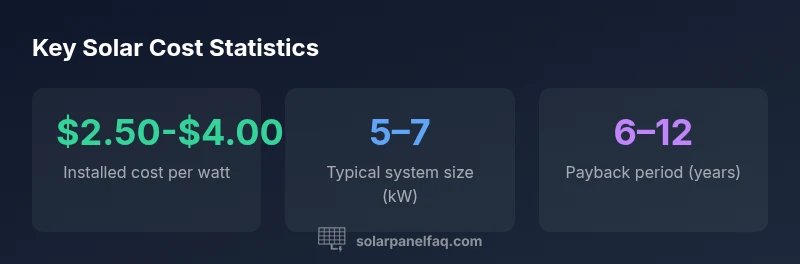
Residential solar panel installations typically cost about $2.50 to $4.00 per watt installed. For a typical 5–7 kW home system, expect roughly $12,500 to $28,000 before incentives. Final price depends on roof type, panel efficiency, inverter choice, mounting hardware, permitting, and installer labor. Federal and state incentives can significantly reduce the out-of-pocket cost, making financing an attractive option.
What homeowners mean by the question "solar panel how much"
When homeowners ask the question "solar panel how much", they are seeking a starting point for budgeting their home retrofit. The price tag is not a single number; it combines hardware, labor, and optional extras. Understanding this helps you avoid sticker shock and set realistic expectations before requesting bids. According to Solar Panel FAQ analysis, most residential projects fall within a broad per-watt range and a total installed price that reflects regional differences, equipment choices, and installer practices. This framing helps you compare apples to apples when evaluating bids and online quotes.
Beyond the headline price, consider how much value you want from the system: higher-efficiency panels often cost more upfront but can yield greater production in limited roof space and shady conditions. Conversely, standard-efficiency modules may deliver lower upfront costs but require a larger array to meet the same energy targets. The overarching goal is to align system size and quality with your electricity usage, roof constraints, and long-term plans (such as battery storage or selling excess power back to the grid).
Breaking down the cost: hardware, labor, and ancillary charges
A residential solar install is a sum of parts, not a single line item. The hardware envelope includes solar modules, an inverter (or microinverters), racking/mounting hardware, DC to AC conversion, wiring, and monitoring equipment. Labor costs cover roof penetrations, electrical conduit runs, system connection to the grid, and the final commissioning. Ancillary charges such as permitting, inspections, interconnection fees, tree trimming, and possible roof repairs can also influence the final price. While module price has trended downward in many markets, labor and permitting frequently drive year-to-year price swings. Keeping bids apples-to-apples means requesting itemized quotes that show module brand, warranty terms, inverter type, and mounting hardware. In many regions, this breakdown helps homeowners anticipate soft costs that can otherwise surprise them at the closing stage.
Equipment choices and their price impact
Panel efficiency, color, and warranty terms directly influence price. Monocrystalline panels typically command higher prices than polycrystalline due to higher efficiency, better performance in low-light conditions, and longer warranties. Inverters also matter: string inverters are common and cost-effective, while microinverters or power optimizers may increase upfront costs but can improve shading performance and system yield on complex roofs. Mounting options (ballasted, flush-mounted, or dual-axis tracking in some cases) add further cost layers. While higher-efficiency modules can reduce the physical footprint, the cost-per-watt advantage depends on roof space, orientation, and aesthetic preferences. When evaluating bids, compare not just price but efficiency, warranty coverage, and expected energy yield over the system’s life.
Regional variation: how location changes price
Geography shapes solar pricing through labor rates, permitting fees, interconnection charges, and net metering policies. Coastal or urban areas with higher contractor overhead often show higher installed costs, while rural regions may offer lower labor rates but longer travel times for installers. Roof types and shading patterns—such as tall trees or neighboring structures—can require more mounting hardware or longer cabling, adding to the price. In some regions, local incentives or utility programs also alter the effective cost after credits, rebates, and time-of-use rate considerations. Always tailor your budget to your location while using national averages as a guide.
Incentives, credits, and financing: reducing the upfront cost
Incentives are a core part of the economics of solar. The federal investment tax credit (ITC) and state or utility programs can substantially cut the net cost, often bringing the upfront expense down by a meaningful percentage. Financing options such as loans, leases, or power purchase agreements (PPAs) can also reshape the affordability equation by spreading payments over time or reducing initial cash outlay. When chasing incentives, coordinate timing with permit approvals and interconnection deadlines to maximize a beneficial blend of credits and quotes. Always verify current program availability with your installer and local government resources before committing.
How to estimate costs for your home: a practical workflow
Start with a household energy assessment to identify current usage, preferred monthly bills, and potential load reductions. Use online solar calculators to generate a preliminary system size and cost estimate based on your address, roof orientation, shading, and panel type. Collect bids from at least three installers, ensuring each bid includes a detailed bill of materials, labor, and soft costs. Ask for a side-by-side comparison of warranties, expected annual production, and maintenance needs. Near the end, calculate net costs after incentives and project a simple payback scenario under current electricity rates. This disciplined approach reduces surprises later in the process.
Estimated cost and payback across common residential sizes
| Scenario | Typical System Size (kW) | Installed Cost Range (USD) | Estimated Payback (years) | Key Considerations |
|---|---|---|---|---|
| Small Roof (3 kW) | 3 | "$7,500-$12,000" | "6-12" | Limited space, lower production |
| Mid-size (5 kW) | 5 | "$12,500-$20,000" | "7-11" | Balanced output and cost |
| Large (7 kW) | 7 | "$17,500-$28,000" | "8-12" | Higher energy production |
| Extended (10 kW) | 10 | "$25,000-$40,000" | "9-14" | Maximize offsets |
Frequently Asked Questions
What is the typical installed cost per watt?
Prices typically range from about $2.50 to $4.00 per watt installed, depending on equipment quality, roof complexity, and regional labor costs.
Prices usually run from two and a half to four dollars per watt installed, depending on your area and choices.
Do roof type and orientation affect price?
Yes. Steep slopes, complex angles, or difficult access can raise labor time and hardware needs, increasing overall cost without changing baseline module price.
Roof complexity can push costs up due to extra labor and gear.
How do incentives affect the out-of-pocket cost?
Federal, state, and utility incentives can significantly reduce upfront costs; the exact savings depend on your location and program rules.
Incentives can cut the upfront cost a lot, depending on where you live.
What should I ask when comparing bids?
Ask for explicit module type and efficiency, inverter options, warranties, included labor, interconnection steps, and whether soft costs are included.
When you compare bids, check equipment details, warranties, and total charges.
Is a larger system always worth it?
Not always; oversizing based on current usage may waste money. Align system size with typical electricity consumption and future plans.
Size it to your usage to avoid overspending.
How long does it take to recoup costs?
Payback varies with usage and incentives, but a typical residential range is six to twelve years.
Most homes see break-even in about six to twelve years, depending on incentives and rates.
“In residential solar, price is driven by system size, equipment quality, and installer efficiency. A well-structured bid helps homeowners avoid paying for unnecessary extras.”
Top Takeaways
- Budget for system size based on energy usage
- Per-watt prices cover hardware, install, and labor
- Incentives and financing dramatically reduce upfront cost
- Shop multiple bids and verify components
- Expect regional variation in price and timeline