Solar Panel Types and Prices: A Practical Home Guide
Explore the main solar panel types, their price ranges per watt, and the factors that drive total installation costs. A data-driven guide by Solar Panel FAQ to help homeowners choose the best option for their roof and budget.


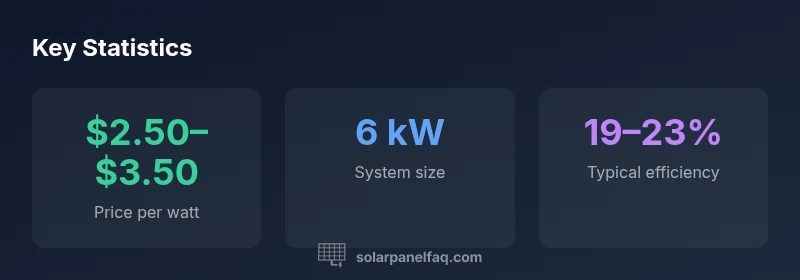
Prices for residential solar panels typically range from $2.50 to $3.50 per watt installed, before incentives, with total system costs often lying in the $12,000 to $25,000 range for a mid-size home. The choice of panel type—mono-, poly-, thin-film—and roof characteristics influence both price and long-term value. This article, based on Solar Panel FAQ Analysis, 2026, explains how to compare options, estimate costs, and choose the right panel type for your roof, weather, and budget.
Solar Panel Types and Prices: Why It Matters for Homeowners
According to Solar Panel FAQ, understanding the differences between solar panel types and how prices are set is essential for homeowners seeking value and predictability. The main price drivers are panel efficiency, system size, roof orientation and shading, mounting hardware, inverter selection, and local incentives. By decoding these variables, you can estimate total costs, compare offers, and avoid sticker shock. This guide frames the decision around real-world constraints like roof space, climate, and long-term performance rather than chasing the highest efficiency. You’ll see how early-stage planning, including roof inspection and shading analysis, translates into tangible dollar saved over the system’s lifetime. The goal is to help you select a configuration that aligns with your goals, whether you prioritize space efficiency, aesthetics, or payback speed.
Solar Panel Types at a Glance
There are several established categories, each with unique trade-offs:
- Monocrystalline (mono): the highest efficiency and compact physical footprint, typically offering strong performance in limited space but at a premium price.
- Polycrystalline (poly): solid performance at a lower cost per watt, with slightly lower efficiency and bigger area requirements.
- Thin-film: flexible or lightweight options with lower efficiency but sometimes lower upfront costs, useful for unusual rooftops or large areas.
- Building-integrated (BIPV) and specialty panels: integrated into architecture or designed for unique applications, usually at higher costs but with design synergy.
Every category can meet different homeowner needs, and incentives can shift the economics enough to change which option is most attractive. For a practical start, map your roof area, budget, and climate to these categories and then compare quotes on a watts-per-dollar basis.
Monocrystalline Panels: Efficiency and Cost
Monocrystalline panels are the workhorse of many residential installs. They boast the highest efficiency ranges typically between 19% and 23%, which means more power from less roof space. Because of this efficiency premium, mono panels usually carry a higher price per watt than polycrystalline options. The cost premium is often justified for homeowners with limited roof area, high sun exposure, or a desire for a sleeker, uniform look. In regions with strong sun, mono panels can maximize energy generation in a small footprint, reducing the number of panels needed. The trade-off is that the upfront investment is higher, but long-term payback can be improved through better performance and potential savings on mounting hardware and space utilization.
Polycrystalline Panels: Pros, Cons, and Price Range
Polycrystalline panels offer a favorable balance between cost and performance. Efficiency typically ranges from 15% to 18%, with lower manufacturing costs leading to a lower price per watt. For many homeowners, polycrystalline panels deliver strong value, especially when roof space is ample and budget constraints are a consideration. The main downside is a slightly larger physical footprint for the same energy output and the potential for more noticeable color variation. In markets with favorable incentives, the total installed cost per watt can be compelling, making poly panels a practical default choice for many new solar projects.
Thin-Film Panels: When They Make Sense
Thin-film panels trade some efficiency for flexibility, light weight, and potential cost advantages in certain installations. Typical efficiency ranges from 10% to 12%, and the best performance often occurs when large, uninterrupted roof areas are available and shading is minimal. Thin-film panels can be attractive for flat rooftops, temporary installations, or architectural projects where weight or airflow considerations are critical. However, they generally require more roof area to achieve the same energy output as crystalline panels, which can increase land use and mounting complexity. For most standard homes, thin-film is less common, but it remains a viable option in special cases where space constraints are less critical and the design goal favors flexibility.
Building-Integrated and Specialty Panels: Costs and Use Cases
Building-integrated photovoltaics (BIPV) and specialty panels merge solar generation with architectural elements like facades, skylights, or glass roofs. These solutions appeal to design-conscious homeowners and builders who want energy generation without compromising aesthetics. The trade-off is cost: BIPV tends to carry a premium per watt and often requires specialized installation and ongoing maintenance. For remodeling projects or new construction where appearance is a central concern, BIPV can deliver a seamless look while still providing useful energy, though the economics require careful planning and designer involvement.
How Prices Break Down: Region, Roof, and Incentives
Solar panel pricing is not a one-size-fits-all figure. Local labor rates, permitting requirements, and roof complexity substantially influence final installed costs. A roof with multiple angles, tiles, or limited roof space will generally drive up hardware and installation time. In contrast, homes with straightforward roofs in sunny climates tend to see lower per-watt costs due to shorter installation times and higher energy output potential. Incentives—federal credits, state programs, and utility rebates—can dramatically alter the net cost. A critical step is to obtain multiple bids that clearly itemize panels, inverters, racking, wiring, and interconnection fees. When comparing offers, calculate the per-watt price and the expected annual energy production to estimate payback more accurately.
Estimating Your Costs: A Simple Framework
A practical approach starts with your desired system size and available roof area. Estimate annual energy consumption and match it to a system size that can reliably cover a portion or all of that usage. Then, apply the per-watt price ranges to determine a rough installed cost: multiply the system size (in kW) by 1000 to convert to watts, then multiply by the price per watt. Don’t forget to include inverter costs, mounting hardware, permits, and monitoring options. Finally, account for incentives and potential financing costs. The result is a realistic net cost and a defensible payback period you can discuss with installers.
How to Choose: Scenarios and Next Steps
Consider three homeowner scenarios to illustrate decision-making:
- Small roof, sunny climate, limited budget: Mono panels may offer the best space efficiency and payback, despite a higher upfront cost.
- Large roof, moderate budget, emphasis on total value: Polycrystalline panels provide solid performance at a favorable price per watt, balancing space and output.
- Architectural project or flat roof with design goals: Explore BIPV or specialty panels for aesthetics and integration, accepting a higher upfront investment for long-term value.
Next steps include conducting a shading analysis, evaluating a few bids with per-watt costs, and checking warranties for panels and inverters. Solar Panel FAQ suggests prioritizing system design quality and long-term performance over the lowest upfront price, especially when incentives and maintenance considerations come into play.
Comparison of solar panel types by efficiency, price, and ideal use
| Type | Typical Efficiency | Typical Price Range per Watt | Best Use Case |
|---|---|---|---|
| Monocrystalline | 19–23% | $0.40–$0.75 | Small roofs, high efficiency |
| Polycrystalline | 15–18% | $0.30–$0.60 | Budget-conscious installs |
| Thin-Film | 10–12% | $0.25–$0.50 | Large roofs, flexible surfaces |
| BIPV (Building-Integrated) | Varies widely | $1.00–$2.50 | Architectural remodeling projects |
Frequently Asked Questions
What are the main solar panel types and how do they differ?
The main types are monocrystalline, polycrystalline, thin-film, and building-integrated panels. Mono offers the highest efficiency but at a higher price. Poly is typically cheaper with slightly lower efficiency. Thin-film provides flexibility and lower weight but lower efficiency. BIPV integrates panels into building materials for aesthetics but at a premium.
The main solar panel types are mono, poly, thin-film, and BIPV. Mono is the most efficient but pricier; poly is a good value; thin-film adds flexibility, and BIPV blends with architecture.
Are thin-film panels worth considering for home rooftops?
Thin-film panels can be attractive for very large or non-traditional rooftops where space isn’t a limiting factor, or where weight and flexibility are important. They are generally less efficient than crystalline panels, so you may need more space to meet the same energy output.
Thin-film can be useful on large, unconventional rooftops, but you’ll likely need more space for the same output.
How does system size influence installed costs per watt?
Prices are typically lower on a per-watt basis for larger systems due to economies of scale. However, a larger system requires more roof space and structural considerations, which can offset some savings.
Bigger systems often cost less per watt, but you’ll need more space and proper setup.
What incentives affect solar panel pricing today?
Incentives vary by location and can include federal credits, state or utility rebates, and solar renewable energy certificates. They reduce net cost and can shorten payback. Check local programs before finalizing bids.
Incentives reduce net cost and shorten payback; check local programs before deciding.
What is a typical payback period for residential solar?
Payback periods generally range from about 6 to 12 years depending on system size, orientation, shading, energy usage, and incentives. Higher-efficiency gear or favorable incentives can shorten this period.
Payback usually between 6 and 12 years, depending on several factors including incentives.
How long do solar panels last?
Most solar panels come with 25-year warranties and can continue to produce meaningful energy beyond that, albeit at reduced efficiency. Proper maintenance helps preserve performance over time.
Most panels last 25 years or more with some decline in output over time.
“Choosing the right solar panel type is a balance between roof space, local climate, and budget. Efficiency matters, but how the system is designed and installed drives real-world performance.”
Top Takeaways
- Compare price per watt across technologies to gauge value
- Consider roof area and shading as core constraints
- Incentives can dramatically improve net costs
- Warranties and inverter life matter for long-term value
- The Solar Panel FAQ team recommends balancing upfront cost with system design