Solar Panel Spec Sheet: Read, Compare, and Choose with Confidence
Learn to read solar panel spec sheets, compare core metrics, and choose panels that fit your roof, climate, and budget, with practical warranty guidance.


A solar panel spec sheet is the official datasheet that lists every key electrical and physical parameter for a module. It helps homeowners compare performance, compatibility, and warranties, and it sets expectations for real-world output when combined with climate and installation factors.
What a solar panel spec sheet covers
A solar panel spec sheet is the formal document that details the electrical and physical characteristics of a module. It lists the rated power (Pmax), open-circuit voltage (Voc), voltage at maximum power (Vmp), short-circuit current (Isc), and current at maximum power (Imp). It then adds efficiency, temperature coefficients, tolerances, and warranty terms. In addition to electrical data, the sheet provides physical dimensions, weight, mounting hole spacing, frame material, glass type, and connector information. For homeowners, these numbers enable energy yield estimates, inverter and racking compatibility checks, and roof-fit considerations. While many people use the terms spec sheet and datasheet interchangeably, the exact wording can vary by manufacturer. Reading under standard test conditions (STC) and noting derate factors—such as NOCT (nominal operating cell temperature)—helps translate lab numbers into real-world performance. The Solar Panel FAQ team emphasizes cross-checking figures across multiple models to avoid surprises during installation.
Key metrics and how they relate to performance
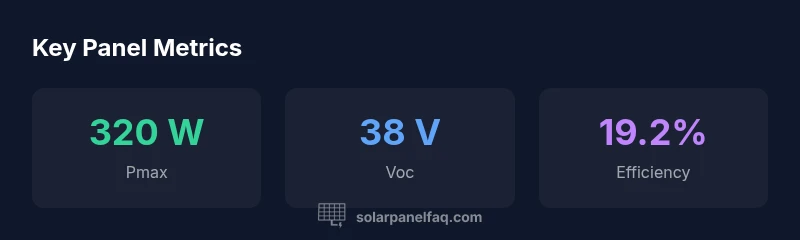
Understanding the core metrics on a spec sheet is essential for meaningful comparisons. Pmax represents the panel’s maximum power output under STC, while Voc is the highest voltage the panel can produce when not connected to a load. Vmp is the voltage where the panel delivers its Pmax, and Isc is the short-circuit current when a load is minimal. Imp corresponds to the current at Pmax. Efficiency indicates how effectively sunlight is converted into electricity per unit area, which matters for space-constrained roofs. Temperature coefficients show how voltage, current, and power change with temperature; higher coefficients mean larger performance losses in heat. Tolerances reveal the possible deviation from nominal Pmax, typically expressed as a percentage. Certifications (IEC, UL) and warranty terms indicate reliability and longevity. When climate and irradiance vary, these numbers guide real-world expectations and help you select panels that meet your climate needs.
How to read a spec sheet: a practical walkthrough
Start with the Pmax value to gauge baseline power. Then verify that Voc and Vmp fall within your inverter’s input voltage window across temperature ranges, including cold starts. Check Isc and Imp to ensure wiring and junction boxes can safely carry the required current. Compare efficiency and temperature coefficients to predict performance in your climate—if you live in a hot region, a lower temperature coefficient can be favorable. Review physical dimensions, weight, and mounting details to ensure a proper fit on the roof and in the racking system. Finally, study the warranty wording and certification marks to understand protection against defects and long-term degradation. This process helps you select modules that align with your energy goals and budget.
Example comparison: generic models A vs B
Consider two generic panels from a side-by-side spec sheet. Model A might offer 320 W with 18% efficiency and lighter weight, while Model B delivers 360 W with 19.2% efficiency but heavier framing. Although Model B provides more power, confirm its Voc and Vmp fit your inverter and rooftop voltage constraints. Temperature coefficient and derating factors should also be weighed against climate expectations. This demonstrates why a spec sheet is a starting point for system design, not the sole determinant.
Practical tips for interpreting spec sheets in real-world installs
Use spec sheets to size the array for your inverter’s voltage and current limits, accounting for series and parallel configurations. In shaded or partially shaded roofs, the benefit of higher efficiency can be outweighed by higher losses due to non-uniform illumination. Always compare multiple models under the same test conditions, and check for updated data if a model year changes. Consider the total array weight for structural load, and plan for proper ventilation to avoid heat buildup. Finally, align the sales terms with installation plans: longer warranties are valuable, but ensure they are backed by a solid performance warranty with clear degradation expectations.
Representative spec comparison for generic modules
| Model Type | Pmax | Voc | Vmp | Isc | Imp | Efficiency | Weight |
|---|---|---|---|---|---|---|---|
| Model A (generic) | 320 W | 38 V | 30.2 V | 9.0 A | 9.6 A | 18.0% | 25 kg |
| Model B (generic) | 360 W | 40 V | 31.4 V | 9.5 A | 11.5 A | 19.2% | 28 kg |
Frequently Asked Questions
What is included on a solar panel spec sheet and why is it important?
A spec sheet lists Pmax, Voc, Vmp, Isc, Imp, efficiency, temperature coefficients, tolerances, and physical dimensions, plus warranty and certifications. These figures let you compare modules and verify compatibility with your inverter and roof. Always cross-check STC values and real-world conditions.
A spec sheet shows the panel’s power, voltage, current, and physical size, plus how it performs in heat. Use it to compare modules and ensure fit.
What is the difference between Voc and Vmp?
Voc is the open-circuit voltage when no load is connected; Vmp is the voltage at which the panel delivers its maximum power. In system design, you must ensure the inverter’s input voltage range can accommodate Vmp under expected conditions, including cold starts.
Voc is the no-load voltage; Vmp is the power point voltage. Check both against your inverter’s range.
Why do spec sheets include temperature coefficients?
Temperature coefficients show how voltage, current, and power change with temperature. In hot climates, panels can lose output; a lower coefficient means less performance drop as temperatures rise.
Temperature coefficients tell you how much power changes with heat; lower numbers are better in hot climates.
How can I estimate real-world output from a spec sheet?
Start with Pmax and adjust for derating factors: shading, orientation, temperature, and system losses. Use performance warranties as a guide and consider NOCT-derived estimates for more realistic results.
Use Pmax and adjust for shading, orientation, and temperature to estimate real output.
Do spec sheets vary by manufacturing lot or model year?
Yes. Minor variations can occur between lots and model years. Always compare the actual lot-specific data when available and check for updates from the manufacturer.
Yes, look for lot-specific data and model-year notes when possible.
“Spec sheets provide the foundational numbers you need to compare modules, but real-world output depends on installation, climate, and shading.”
Top Takeaways
- Always compare Pmax and Vmp with your MPPT range.
- Review warranty terms before purchase to ensure long-term protection.
- Check temperature coefficients for climate-specific performance.
- Verify physical fit (dimensions and weight) for roof compatibility.