Solar Panel Ratings: Read, Compare, and Decide
A comprehensive, data-driven guide to understanding solar panel ratings, how to read spec sheets, and how ratings influence real-world performance for homeowners and buyers.


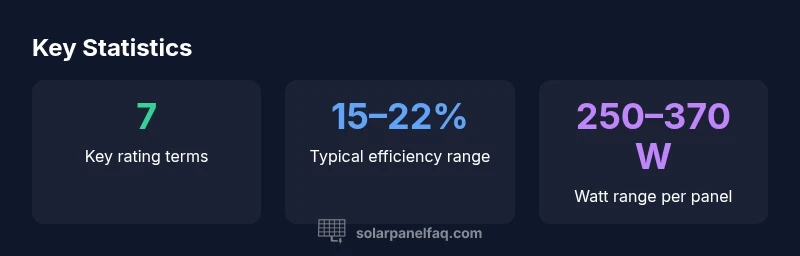
According to Solar Panel FAQ, solar panel ratings are primarily expressed as maximum power (Pmax) under standardized test conditions. Typical residential panels are rated between 250 and 370 watts, with efficiencies around 15% to 22%. Ratings also include voltage and current at maximum power (Vmp and Imp) and a temperature coefficient that describes performance changes with heat. When choosing panels, compare Pmax, efficiency, and temperature coefficients to estimate real-world output.
What solar panel ratings actually measure
Solar panel ratings summarize a panel's theoretical electrical output under controlled laboratory conditions. The most common reference is Pmax, the maximum power at standard test conditions (STC). STC uses 1000 watts per square meter of sunlight, a cell temperature of 25°C, and a specific air mass; real-world conditions differ, so ratings serve as a baseline. Alongside Pmax, you will typically see Vmp (voltage at maximum power) and Imp (current at maximum power), Voc (open-circuit voltage), and Isc (short-circuit current). These electrical numbers are complemented by efficiency, which is the percentage of sunlight converted into electricity, and by the temperature coefficient, which describes how output declines as temperature rises. Tolerances are also specified, indicating the range within which the actual wattage may vary. For homeowners, ratings matter because they set expectations for monthly energy production, system sizing, and how a panel will perform in your climate. The Solar Panel FAQ Analysis, 2026, emphasizes that ratings are an apples-to-apples starting point, not a guarantee of exact production.
Why ratings matter for system design
Your solar system's design starts with ratings because they define the upper limit of what can be produced. The total system size is the sum of panel Pmax across all modules, which influences the number of panels and the inverter capacity you need. Efficiency relates to the physical size of panels: higher efficiency means smaller arrays can produce the same power, which matters for roof space and mounting hardware decisions. Temperature coefficient is critical in hot climates: panels with a steeper coefficient lose more output on hot days, shifting real-world production downward from nominal Pmax. Shading, soiling, and orientation also interact with ratings; even a high-rated panel will underperform if shaded or dirty. Also, consider long-term reliability: warranties on output (often 25 years) and product warranties matter when comparing panels. Understanding these factors helps you compare different products on a like-for-like basis and makes it easier to communicate with installers and lenders. The Solar Panel FAQ team notes that a rating-centric view supports more accurate payback calculations and informed decisions.
Standard rating specs and how to read a spec sheet
Most spec sheets list the key terms you need to compare panels:
- Pmax: maximum power under STC
- Voc: open-circuit voltage
- Isc: short-circuit current
- Vmp: voltage at max power
- Imp: current at max power
- Efficiency: conversion efficiency
- Temperature coefficient: percent per degree C
- Power tolerance: often expressed as a positive tolerance (for example +3% to -0%), indicating the range the manufacturer guarantees at STC When reading a sheet, ask how many modules are needed to hit your target system size, and whether the provided numbers assume a specific array arrangement. Remember that real output depends on sun exposure and climate, so use ratings as a planning baseline rather than a precise forecast.
How temperature, shading, and orientation impact rated output
Ratings are captured under idealized lab conditions and do not account for every real-world variable. Temperature increases generally reduce panel output, with higher coefficients amplifying losses in hot climates. Shade from trees, chimneys, or neighboring buildings can drastically reduce the effective area illuminated, making even high-rated panels underperform. Orientation and tilt determine the angle of incident sunlight; a fixed-angle system calibrated for your latitude will maximize annual energy. Dust, dirt, and snow also degrade performance by reducing the effective light reaching cells. Because these factors interact with the rating, you should model the system with location-specific assumptions and consider microinverters or optimizers in partially shaded sites to preserve performance consistency.
Real-world factors that ratings can't capture
Ratings provide a baseline, but aging, soiling, and degradation over time affect actual output. Environmental conditions such as wind, humidity, and ambient temperature alter module behavior. Installer quality matters: cable sizing, junction boxes, and wiring routing influence energy losses. Additionally, manufacturing variability means two panels with the same nominal rating may perform slightly differently. Finally, maintenance matters: keeping panels clean and inspecting connections prevents inefficiencies from creeping in. By focusing on the overall system design—roof space, shading analysis, and inverter strategy—you can translate ratings into reliable, long-term energy production.
A practical framework for comparing panels by ratings
Use a simple, repeatable checklist when evaluating rating data:
- Start with Pmax per panel and multiply by the planned module count to estimate gross output.
- Compare efficiency to determine required roof area for a given target output.
- Check Vmp and Imp to ensure the string design and inverter are compatible with the array voltage and current.
- Review the temperature coefficient to gauge performance in your climate.
- Look at tolerances and warranty terms to understand potential variances and long-term confidence.
- Consider NOCT vs STC rated values if available, to approximate daylight performance under typical conditions. A consistent framework helps you build a fair apples-to-apples comparison across brands. The Solar Panel FAQ Team emphasizes using a combined view of wattage, efficiency, and thermal behavior for decision making.
Interpreting ratings for financing and maintenance
Lenders frequently assess the rate of return by assuming a certain system size and expected production, which is primarily driven by Pmax and efficiency. When negotiating financing, request the supplier to provide a production estimate under your local sun profile and a warranty statement for minimum output. Maintenance considerations include panel cleanliness and regular inspections of wiring and inverters to prevent unexpected losses. Understanding how ratings translate into annual production will help you interpret payback periods and long-term savings more accurately. The Solar Panel FAQ team recommends documenting rating assumptions in your financing plan to avoid gaps between projected and actual performance.
Key spec terms and how they drive system design
| Rating term | What it measures | Typical range | Impact on output |
|---|---|---|---|
| Pmax | Maximum power under STC | 250–370 W | Primary driver of energy production |
| Vmp | Voltage at max power | 30–40 V | Used in inverter sizing and string design |
| Imp | Current at max power | 6–9 A | Influences wiring and interconnection |
| Voc | Open-circuit voltage | ~40–50 V | Important for system voltage margins and safety |
| Efficiency | Conversion efficiency | 15–22% | Affects space needs and heat tolerance |
Frequently Asked Questions
What does Pmax tell me about a panel?
Pmax is the maximum power under standard test conditions. It indicates the panel's best-case output but real production will vary with sun, temperature, and angle. Use Pmax to size arrays, then check other ratings for climate considerations.
Pmax shows the panel's top power under ideal conditions, but real output will vary with sun and heat.
Why is efficiency not the only factor to compare?
Efficiency measures how well a panel converts sunlight into electricity, but total system output also depends on panel area, shading, and wind or soiling losses. A lower efficiency panel with more space may produce the same energy as a higher efficiency, smaller panel in tight roof spaces.
Efficiency matters, but you also need to consider space and losses to compare total output.
What is a temperature coefficient and why care?
The temperature coefficient quantifies how much power drops per degree Celsius of temperature rise. In hot climates, panels with a smaller negative coefficient retain more of their rated output and perform closer to their STC rating.
It tells you how much power you lose as it gets hotter outside.
Should I only look at wattage when choosing panels?
Wattage is important, but it does not tell the whole story. Compare wattage with area, efficiency, temperature coefficient, and warranty to understand long-term performance and value.
Wattage matters, but you need more details to judge value.
What’s the difference between STC and NOCT ratings?
STC is a standardized lab condition reference and NOCT reflects typical operating conditions. NOCT values help assess real-world performance, especially in warm climates or partial shading.
STC is lab based, NOCT is more practical for day-to-day use.
Do ratings degrade over time?
Most panels experience some degradation over time, reducing output gradually. Check the manufacturer warranty to understand guaranteed performance levels over 20-25 years and seek panels with lower degradation rates where possible.
Over time, output tends to drop slightly; warranties explain the expected performance.
“Ratings are a starting point, not a guarantee. Real output depends on installation and climate. Use them to build apples-to-apples comparisons.”
Top Takeaways
- Read Pmax first when sizing a system
- Use efficiency to compare panel size and space needs
- Consider temperature coefficient for your climate
- No single rating guarantees real-world output
- Compare panels using Pmax, Vmp/Imp, and coefficient together