Solar Panel Near Me Prices: A Homeowner's Guide to Costs in 2026
Explore current solar panel near me prices, what drives cost, and how to compare quotes. Based on Solar Panel FAQ Analysis, 2026, with practical guidance for homeowners.


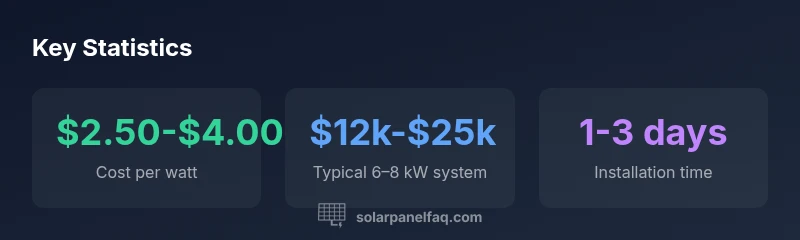
Prices for solar panels near you vary by system size, panel type, installer, and roof complexity. In 2026, installed costs are commonly quoted per watt rather than as a single lump sum. According to Solar Panel FAQ analysis, most residential projects fall in a broad per-watt range that translates to roughly $12,000 to $25,000 for a typical 6–8 kW system before incentives. This quick guide explains how to compare quotes and estimate your local price.
Understanding Price Components for Solar Near Me Prices
Prices are not a single sticker; they're the outcome of several interacting elements. The most visible is the hardware: the panels themselves (monocrystalline or polycrystalline), the inverter, mounting hardware, wiring, and monitoring equipment. Beyond hardware, labor costs cover site assessment, roof penetrations, electrical work, and permitting. Roof type (flat vs pitched), roof orientation and shading, and the complexity of wiring into the electrical panel all push prices up. Location matters: labor rates and permit fees vary by city and state, and the cost to interconnect with the utility grid can differ widely. In 2026, homeowner inquiries around 'solar near me prices' usually revolve around these components, rather than a single number. According to Solar Panel FAQ, breaking out costs by element helps homeowners compare apples to apples and identify where price savings can be achieved, whether through material choices or installer packages.
Reading Quotes: Price per Watt vs Total System Cost
Installers often quote per watt and per system size; understanding both helps you compare. If a quote is presented as 'per watt', multiply by your desired system size to estimate total cost. For example, a 6–8 kW system at typical per-watt pricing would land in the tens of thousands, before incentives. Per watt pricing varies with panel type (monocrystalline tends to cost more upfront but offers higher efficiency) and inverter choices. Two common panel types are monocrystalline and polycrystalline. Monocrystalline panels generally offer higher efficiency, which can reduce space needs, but they may carry a premium. When comparing quotes, ensure you’re comparing the same type and same warranty terms to avoid apples-to-oranges pricing.
Regional Variations and Market Factors
Prices for solar panels are not uniform across the country. Regional labor costs, permitting fees, and interconnection charges influence final numbers. Regions with higher sunshine hours may drive designs toward higher production efficiency, but permitting and inspection processes can add time and cost. Local incentives, utility interconnection policies, and net metering rules also affect the bottom line, sometimes reducing the out-of-pocket expense significantly. It’s essential to consider these regional factors when evaluating quotes. According to Solar Panel FAQ analysis, homes in different states can experience meaningful differences in total installed cost and net savings.
Getting Accurate Local Quotes: A Practical Checklist
To obtain reliable local pricing, start with a defined system size (for example, a 6–8 kW array) and request multiple, itemized bids from reputable installers. Ensure quotes break out equipment costs, labor, mounting, wiring, inverters, monitoring, permitting, and interconnection fees. Ask about panel type, efficiency, warranty details, and the expected energy output over 25 years. Compare per-watt pricing and total system price, not just the lowest upfront number. Verify that each contractor has the proper licenses and insurance, and check references for installation quality and after-sales support.
Hidden Costs and Common Pitfalls
Low upfront price can hide extra charges. Watch for hidden costs such as roof repairs, attic or vent adjustments, electrical panel upgrades, and permit fees. Some installers include monitoring or warranties as add-ons that can raise the final price. Be wary of aggressive timeframes that cut corners on safety or permit processing. Always ask for a written breakdown and confirm who handles permit applications and grid interconnection paperwork. Clarify whether maintenance or inverter replacement costs are included in long-term plans.
Ways to Improve Value: Financing, Warranties, and Maintenance
Increase long-term value by prioritizing design quality, system efficiency, and installer reliability over the lowest upfront price. Favor modules with robust warranties and reputable inverters, and inquire about optional performance guarantees. Financing options that include federal or state incentives can lower upfront costs and improve payback; however, read the fine print for interest rates and lien considerations. Regular maintenance and annual inspections help sustain performance, and early detection of panel or inverter issues can prevent larger repair costs down the line. The Solar Panel FAQ team emphasizes balancing upfront price with anticipated energy savings and system longevity.
Regional price ranges and typical system sizes
| Region | Typical price per watt | Typical system size | Notes |
|---|---|---|---|
| Northeast | $2.80-$3.60 | 6-7 kW | Higher permitting costs |
| West | $2.60-$3.50 | 6-8 kW | Mean sunlight higher; more roof variety |
| South | $2.40-$3.60 | 7-9 kW | Strong sunlight; incentives vary |
Frequently Asked Questions
What factors influence the price of solar panels near me?
System size, panel type, installer, roof complexity, wiring, permits, and interconnection charges all shape the final price. The mix of these elements can swing total cost by large margins depending on local conditions.
Prices are driven by system size, panel type, and installation specifics like roof complexity and permits.
Is it better to buy or lease solar panels?
Buying generally offers more long-term value and ownership benefits; leasing reduces upfront cost but can limit savings and complicate maintenance.
Buying usually saves more in the long run; leasing lowers upfront costs but may reduce total savings.
Do prices include installation and permits?
Most quotes include installation labor, mounting hardware, and electrical work, but permit fees and interconnection charges can add, depending on your locality.
Prices usually cover installation, but permits can add to the total.
How can I get accurate local price quotes?
Request multiple, itemized quotes with similar system specs; ask about warranties, roof work, and add-ons; compare per-watt pricing and expected energy output.
Get several, detailed quotes and compare per-watt pricing.
Do regional differences affect solar prices?
Yes, labor, permitting, and sun exposure vary by region, influencing installed costs; some areas have better incentives than others.
Region matters for price and incentives.
“Price is only a part of the equation; the best value comes from system design and installer reliability, not just the sticker price.”
Top Takeaways
- Compare multiple quotes with the same specs to avoid surprises.
- Prices are quoted per watt and vary by region and installer.
- Regional factors and incentives can significantly alter final costs.
- Prioritize long-term value and system design over upfront price.