Solar Panel Cost Per Watt: What Homeowners Need to Know
Understand solar panel cost per watt, what drives it, and how to estimate your home solar investment with realistic ranges, incentives, and budgeting tips.


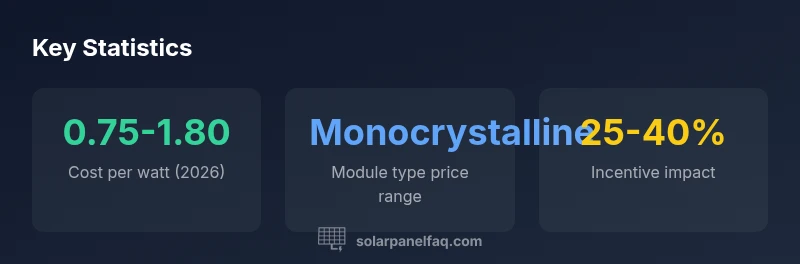
Cost per watt for residential solar systems typically falls in the range of about $0.75 to $1.80 per watt installed in 2026. This unit helps you compare bids across installers, module types, and roof conditions, and it’s most informative when you consider total system size and incentives. Understanding this metric also highlights how changes in modules or mounting can swing your price per watt.
What cost per watt means for homeowners
The term solar panel cost per watt is the industry standard for sizing a home solar installation. It represents the installed price divided by the DC wattage of the system, giving you a single number to compare across bids. For homeowners, this metric aligns directly with your budgeting and payback calculations, especially when combined with incentives and energy credits. In 2026, you’ll typically see this metric expressed as a range rather than a single fixed price, reflecting regional differences, installer practices, and module choices. Solar Panel FAQ's analysis shows that while the sticker price per watt can vary, the real value comes from understanding what is included in the installed package—panels, inverters, racking, wiring, and labor. As you review bids, demand a per-watt breakdown and a clear explanation of what’s included to avoid hidden costs. The goal is to translate the per-watt figure into a realistic total project cost that fits your household budget and energy goals.
How cost per watt is calculated in practice
In practice, cost per watt is calculated by dividing the total installed system cost by the total DC wattage of the solar array. A typical calculation looks like this: total installed price / system size (watts). For example, a 6,000-watt system priced at $9,000 would yield a per-watt cost of $1.50. If the same system is quoted at $6,000, the per-watt cost would be $1.00. This calculation is useful when comparing bids from different installers, but it must be interpreted alongside module type, roof complexity, and inverter choices. Be aware that some bids quote only the panel price, not the full installed cost per watt, which can distort comparisons. Always ask for a full per-watt figure that includes all hardware, permit fees, and labor.
Real-world ranges in 2026 and what drives them
Costs per watt in 2026 span a broad range, largely driven by module efficiency, manufacturing quality, installation labor, and regional incentives. Expect higher per-watt prices for premium monocrystalline modules and more complex roof installs, while polycrystalline and thin-film options tend to offer lower upfront per-watt costs but may require more space or yield less energy per watt. Regional incentives, state programs, and net metering policies further influence the net price you pay per watt after credits. The real value comes from comparing apples-to-apples bids that include the same per-watt base and identical workmanship, warranties, and system sizing assumptions. Solar Panel FAQ notes that a thoughtful assessment of per-watt pricing alongside incentives provides a clearer view of total project economics.
Module types and the per-watt delta
Module technology substantially changes the per-watt price. Monocrystalline modules typically deliver higher efficiency and better performance under shade or heat, but they cost more per watt than polycrystalline modules. Thin-film modules can offer lower upfront costs per watt but often require more space and may degrade differently over time. When you see per-watt quotes, consider the space you have on your roof, the slope and orientation, and how much energy you expect to generate. A smaller roof with high-efficiency panels can achieve your energy goals with a similar or even lower per-watt price than a larger array using lower-efficiency modules. The takeaway: the per-watt figure should be interpreted in the context of module performance and roof feasibility.
Roof and installation factors that affect per-watt pricing
Beyond module type, the physical installation plays a major role in the final per-watt cost. Roof pitch, orientation, shading, and material all influence labor time and safety requirements. Complex mounting systems, racking, and micro-inverters or optimizers add to the per-watt price, even if the panel prices themselves are competitive. Permitting, electrical upgrades, and interconnection with the grid also factor in. A bid that looks cheap per watt may come with surprises if it lacks comprehensive design or long-term warranties. Always compare the same scope of work across bids and ask for a breakdown of per-watt labor and material costs.
Incentives, financing, and net cost per watt
Incentives such as tax credits and rebates reduce your net cost per watt by lowering the effective price you pay. Financing options, including solar loans and lease structures, can also change the apparent per-watt cost by spreading payments over time. When evaluating bids, separate the installed per-watt price from the financing terms to understand the true cost of ownership. If you’re eligible for programs that offset a portion of the total system cost, calculate how those credits translate into a lower effective per-watt price. This approach helps you compare offers on a level playing field.
How to compare bids using cost per watt
To compare bids effectively, request a detailed per-watt breakdown from each installer, including panels, inverters, mounting hardware, wiring, and labor. Ensure the quotes assume the same system size and roof conditions, or create a standardized baseline to make the per-watt comparison valid. Look for hidden fees, permit charges, or add-ons that can inflate the per-watt cost. Also check for warranties (panel, inverter, and workmanship) and expected production under your local climate. In summary, use per-watt cost as a starting point, then validate the downstream elements of the proposal.
Budgeting tips: translating per-watt cost into a project quote
Begin with the per-watt price and multiply by your target system size to estimate gross upfront costs. Factor in potential incentives to estimate net price. Don’t forget ongoing costs like maintenance, potential inverter replacement, and monitoring services. Build a contingency into your budget for roof repairs or upgrades that may be required before installation. By structuring your budget around per-watt cost plus incentives, you create a transparent plan that reduces surprises and speeds up decision-making.
Common mistakes to avoid when evaluating per-watt bids
Common mistakes include comparing per-watt prices without considering system size, ignoring differences in modules and inverters, and overlooking roof-related installation challenges. Another error is treating per-watt price as the sole determinant of value; you should also consider energy yield, space requirements, warranty terms, and the reliability of the installer. Finally, avoid bids that omit a complete breakdown of the per-watt cost and any potential future maintenance costs. A well-informed buyer evaluates both the math and the mechanics behind the numbers.
Comparison of module types and their approximate per-watt costs
| Module Type | Typical Cost per Watt Installed | Notes |
|---|---|---|
| Monocrystalline | 0.90-1.60 | Higher efficiency, higher cost |
| Polycrystalline | 0.70-1.10 | Lower efficiency, lower cost |
| Thin-film | 0.50-0.90 | Lower efficiency, flexible, less common |
Frequently Asked Questions
What is the current cost per watt for residential solar in 2026?
In 2026, installed cost per watt typically ranges from $0.75 to $1.80, depending on module type and installation conditions. Regional incentives can further reduce net price.
Per-watt costs typically run from three quarters to about two dollars per watt, depending on where you live and which equipment you choose.
How do I calculate my system size using cost per watt?
Multiply your desired system size in watts by the per-watt price to estimate cost, or divide your budget by the per-watt price to estimate capacity. Make sure the scope matches the bid.
Multiply the watts you need by the per-watt price to estimate cost, or divide your budget by per-watt price to estimate capacity.
What factors influence the per-watt price besides module type?
Roof complexity, mounting hardware, labor, permits, wiring, interconnection, and inverter choice all influence the installed per-watt price.
Roof shape, shading, and installer choices can change the per-watt price.
Do incentives affect the cost per watt?
Yes. Federal, state, and utility incentives reduce net cost per watt by lowering the effective price you pay and can shorten payback.
Incentives can dramatically drop what you pay per watt.
Is cost per watt the best metric for comparing bids?
Per-watt cost is a common, useful metric, but you should also assess total system size, expected production, warranties, and installer reputation when comparing bids.
Per-watt is helpful, but look at the whole package.
“Cost per watt is a useful starting point, but homeowners should view it alongside incentives and installation specifics to estimate true project cost.”
Top Takeaways
- Start with cost per watt to compare bids
- Expect regional variance and higher costs for premium modules
- Factor roof complexity and mounting into per-watt price
- Incentives can substantially reduce net per-watt cost