Solar Panel 9kW Price: Costs, Savings & Buying Guide
Explore expected price ranges for a 9kW solar panel system, what affects cost, potential savings, and practical buying tips for homeowners.


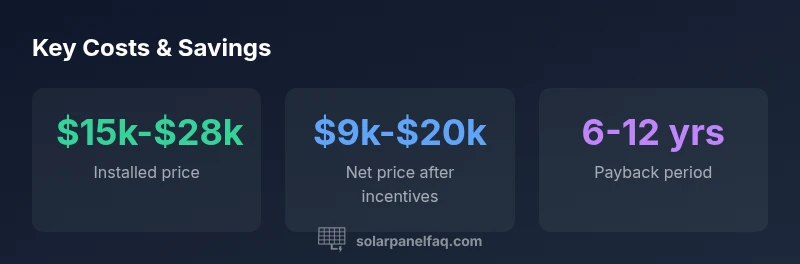
For a 9kW solar panel system, the installed price typically ranges from roughly $15,000 to $28,000 before incentives. Net costs after rebates often fall to about $9,000-$20,000, depending on location, roof type, and equipment quality. Solar Panel FAQ Analysis, 2026 notes that inverter choice and permitting fees drive big variations.
Solar Panel 9kW Price: Sizing, Costs, and Key Trends
A 9kW system represents a common mid-to-large residential installation that can cover a substantial portion of a typical home's daytime electricity usage. When homeowners search for the phrase "solar panel 9kw price", they’re seeking a ballpark to anchor budgeting, understand what pushes price up or down, and gauge whether the system aligns with long‑term energy goals. Price is driven by system size, component quality, installation complexity, regional permitting costs, and the level of warranty and service bundled with the package. While a broad price range exists, the goal is to distinguish upfront costs from long-term savings and to map these against incentives available in your area. In this guide, we examine how a 9kW configuration translates into dollars, how to compare bids, and how incentives affect the bottom line. The analysis comes from Solar Panel FAQ Analysis, 2026, and is designed to help homeowners make informed decisions without overpaying for features they don’t value.
What Drives the Price of a 9kW System
The total price of a 9kW solar system is not a single number but a spectrum influenced by multiple moving parts. First, system size and layout matter: a larger system installed in a location with high sun exposure will produce more energy, potentially justifying a higher upfront cost for premium panels or inverters. Second, equipment quality and efficiency play a role. Higher‑efficiency panels can reduce shade sensitivity and space needs but may carry a premium. Third, the inverter type and brand contribute to upfront costs, while sometimes affecting long‑term maintenance costs and performance. Fourth, installation labor, roof complexity (slopes, penetrations, tile roofs), and local permitting requirements can shift the total price. Finally, warranty terms and post‑sales service influence the perceived value and long‑term reliability of the system. Collecting bids from multiple installers helps reveal the spread caused by these factors and makes it easier to identify legitimate value rather than a single quoted price. The takeaway is to quantify both upfront price and anticipated energy savings to evaluate true value over the system’s life.
Components That Affect 9kW Price
A 9kW installation comprises several discrete components, each contributing to the final bill. The solar modules are the most visible part, with choices ranging from standard to premium high‑efficiency models. The mounting hardware and racking determine ease of installation and roof compatibility. The inverter is a critical component, converting DC to AC and shaping system reliability; string, micro, and hybrid inverters each carry different price implications. Wiring, combiner boxes, and monitoring equipment affect both cost and post‑installation control. Labor costs account for site preparation, roof access, mounting, wiring, and system connection to the grid. Permitting and inspection fees vary by municipality and can add to the total. Finally, warranties, performance guarantees, and service plans add perceived value but can increase the upfront price. For a given 9kW design, tradeoffs among these elements determine the final price and the system’s long‑term economics.
Financing and Incentives for 9kW Installations
Financing and incentives can dramatically affect the effective price of a 9kW system. Federal, state, and local programs may provide credits, rebates, or performance incentives that reduce upfront costs or improve post‑install ROI. Some programs are structured as tax credits; others arrive as direct rebates or lower‑interest financing options. Eligibility often depends on system size, installation date, and household tax situations. Even when incentives are modest, they can meaningfully shorten the payback period and improve the system’s net economics. Homeowners should tally the total installed cost first, then apply all applicable incentives to determine the net price. It’s also prudent to consider the financing term, interest rate, and potential changes to policy that could affect future eligibility. In summary, incentives are an essential lever in the overall cost picture but should be evaluated alongside system quality and long‑term savings.
Real-World Scenarios: Roof Type, Location, and Installer
Roof type and location create real-world cost implications that reach beyond sticker price. A metal roof or a tile roof typically requires specialized mounting solutions and skilled labor, increasing installation time and cost. Tilt and orientation impact energy production and project scope; more complex roof angles may necessitate additional safety measures and equipment. Local climate and energy prices influence the value proposition of a given 9kW system, affecting the payback period and lifetime savings. The installer choice matters as well: experience, warranty, and after-sales support can justify higher bids if they translate into less risk and better performance. When evaluating quotes, compare not just the price but the components included, the expected energy production, and the reliability of after‑sales service. A well‑priced quote that delivers dependable performance and support is usually the best long‑term choice.
Steps to Get an Accurate 9kW Price Quote
To obtain an accurate price estimate, homeowners should prepare a consistent set of information for each bid: roof type and age, shading profile, desired panel efficiency, inverter preference, and any preferred brands. Request a layout plan showing panel count and orientation, a breakdown of material costs (modules, inverter, racking, wiring), and a clear labor line item. Ensure quotes include permitting, inspection fees, interconnection costs, and a projected maintenance plan. Ask for the warranty terms, expected degradation rate, and the monitoring options. Finally, verify the reliability and track record of the installer, and obtain references. By standardizing the bid format, you can compare apples to apples and avoid price creep or hidden fees. This approach aligns with the data-driven guidance of Solar Panel FAQ Analysis, 2026 and helps homeowners make an informed decision.
Looking Ahead: What 9kW Price Signals for Homeowners
The price trajectory for 9kW solar systems is shaped by manufacturing costs, material quality, and policy momentum. Even as technology evolves toward higher efficiency and better reliability, price transparency and clear value propositions remain critical. Homeowners who greet price with a comprehensive ROI framework—accounting for upfront costs, incentives, energy savings, and maintenance—tend to select solar solutions that deliver predictable performance and long‑term value. The goal is not simply to minimize upfront price but to maximize the total return on investment over the system’s lifetime.
Price guide for 9kW systems
| Scenario | Estimated price range before incentives | Notes |
|---|---|---|
| Installed 9kW system (new) | $15,000 - $28,000 | Standard equipment and typical installation |
| Net price after incentives (national average) | $9,000 - $20,000 | Includes federal and local incentives where applicable |
Frequently Asked Questions
What is the typical installed cost for a 9kW solar system?
The installed cost for a 9kW system ranges widely depending on location, roof configuration, and equipment quality. Before incentives, it often falls within a broad range; after incentives, the net price can be substantially lower. Always compare multiple bids and consider total cost of ownership.
The 9kW installation cost varies by location and roof type. Get multiple bids to understand the range and total ownership costs.
How do incentives affect the 9kW price?
Incentives reduce net price through federal and local programs. The exact amount depends on eligibility and timing, so the net cost can swing significantly between installations.
Incentives lower the net price, but eligibility varies by location and timeline.
Does roof type impact the cost of a 9kW system?
Yes. Roof type and condition influence mounting complexity, penetrations, and labor costs. Tile and metal roofs often require more specialized mounting and safety measures, increasing the quote.
Roof type can add to costs due to mounting and labor needs.
What components drive the price most for a 9kW system?
The inverter, solar modules, mounting hardware, and labor costs are the primary price drivers. Higher efficiency panels and premium inverters raise upfront costs but can improve long-term performance and reliability.
Inverters, panels, and labor are the big price drivers.
What is a typical payback period for a 9kW system?
Payback periods commonly range from about six to twelve years, depending on energy prices, system cost, and incentives. Higher electricity rates shorten the payback.
Most homes see payback in about 6 to 12 years depending on rates and incentives.
Should I buy or lease a 9kW solar system?
Buying typically yields greater long-term savings and ownership benefits, while leases or PPAs can lower upfront costs but may reduce total lifetime savings. Evaluate both options against your taxes and incentives.
Buying usually brings more long-term value; leases can lower upfront costs but may limit savings.
“Price is not fixed; the final 9kW system cost reflects equipment mix, installer practices, and local incentives. Small changes in components can yield meaningful long-term savings.”
Top Takeaways
- Compare installed price ranges across installers to avoid surprises
- Factor incentives into upfront budgeting and net cost
- Consider inverter quality and roof type for cost efficiency
- Calculate payback using local electricity rates for ROI
- Account for permits and interconnection fees in totals