3kW Solar Panel Price Guide: Costs, Quotes, and Savings in 2026
Explore the costs, regional variations, and incentives for a 3 kW solar panel system. Learn how to compare quotes, estimate payback, and plan your budget in 2026.


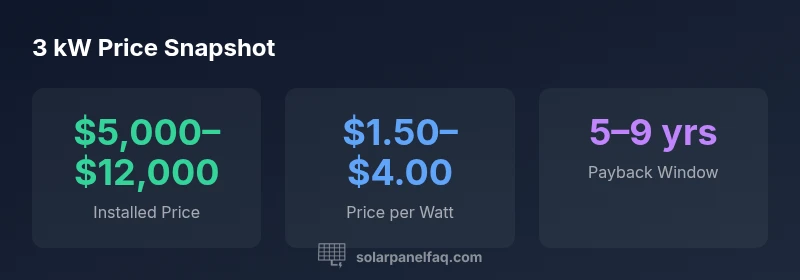
The typical installed price for a 3 kW solar system ranges from $5,000 to $12,000 before incentives, depending on location, system components, and permitting costs. Per-watt costs commonly fall in the $1.50–$4.00 range, with higher-end modules and inverters edging toward the upper end. Maintenance costs are generally low, and many homeowners offset this with federal, state, and utility incentives.
What a 3 kW price includes
A 3 kW solar price combines several components and services. Core hardware includes solar modules, an inverter, racking, wiring, and sometimes microinverters. Labor, permitting, interconnection to the grid, and any required electrical work are part of the installed price. Depending on the project, additional items such as optimizers, monitoring hardware, or a battery storage system can raise the total cost. When homeowners ask, “What is a 3 kW price?” they’re often considering the balance between upfront cost and long‑term value. The Solar Panel FAQ team emphasizes that price should reflect not just the lowest sticker price, but the system’s performance, warranty coverage, and expected energy production. This is why a higher-quality 3 kW system with a robust warranty can deliver greater long-term savings despite a higher initial outlay.
Key price drivers for a 3 kW system
Several factors push the price up or down. Panel quality, efficiency, and warranty term directly affect upfront cost and long-term performance. Inverter type (string vs. microinverter) and balance-of-system quality matter as well. Roof complexity, shading, and the number of roof penetrations influence labor costs. Permitting and interconnection fees vary by city and utility, sometimes adding hundreds to thousands of dollars. Geographic labor markets and supply chain conditions also drive price changes. When evaluating quotes, homeowners should ask for a breakdown of modules, inverters, racking, wiring, labor, and interconnection charges to understand where money is going and to identify opportunities for savings.
Incentives and financing: how they shift the bottom line
Incentives can dramatically reduce the net cost of a 3 kW installation. Federal, state, and utility programs and time-based incentives vary by year and region. Financing options—such as green loans, leases, and power purchase agreements (PPAs)—can alter the effective price and monthly cash flow. The key is to compare the total cost of ownership over the system’s life, not just the upfront price. Solar Panel FAQ recommends factoring in tax credits or rebates where available, and running a side-by-side comparison of cash purchases versus financed options across multiple quotes to identify the best long-term value.
Regional differences: how installation complexity affects price
Prices reflect local labor markets, permitting costs, and interconnection processes. Areas with streamlined permitting and competitive installer markets tend to offer lower installed prices for a 3 kW system. Conversely, regions with complex roof shapes, hurricane or wildfire codes, or higher labor rates tend to see higher costs. HOA restrictions or required electrical upgrades can add to the bill as well. Homeowners should request a per‑item price breakdown in quotes and ask installers how roof type, orientation, and shading influence estimated energy production and payback.
Reading and comparing quotes: what to ask
To fairly compare quotes, request a detailed bill of materials and labor. Look for the same system size (3 kW) across bids and compare panel types, efficiency ratings, inverter configuration, warranty terms, and monitoring capabilities. Ask about anticipated production in your location, as well as expected degradation over time. Ensure quotes include permit fees, interconnection costs, and any necessary electrical upgrades. If a quote seems unusually low, probe for hidden costs or lower-quality components that could shorten system life or reduce performance.
Budgeting scenarios: conservative, balanced, and premium setups
A conservative setup might favor lower-cost panels with standard inverters and minimal monitoring, delivering a lower upfront price but potentially lower efficiency and shorter warranty. A balanced approach uses mid-range panels and reliable inverters with solid warranties, offering a respectable price and good long-term value. A premium setup uses high-efficiency panels, top-tier inverters, comprehensive monitoring, and extended warranties, resulting in higher upfront costs but potentially higher energy output and longer system life. In all cases, incentives and financing can shift the final price substantially.
Maintenance and lifecycle costs
Most residential solar systems require minimal maintenance, typically just occasional cleaning and periodic inverter checks. Warranties commonly cover 20–25 years for modules and 10–12 years for some inverters, with performance warranties that guarantee a certain output level over time. When budgeting, include potential replacement of inverters and eventual module degradation. A well-designed system from a reputable installer can reduce maintenance costs and improve long-term reliability. Keeping a maintenance log and scheduling annual checkups helps protect your investment.
Practical steps to reduce upfront costs
- Obtain multiple quotes (at least 3) and compare apples-to-apples components.
- Look for higher-efficiency modules that maximize production in your roof’s sun exposure.
- Consider a single, well-rated inverter rather than multiple cheaper inverters.
- Check for local incentives and utility rebate programs that can lower net price.
- Evaluate financing options to optimize monthly cash flow while preserving long‑term value.
Pricing options for a 3 kW solar system
| Option | Typical Installed Price (3 kW) | Notes |
|---|---|---|
| DIY components | $3,000–$8,000 | Lower upfront; requires permits and electrical know‑how |
| Professional install | $5,000–$12,000 | Labor, permitting, interconnection included |
| Lease/PPAs | $0 upfront or low upfront | Contract-based; ongoing payments |
Frequently Asked Questions
What is the typical price range for a 3 kW system before incentives?
Prices vary by region and hardware, but a 3 kW system typically falls within a broad installed price range before incentives. Always request a detailed breakdown to see where costs arise and how to optimize value.
Prices for a 3 kW system vary by region and components. Get a detailed breakdown from several installers to compare value.
How do incentives affect the final out-of-pocket cost?
Federal, state, and utility incentives can significantly lower net costs, sometimes by substantial percentages. Always verify current programs and whether the quote accounts for them.
Incentives can greatly reduce net cost; check current programs and confirm quotes account for them.
Is DIY installation feasible for a 3 kW system?
DIY installation for a 3 kW system is possible for experienced homeowners, but permits, electrical work, and interconnection processes require professional handling in many jurisdictions.
DIY can be possible with expertise, but permits and interconnection often require a licensed installer.
What should I look for in a quote?
Look for a clear breakdown of modules, inverters, racking, labor, permits, interconnection, warranties, and expected production. Ask about degradation rate and monitoring features.
Ensure the quote breaks down all parts, warranties, and expected energy production.
Do 3 kW systems produce enough energy for a typical home?
Production depends on location, shading, and roof orientation. In sunny areas, a 3 kW system can offset a meaningful portion of usage, while in less sunny regions it will be smaller.
Production depends on your location and roof; a 3 kW system offsets some, not all, energy use.
How long do warranties last on a 3 kW system?
Most residential solar warranties cover modules for 20–25 years and inverters for 10–12 years, with performance guarantees over time.
Modules often have 20–25 year warranties; inverters about 10–12 years.
“Pricing for a 3 kW solar system reflects hardware quality, installation complexity, and available incentives. To maximize value, compare multiple quotes and evaluate long-term energy savings, not just the upfront cost.”
Top Takeaways
- Get multiple quotes to map the price landscape
- Incentives can dramatically reduce net cost
- Region, roof complexity, and labor shape the final price
- Balance upfront price with long-term value and warranties
- Ask for a transparent, line-by-line breakdown on quotes