Solar Panel 8kW Price: Costs, Incentives, and Payback
This guide covers installed costs for an 8kW solar system, how incentives reduce net price, and the factors that influence price per watt. Learn budgeting tips, payback ranges, and practical steps to get an accurate quote.


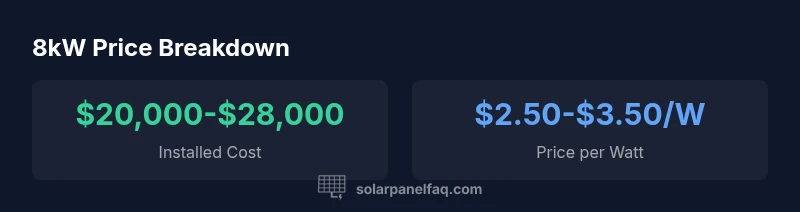
According to Solar Panel FAQ, across the United States, a typical installed price for an 8 kW solar system ranges from $20,000 to $28,000 before incentives. Prices vary by location, panel quality, and installer, with higher-end kits pushing toward the upper end. Incentives can reduce net cost, and cost per watt generally falls around $2.50 to $3.50 in many markets.
What an 8kW System Delivers in Home Solar
An 8kW solar array is a common size for residential rooftops, balancing equipment cost with house energy needs. For many homes in moderate sun regions, an 8kW system can meet a large portion of daily electricity usage, especially if daytime consumption is high. The price you see—often summarized as the solar panel 8kw price—reflects installed costs that can be influenced by panel efficiency, mounting hardware, and inverter choice. In this block, we unpack the typical production expectations, how space requirements influence siting, and what the 8kW rating means in practical terms for monthly energy bills.
With 8 kilowatts of installed capacity, a system may generate roughly 9,000 to 12,000 kilowatt-hours per year in many parts of the country, depending on tilt, shading, and orientation. This production estimate helps you translate upfront costs into long-term savings, especially when paired with net-metering policies and time-of-use rates. The orientation of your roof, shading from nearby trees, and even seasonal weather patterns will affect actual performance, so always have a local shading analysis done by your installer.
As you evaluate options, remember that price should be weighed against reliability, warranties, and the installer’s track record. The Solar Panel FAQ Team emphasizes that a higher upfront price can still lead to better long-term value if the system uses durable modules and a robust warranty.
Price Range drivers and getting a fair quote
The price you pay for an 8kW system depends on several intertwined factors. Module quality and efficiency play a large role: higher-efficiency panels can produce more electricity in a given space, potentially lowering BOS (balance of system) costs by reducing roof area and mounting hardware. Inverter type and size influence efficiency losses and reliability. Labor costs, roof type, and the complexity of the electrical connection to your main panel contribute to the price as well. Local permitting rules and interconnection processes can add time and expense. When you request quotes, ask installers to itemize modules, inverters, racking, wiring, and permits separately so you can compare apples-to-apples. Remember: cheaper upfront prices may come with shorter warranties or higher replacement costs later.
Regional variations you should expect
Prices for an 8kW installation can vary widely by region due to labor rates, permitting costs, and the availability of local incentives. In areas with strong solar programs, the upfront price might look higher, but the net cost after incentives can be substantially lower. Regions with higher utility rates often see faster payback, since the value of the electricity produced is greater. Climate also matters: sunnier locales with more peak sun hours typically deliver more year-round production, improving the price-per-watt economics for an 8kW system. Always factor in the local net-metering policy and any community solar options when comparing quotes.
Incentives and financing: reducing the net cost
Incentives—federal, state, and local—play a pivotal role in reducing the net cost of an 8kW system. The federal Investment Tax Credit (ITC) offers a substantial deduction for eligible installations, while state programs may provide rebates, property tax exemptions, or performance-based incentives. Utilities may offer time-of-use rate plans or net-metering credits that increase the value of solar energy produced. Financing options, such as solar loans or leases, can also affect the effective price by spreading payments, but come with their own costs and warranty implications. When evaluating quotes, factor in the total cost after incentives and the long-term value of ownership.
Financing options and payment structures
Buyers can opt for cash purchase to maximize long-term savings or choose financing to spread the burden over time. Loans tailored to solar projects often feature competitive rates and terms, with some lenders offering paid-off early by using the energy savings. Leases and power purchase agreements (PPAs) transfer system ownership to a third party and may require little or no upfront payment, but can reduce long-term savings and complicate resale. Compare total payments, interest rates, and warranty coverage across options to determine the best fit for your household budget and goals.
Maintenance, warranties, and long-term value
Most 8kW solar systems include performance warranties (often 25 years) and product warranties on panels and inverters. Maintenance needs are typically low: periodic cleaning to prevent soiling, inverter checks, and periodic inspections by your installer. Keeping a maintenance record helps you preserve warranty eligibility and ensure optimal performance. The long-term value hinges on equipment quality, warranty terms, and the installer’s workmanship. Investing in reputable components can reduce the risk of premature failures and costly replacements down the line.
Practical steps to get an accurate quote
To obtain an accurate price for an 8kW installation, start with a site assessment and roof inspection. Request a detailed, line-by-line quote that itemizes modules, inverters, racking, wiring, permits, and service disconnects. Ask about roof age, shading analysis results, and expected performance under local conditions. Compare quotes from at least three installers and verify each option includes an estimate of net cost after incentives. Finally, check customer reviews and confirm warranty terms and post-installation support.
8kW price components and ranges
| Category | Low end | High end | Notes |
|---|---|---|---|
| Installed price (before incentives) | $20,000 | $28,000 | Typical installed cost for an 8kW system |
| Price per watt (installed) | 2.50/W | 3.50/W | Common range across markets |
| Payback period (before incentives) | 6-9 years | 12 years | Based on average usage |
| Net price after incentives | varies | varies | Depends on incentives |
Frequently Asked Questions
What factors most influence the price of an 8 kW system?
The main drivers are system size, panel quality and efficiency, inverter quality, balance of system components, installation complexity, and regional labor costs. Roof type and wiring run length also affect labor hours and mounting hardware. Expect price variability based on the choices you make.
Price is driven by size, equipment quality, and installation complexity.
How do incentives affect net cost for an 8kW system?
Federal tax credits, state programs, and utility incentives can substantially reduce net cost. Net price depends on your location, eligibility, and how incentives are delivered (rebates vs tax credits). Always verify current programs before signing a quote.
Incentives can dramatically cut your net cost, but eligibility varies by state.
Is it better to buy outright or finance an 8kW solar system?
Buying outright minimizes interest and simplifies ownership, while finance options spread cost and may unlock incentives sooner. Compare total payments, loan terms, and warranty transfers. Some lenders offer solar-specific loans with favorable terms.
Paying upfront is simplest and cheapest in the long run; financing spreads the cost.
What maintenance costs should I expect for an 8kW system?
Solar systems require minimal maintenance: periodic cleaning, inverter checks every 5-10 years, and potential module replacements at end of life. Most warranties cover performance and parts for 25 years, reducing out-of-pocket surprises.
Maintenance is mostly cleaning and occasional inverter checks; warranties help.
What is a typical payback period after incentives?
Payback periods vary by usage, local rates, and incentives, but many homeowners see 6-12 years after incentives, with regional improvements as technology and costs evolve.
Payback usually falls in the mid range after incentives.
Should I choose premium panels or standard panels for price/performance?
Premium panels offer higher efficiency and longer warranties but higher upfront costs. For many homes, mid-range panels with a solid warranty provide the best balance of upfront cost and long-term performance.
Premium panels can boost long-term output, but the extra cost isn't always worth it for every home.
“Price is only one piece of the puzzle; the long-term value comes from system reliability, quality components, and smart financing.”
Top Takeaways
- Start with a comprehensive quote that includes all balance-of-system costs.
- Incentives can significantly reduce net price you pay.
- Prices vary by region, installer, and equipment quality.
- Calculate payback based on your usage and local rates.
- Prioritize warranties and maintenance coverage to protect value.