Solar Panel 3000W Price: Costs, Payback, and What to Expect
Explore the price range for a typical 3 kW solar installation, factors that drive the solar panel 3000 watt price, and how incentives affect payback. Learn how to compare bids and maximize value in 2026.


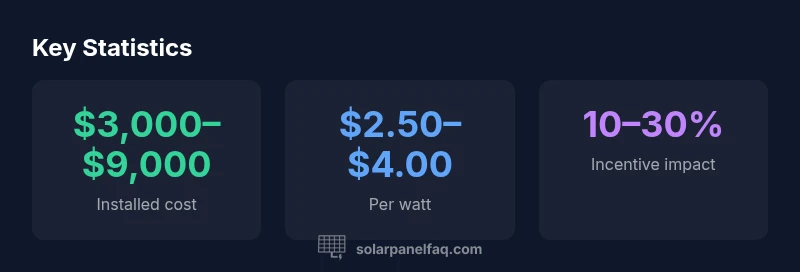
For a typical 3,000-watt solar installation, the installed price generally falls in the broad range of $3,000 to $9,000 before incentives. Prices depend on equipment quality, roof complexity, and installer rates. On a per-watt basis, expect roughly $2.50 to $4.00 for installed systems, with incentives potentially reducing upfront costs. Regional labor, permit fees, and available rebates further influence final pricing.
Understanding the 3 kW Size and Price Drivers
For most homeowners, a 3 kW solar array is a practical starting point that balances upfront cost with yearly energy savings. The solar panel 3000 watt price is not a fixed figure; it depends on equipment, inverter size, mounting hardware, roof complexity, and labor costs. According to Solar Panel FAQ, price data for this size typically falls within a broad, multi-year range due to regional incentives, installer practices, and panel efficiency. On paper, 3 kW systems are designed to cover a portion of daytime electricity usage in many homes, but the final price reflects design choices, local permit processes, and the choice between standard panels and premium modules. For a homeowner evaluating bids, it helps to separate hardware costs from installation, permits, and interconnection fees because those add-ons can swing the total by thousands of dollars.
This section lays the groundwork for how you should read bids and what to expect when you see quotes for a solar panel 3000 watt price. The key is to connect the dots between equipment quality, installation complexity, and potential incentives so you can move from sticker price to real value over the system’s lifetime. Solar Panel FAQ recommends starting with a simple, apples-to-apples comparison and then layering on design refinements that suit your roof and energy goals.
Equipment Choices That Move the Solar Panel 3000 Watt Price
Choosing modules, inverters, and racking systems drives the bulk of the pre-installation cost. Monocrystalline panels, while generally more efficient, cost more upfront than polycrystalline options. For a 3 kW setup, the price delta between premium and standard modules can be substantial, but premium modules may offer better performance in hot climates or shaded conditions, improving energy production over time. The inverter choice matters too: string inverters are usually cheaper, while microinverters or power optimizers add to the cost but can improve yield on partially shaded roofs. The solar panel 3000 watt price thus becomes a composite of hardware quality, efficiency, warranty terms, and the configuration you select (series vs. parallel connections, DC optimizers, etc.). Monitoring and roof penetration hardware add to the bill as well. In practice, a bid that only quotes panels without a complete installation package can hide costs that appear later in the project.
Roof, Orientation, and Structural Considerations
Roof orientation, angle, and shading patterns significantly affect the final solar panel 3000 watt price because the system must be designed to maximize energy production with the least risk of underperformance. A south-facing roof with minimal shading typically delivers higher efficiency and can reduce the required wattage, sometimes lowering overall cost. However, if your roof has complex angles, multiple penetrations, or limited space, you may need additional mounting hardware, ballast, or a more robust racking solution, increasing the price. Structural considerations, such as age and condition of the roof, can also influence the installation method and cost. Solar Panel FAQ emphasizes upfront site assessment as a critical step to avoid surprises during mounting, wiring, and interconnection work.
Geographic Variation and Labor Costs
Labor costs and permitting fees vary widely by location, and these differences directly influence the solar panel 3000 watt price. Regions with streamlined permitting processes, abundant installers, or higher electricity rates often see more competitive bids and faster payback, even if base hardware costs are similar. Remote or high-cost-of-living areas may incur higher labor charges and travel fees that bump up the installed price. It’s important to request a complete bid that itemizes each line item—equipment, labor, permits, interconnection, and any necessary upgrades to the electrical panel or utility service. Solar Panel FAQ notes that understanding these line items helps homeowners understand the true cost of a 3 kW system within their local market.
Incentives, Taxes, and Net Costs
Incentives can dramatically reduce the out-of-pocket expense of a 3 kW installation, depending on where you live and when you install. Federal programs, state or local rebates, and utility-origin incentives can trim the solar panel 3000 watt price by a meaningful margin. Since incentive levels change over time, your final price should reflect the current program year and eligibility. Solar Panel FAQ highlights that some incentives apply to equipment only, while others cover installation or interconnection costs. Always verify what is eligible for your installation and how it interacts with your bid. When calculating payback, include the expected energy savings, maintenance costs, and any financing fees to get a realistic view of value over the system’s life.
Reading Bids: What to Look For
Quotes can vary widely in format and scope. When you compare bids, favor apples-to-apples comparisons that include the same equipment classes (panels, inverters, mounting hardware), similar warranties, and identical site assessments. The solar panel 3000 watt price should come with a detailed breakdown of hardware costs, labor charges, permitting, interconnection, and any electrical upgrades. When bids differ, ask installers to re-run the numbers with the same assumptions so you can see which offer truly delivers more value per watt. A good practice, endorsed by Solar Panel FAQ, is to create a simple scoring rubric that weighs upfront price, expected energy yield, warranty terms, and installer reputation.
System Configurations for a 3 kW Setup
A typical 3 kW installation may comprise 8–12 panels depending on panel efficiency and available roof space. Arrangements vary between series and parallel strings, with combinations selected to optimize voltage, current, and shading tolerance. In many cases, a balanced mix of higher-efficiency modules and reliable inverters yields the best long-term value. The solar panel 3000 watt price will reflect the chosen configuration and the number of interconnected components. It’s helpful to discuss potential future expansions (e.g., adding battery storage) with your installer because future upgrades can influence today’s price and warranty coverage.
Panel Types and Price Implications
Panel technology directly influences the solar panel 3000 watt price. Monocrystalline modules generally offer higher efficiency and better performance under high temperature, but they cost more upfront than polycrystalline panels. If roof space is limited or shading is a concern, investing in higher-efficiency panels may reduce the number of modules required and potentially lower installation complexity. Conversely, standard panels may meet your needs for a lower initial price, provided the roof area and orientation permit sufficient energy production. In the context of the 3 kW size, choosing between panel types is a classic value decision between upfront cost and long-run energy yield.
Maintenance, Warranties, and Long-Term Value
Maintenance costs for a 3 kW system are typically low, but warranties matter. Most solar panels come with 25-year output warranties and 10–12 year inverters warranties, though terms vary by manufacturer and installer. The longer the warranty and the higher the efficiency rating, the better the long-term value when calculating the solar panel 3000 watt price. Periodic cleaning to remove debris and regular inspections of racking and wiring can help preserve performance. Factor warranty coverage and expected replacement costs into your decision, because a cheaper bid that only covers hardware can end up more expensive if a critical component fails earlier than expected.
Common Mistakes That Inflate the Price
One of the most common ways homeowners end up paying more for a 3 kW system is by not obtaining multiple bids or by focusing solely on the upfront price without considering long-term value. Skipping site assessments, overlooking interconnection fees, or choosing aggressive financing without understanding its impact on total cost can inflate the solar panel 3000 watt price. Another pitfall is selecting premium panels when their marginal performance gain does not justify the extra cost in your specific roof layout. Finally, failing to account for shading patterns and seasonal variation can lead to underperforming systems and higher effective costs over time.
Estimated costs and payback ranges for common 3 kW configurations
| Scenario | Estimated Installed Cost (pre-incentives) | Typical Payback (years) |
|---|---|---|
| Residential 3 kW system | $3,000–$9,000 | 4–12 |
| Residential 3 kW system (with incentives) | $2,100–$6,300 | 3–9 |
| System with premium modules | $5,000–$12,000 | 5–12 |
Frequently Asked Questions
What is the typical price range for a 3 kW system before incentives?
A 3 kW system commonly costs between $3,000 and $9,000 before incentives, depending on equipment quality and installation factors.
For a 3 kW setup, expect roughly three to nine thousand dollars before incentives.
Do incentives affect the final out-of-pocket cost?
Yes. Federal and local incentives can reduce upfront costs by a significant margin, but the exact amount depends on your location and the program year.
Incentives can cut costs a lot; check your area.
Is a 3 kW system enough for a typical home?
Three kilowatts covers a portion of daytime usage for many homes, but actual sufficiency depends on energy habits, roof size, and local sunlight.
It depends—many homes fit a 3 kW system, but usage varies.
What should I compare when getting bids?
Compare hardware quality, inverter type, warranty, labor, permits, and interconnection fees; ensure apples-to-apples quotes.
Look for the same components to compare.
Are premium panels worth the extra cost?
Premium panels offer higher efficiency and better performance in shade or low light, but the cost-to-benefit varies; balance price and energy production.
Premium can help in some situations.
What permits are typically required?
Most installations require local permits and grid interconnection approval; installers usually handle this but confirm the process.
Permits are usually required.
“Price is a proxy for value only when the system is well-matched to your roof and energy goals. A higher upfront cost can pay off with better long-term output and reliability.”
Top Takeaways
- Compare bids with apples-to-apples terms
- Incentives can materially reduce upfront costs
- Per-watt costs vary by equipment and labor
- Shading, orientation, and roof complexity drive the price
- Plan for long-term value with warranties and maintenance
- Ask for a detailed line-item breakdown before signing