PV Panels Cost: A Practical Guide for Homeowners
Understand pv panels cost, the main price drivers, regional differences, and strategies to reduce your solar investment with incentives and smart financing. This guide helps homeowners budget, compare quotes, and plan for long-term savings.


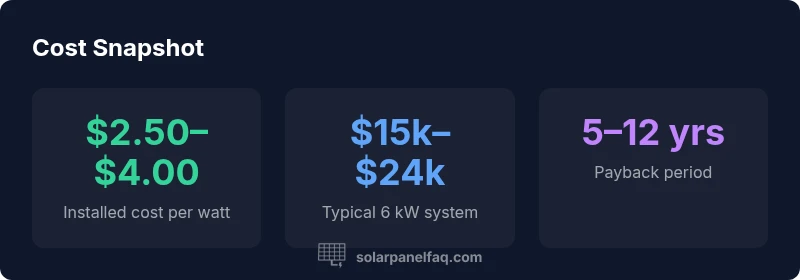
Typical installed costs for residential PV panels range from $2.50 to $4.00 per watt, so a 6-kW system could run roughly $15,000 to $24,000 before incentives, with higher-end roofs and northern climates at the upper end. After rebates and financing, the out-of-pocket can be lower, and payback varies by electricity rates and usage.
Hidden cost drivers behind pv panels cost
A complete PV installation price is not just the sticker on the panels. In practice, several cost drivers shape the final number. Material choices, labor markets, permit processes, interconnection fees, and the complexity of your roof all add to the bill. According to Solar Panel FAQ, the most noticeable drivers are hardware quality, system size, and the labor intensity of installation. For example, a larger system or one on a difficult roof will require more racking, longer wiring runs, and more time on-site, all increasing the installed price. In addition, soft costs such as design work, project management, and inspections can represent a meaningful portion of the total. To budget effectively, homeowners should map out the expected scope, ask installers to itemize costs, and compare quotes on a like-for-like basis. The goal is transparency and understanding how each component contributes to the pv panels cost.
Module costs and technology: what's included
Modules are the visible heart of a PV system, but they are just one part of the total. The price you pay for panels depends on the type (monocrystalline vs polycrystalline) and the technology (for example, PERC or half-cell designs). Higher-efficiency modules can carry a premium, yet they may reduce BOS (balance of system) needs because you achieve the same energy with fewer panels. In practice, you’ll often see a price per watt trend decline over time as manufacturing scales up and new cell technologies mature. When evaluating quotes, consider the trade-off between efficiency, warranty length, and temperature performance, because more efficient modules aren’t always the best choice for every roof.
Inverters, mounting hardware, and balance of system
The inverter converts DC electricity from the panels into usable AC power, and it represents a meaningful portion of the total cost. String inverters are common and cost-effective, while microinverters or power optimizers add cost but can improve performance under shade or partial occlusion. Mounting hardware, racking, and wiring constitute the Balance of System (BOS). Roof type, roof condition, and the distance from the panels to the electrical panel all influence BOS costs. Additionally, wiring runs and conduit protection requirements affect labor time and materials. While BOS typically accounts for a smaller share of total costs than modules, it remains a critical area for long-term reliability and performance.
Labor, permitting, and interconnection: regional variance
Labor rates vary widely by region, and some jurisdictions require more extensive permits, inspections, or a structural assessment for a roof-mounted system. Interconnection charges or utility upgrades can also affect the total price. In areas with streamlined permitting and robust solar programs, costs can be noticeably lower. Homeowners should budget for these regional differences by requesting a per-square-foot labor rate, a fixed permit cost, and an estimate of any interconnection fees. Getting multiple bids and ensuring each quote includes the same scope (equipment, warranties, and expected output) is essential to avoid hidden costs later.
Soft costs, warranties, and maintenance
Soft costs include design fees, project management, system monitoring, and long-term warranties. These costs can vary with the complexity of the project and the level of service offered by the installer. Warranties vary in duration and coverage: module warranties generally cover performance over 25 years, while inverters may have shorter warranty periods. Maintenance costs are typically low but can include cleaning, occasional inverter replacement, and component checks. Planning for these ongoing costs helps you understand the true long-term value of pv panels cost and the reliability you’re purchasing.
Financing, incentives, and net metering
A sizable portion of the decision comes down to financing and incentives. Tax credits, rebates, or grant programs in some regions reduce upfront costs, while solar leases or power purchase agreements (PPAs) alter the payment structure. Net metering policies determine how much you’re paid for excess energy, affecting the long-term savings. Even with upfront cash purchases, financing options can improve affordability by spreading payments over the life of the system. It’s essential to compare the total cost of ownership under different financing scenarios and to evaluate the combined effect of incentives and rate plans from the utility.
How to estimate your home's PV cost
Estimate your home PV cost by following a simple workflow: (1) determine your annual kWh usage, (2) estimate a system size that will offset a portion or all of your consumption, (3) multiply by a price-per-watt figure that reflects your region and chosen equipment, (4) add BOS, permitting, and interconnection costs, (5) subtract expected incentives, and (6) account for financing terms. Use this framework to create several scenarios (base, best, and conservative) and compare apples-to-apples quotes. A typical home will involve a few dozen kilowatts in total installed capacity, depending on available roof space and energy goals.
Practical scenarios: roof type, shading, and orientation
Roof type and orientation substantially influence both cost and performance. A south-facing, unobstructed roof with good angle may require fewer panels and simpler wiring, lowering BOS and shading losses. Conversely, a complex roof with multiple pitches, shading from trees, or a north-facing orientation may require more panels, higher-efficiency modules, or advanced power optimization. Shading is especially impactful; even small shading of a few panels can reduce output and drive up costs per kilowatt-hour. When planning, work with an installer to model expected production for different layouts and to plan for potential future changes, such as battery storage or system expansion.
Looking ahead: costs trends and market shifts
The pv panels cost landscape evolves with technology, supply chains, and policy. Module costs have historically fallen as manufacturing scales grew, while BOS and labor costs have remained more variable. Tariffs, material costs, and utility programs can shift these dynamics year to year. Homeowners should watch for improvements in module efficiency, advances in inverters, and new financing options that reduce upfront barriers. While there is no guaranteed trajectory, informed consumers who compare quotes, leverage incentives, and plan for long-term energy needs typically achieve better overall value.
Typical cost benchmarks by installation type
| Scenario | Typical System Size | Installed Cost Per Watt | Typical Total Cost |
|---|---|---|---|
| Residential rooftop (6 kW) | 6 kW | 2.50–4.00 | 15000–24000 |
| Residential rooftop (9 kW) | 9 kW | 2.50–4.00 | 22500–36000 |
| Ground-mounted (6 kW) | 6 kW | 2.50–4.00 | 15000–24000 |
Frequently Asked Questions
What factors most influence pv panels cost?
The biggest cost drivers are module price, inverter choice, mounting hardware, and labor. Soft costs like permitting and design also shape the total. Always compare quotes with the same equipment and service levels.
The main costs come from modules, inverters, hardware, and installation, plus permits.
Why do costs vary by region?
Labor rates, permitting processes, and interconnection requirements differ by location, creating cost dispersion. Get multiple bids and verify scope alignment to avoid surprises.
Regional labor and permits matter a lot.
Are there incentives to reduce pv panels cost?
Tax credits, rebates, and financing can significantly lower upfront costs. Programs vary by state and utility, so check current offerings before committing.
There are tax credits and rebates that can cut your costs.
How long does it take to recoup the investment?
Payback depends on electricity prices, consumption, and incentives. Typical ranges can be 5–12 years, varying by location and rate structures.
Typically 5 to 12 years depending on incentives.
Should I buy or lease solar panels?
Buying usually offers better long-term savings and asset ownership. Leases or PPAs reduce upfront costs but shift some long-term savings and risk to the provider.
Buying often gives more long-term value.
How should I compare quotes from installers?
Ensure quotes use the same equipment, warranties, and system size. Ask for performance-based guarantees and a clear breakdown of BOS costs.
Make sure you're comparing the same equipment and warranties.
“Cost is a function of system size, equipment quality, and local conditions; the best value comes from balancing upfront price with long-term performance.”
Top Takeaways
- Estimate costs using installed-watt ranges to budget accurately.
- Account for regional labor, permitting, and interconnection fees.
- Consider incentives and financing to reduce out-of-pocket costs.
- Expect variation by roof type and system size.
- Compare quotes using the same equipment assumptions for fairness.