Photovoltaic Panels Price: A 2026 Guide to Costs and Savings
A comprehensive guide to photovoltaic panels price, covering module costs, installed prices, regional differences, incentives, and practical steps to compare quotes for homeowners in 2026.


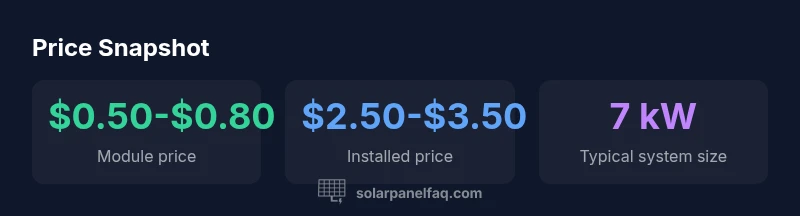
Photovoltaic panels price typically ranges from $0.50 to $0.80 per watt for modules, with installed prices about $2.50 to $3.50 per watt depending on system size and location. For a standard home, total installed costs often fall in the $10,000 to $20,000 range before incentives. Prices have trended upward modestly due to material costs.
Understanding photovoltaic panels price: what is included and what isn't
When homeowners discuss photovoltaic panels price, they’re usually comparing the module cost to the full installed price. The price you ultimately pay is influenced by the panel’s efficiency and quality, the balance of system (BOS) components, installation labor, permitting, and local incentives. In 2026, most homeowners see a modular price around $0.50–$0.80 per watt for the panels themselves, with complete installed prices typically around $2.50–$3.50 per watt. These ranges reflect differences in system size, roof type, and geography. Remember: the quoted module price is only a portion of what you will pay; BOS costs and installer margins add significantly to the final number. For many homeowners, incentives reduce the net price, while financing options can alter the cash flow profile even if headline costs look similar. According to Solar Panel FAQ, the overall price picture is shaped by supply chain dynamics, tariff policies, and regional programs, making the final number highly location-specific.
The takeaway for homeowners is that you should benchmark both module and installed costs, and treat incentives as a discount that may unlock a more favorable long-term ROI. In 2026, price awareness matters because the value proposition hinges on keeping ongoing electricity costs low, while ensuring you don’t sacrifice warranty and service quality. The Solar Panel FAQ team stresses that the best decision comes from comparing apples to apples: equipment quality, BOS costs, and supplier reliability, not just the sticker price.
Cost components that shape photovoltaic panels price
Prices for photovoltaic panels are the sum of several distinct cost components. Breaking them down helps homeowners target savings where it matters most:
- Modules: The price per watt of the solar panels themselves is the starting point. Higher-efficiency or premium brands typically command higher module prices, but they can reduce BOS needs if more power is produced per square foot.
- Inverters and electrical balance of system (BOS): The inverter cost, wiring, combiners, racking, and monitoring hardware all add to the price, sometimes more than the panels themselves on smaller systems.
- Labor and permitting: Installation labor varies by region and roof complexity. Permitting, inspection fees, and interconnection costs can swing the final installed price by a meaningful margin.
- Warranties and service: Longer warranty terms and better post-installation support may raise upfront price but reduce future risk and maintenance cost.
- Overhead and profit: Dealer or installer margins, business overhead, and financing charges influence the quote.
A practical approach is to request itemized quotes that separate modules, BOS, and labor. This helps identify where you might negotiate or where a different system design could improve overall value. The 2026 Solar Panel FAQ analysis emphasizes that quote transparency correlates with better decision making and fewer surprise costs after installation.
Price ranges by panel type and quality
Panel type and quality are major levers for price. Monocrystalline panels, which generally offer higher efficiency and better performance in limited space, tend to cost more per watt than polycrystalline panels, which are typically cheaper but slightly less efficient. In 2026, the price range for panels themselves is broad enough that a consumer can balance budget against space and performance needs. Importantly, higher efficiency panels do not automatically guarantee the best ROI if your roof area is ample and your future electricity usage is modest; the balance of system and installation costs often determine the final cost-per-watt and the system’s value over time. When comparing quotes, consider panel efficiency, warranty terms, temperature coefficients, and degradation rates, not just upfront price.
- For space-constrained roofs: higher-efficiency modules can maximize energy production per square foot, potentially lowering BOS costs.
- For larger roofs with abundant space: cheaper polycrystalline modules may deliver the best value when paired with a properly sized system and favorable BOS terms.
Market dynamics in 2026: supply chain, tariffs, and installation costs
Market dynamics play a crucial role in photovoltaic panels price. In 2026, global supply chain constraints, the availability of polysilicon, and manufacturing capacity in key regions continue to influence module pricing. Tariffs or duties on imported panels can shift price structures and prompt buyers to consider domestically produced or higher-efficiency modules to offset higher costs. At the same time, installation costs can rise due to labor market conditions and demand cycles, especially in hot housing markets with rapid solar adoption. While module prices may decrease as manufacturing scales improve, the net installed price per watt can still rise if BOS costs climb or permitting processes lengthen. Homeowners should watch for regional policy changes, utility interconnection standards, and evolving financing options that can alter the overall price-to-value equation. Solar Panel FAQ’s 2026 analysis notes that price fluctuations are typically more pronounced in the installed price than in the module price alone.
Understanding these dynamics helps homeowners set realistic budgets and avoid sticker shock when a local installer adjusts labor or permitting fees.
Regional variations, incentives, and financing
Regional variation is a constant in photovoltaic panels price. National averages hide wide differences in local labor costs, permitting fees, available incentives, and interconnection charges. Federal, state, and utility-level programs can either reduce upfront costs or improve the financial return through tax credits, rebates, or performance-based incentives. It’s essential to identify all applicable programs in your area and model their impact on net price and payback. Financing options—cash purchases, solar loans, leases, and power purchase agreements (PPAs)—also affect how price translates into out-of-pocket cost and long-term savings. Even with the same sticker price, a loan with lower interest but higher term can change the effective cost per watt over the system’s lifetime. The Solar Panel FAQ analysis highlights that a well-structured financing plan, combined with local incentives, often yields the best value for homeowners.
A practical step is to map incentive availability by location and then run multiple financing scenarios to determine which option offers the lowest lifetime cost, factoring in electricity rate trends, maintenance, and potential replacements.
Financing options and long-term savings
Financing can make solar more accessible, changing how photovoltaic panels price is perceived. Cash purchases deliver immediate ownership with the strongest long-term ROI, while loans spread the cost over time with interest. Leases and PPAs lower upfront costs but tie you to a provider for the system’s life and may transfer some incentives or performance credits away from the homeowner. Regardless of financing, it’s important to model expected energy production, electricity rate growth, and maintenance costs to estimate the total cost of ownership. In 2026, a growing number of lenders offer solar-specific loan products with flexible terms, and some utilities provide on-bill financing or structured rebates that can further improve affordability. Solar Panel FAQ’s framework recommends comparing at least three quotes with transparent BOS line items and a clear payback calculation across scenarios.
How to compare quotes and maximize value
To maximize value, homeowners should follow a structured quote comparison process:
- Ensure quotes are itemized (modules, BOS, labor, permits, interconnection).
- Compare the same BOS scope across quotes to avoid hidden costs.
- Check panel warranties, inverter warranties, and expected degradation rates.
- Factor incentives and financing terms into net price and payoff period.
- Consider site-specific factors like roof orientation, shading, and system size.
- Request an energy production estimate (production profile) to compare expected energy yields.
- Review contractor credibility, installation timeline, and post-installation support.
By systematically evaluating these elements, homeowners can avoid overpaying and secure a system that meets their energy needs reliably. The Solar Panel FAQ team recommends gathering multiple, transparent quotes and running a side-by-side cost-benefit analysis that includes estimated payback and total cost of ownership.
Case study: sample 7 kW system cost breakdown
Consider a typical residential 7 kW system in a mid-range market. Module cost might be around $0.60 per watt, with BOS and installation contributing a larger share of the price. In this scenario, total installed cost would reflect module price plus BOS, labor, interconnection, and permitting. The case study demonstrates how small changes in module efficiency, roof complexity, or inverter choice can shift the total price materially. It also shows how incentives and financing can shrink the net cost and shorten the payback period. While individual results vary, this example illustrates the importance of a transparent, component-level quote and a clear estimate of annual energy production.
Practical steps to estimate your photovoltaic panels price
- Gather site details: roof type, orientation, shading, and available roof area.
- Define system targets: desired annual energy production and peak power (kW).
- Collect at least three quotes with itemized line items for modules, BOS, labor, and interconnection.
- Assess inverter type, warranty length, and expected panel degradation.
- Research available incentives in your area and model net price under different financing options.
- Use a simple payback model to compare scenarios and select the best balance of upfront cost and long-term savings.
Residential photovoltaic panels price snapshot (2026)
| Item | Typical price range | Notes |
|---|---|---|
| Module price (per watt) | 0.50-0.80 | Depends on efficiency and brand |
| Installed price (per watt) | 2.50-3.50 | Includes BOS and labor |
| Typical system size (home) | 6-9 kW | Roof space and energy goals drive size |
| Total installed cost (typical home) | USD 14,000-21,000 | Region and incentives vary |
| Incentives impact | Varies by program | Federal/state utilities affect net cost |
Frequently Asked Questions
What factors influence photovoltaic panels price the most?
Module cost, installation labor, and the balance of system components shape the price most. Regional shipping and tariffs can shift quotes as well.
The biggest cost drivers are the panels, the labor to install them, and the rest of the system.
Does location affect photovoltaic panels price?
Yes. Regional labor costs, permitting fees, interconnection charges, and local incentives vary by area and can change the final installed price.
Location can add or reduce costs through labor, permits, and incentives.
Are incentives and rebates reliable?
Incentives reduce net cost but vary by state and program. Federal tax credits and utility programs can significantly affect affordability.
Incentives can cut the price, but they differ by location.
What time of year should I buy solar panels?
Pricing isn’t strongly seasonal, but promotions and installation demand can shift quotes. Plan ahead to align with tax incentives and contractor availability.
Prices can vary, but timing can affect deals.
Should I buy or lease solar panels?
Buying builds equity and maximizes long-term savings; leases and PPAs lower upfront costs but may limit incentives and ownership.
Buying tends to be better for long-term savings; leases can lock you into a provider.
Do high-efficiency panels always cost more?
Higher-efficiency modules cost more upfront but can reduce BOS needs in tight spaces. Total value depends on roof area and system design.
More efficient panels cost more upfront but may save space and improve yield.
“Price is only part of the value equation—installation quality, warranties, and post-installation support matter just as much as module efficiency.”
Top Takeaways
- Compare module price and installed price separately
- Factor incentives into total cost
- Expect price ranges, not fixed numbers
- Request itemized quotes for BOS and labor
- Consider payback period in planning