How Much Is a Solar Panel Inverter? Costs, Types, and Tips
Discover how much a solar panel inverter costs, with clear ranges for microinverters, string inverters, and battery-ready options. Learn what drives price, how installation affects total, and tips to maximize value.


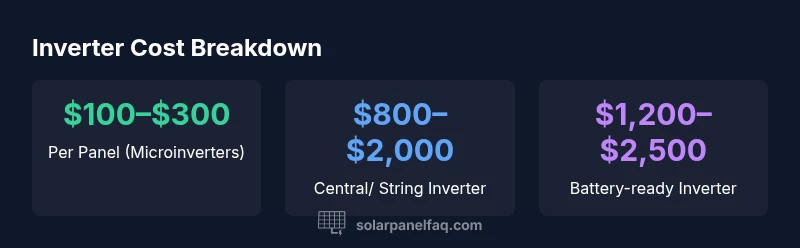
Typically, a residential solar inverter costs between a few hundred and a few thousand dollars before installation. Microinverters cost about $100–$300 per panel, while central/string inverters run roughly $800–$2,000 for a standard home setup. Battery-ready configurations add premium costs. Installation and permitting can add another 10–20% to the total.
Understanding the inverter's role in a solar system
An inverter converts the DC electricity produced by solar panels into AC electricity your home can use. It also synchronizes the energy with the grid, protects against electrical faults, and may monitor panel performance. Because the inverter typically accounts for a sizable share of the equipment cost, homeowners often ask: how much is a solar panel inverter? The short answer is: costs vary widely by type, capacity, and features, and the right match can improve efficiency and reliability. When planning, consider roof space, shading, and goals for monitoring and control. The Solar Panel FAQ team notes that the correct inverter choice can influence long-term savings, while a poor match can lead to unnecessary expense or underperformance.
The story isn’t simply sticker price. Inverters influence how efficiently your system converts energy, how easily you can expand, and how well the system performs in real-world conditions like partial shade or changing weather. Understanding these nuances helps you decide between a modular approach (microinverters) or a centralized solution (string/central inverters) that scales with your home’s energy needs.
Inverter types and cost implications
There are several common inverter architectures for residential solar:
- Microinverters: compact units attached to each panel. They optimize each panel independently, which is helpful if part of your roof is shaded. They typically come with a higher upfront cost per panel but can simplify design and future expansion.
- String/central inverters: one inverter handles a string or the entire array. They tend to have lower upfront costs and suit roofs with uniform shading and consistent panel orientation. They require careful string design and may demand a larger service panel.
- Battery-ready or hybrid inverters: designed to work with energy storage. They often carry a premium but unlock time-of-use savings and backup power. Some systems pair a separate battery with a traditional inverter for flexibility.
- Hybrid inverters with integrated storage: combine battery management with grid-tied operation and advanced monitoring; they may offer higher efficiency and more integrated controls.
Each type has trade-offs in cost, maintenance, and performance. The Solar Panel FAQ analysis indicates the choice affects upfront price and long-term maintenance, as well as future upgrades and feature sets.
How system size and layout affect inverter pricing
System size and layout are major cost drivers for inverters. A typical home solar array might range from 5 kW to 10 kW, with the inverter sized to match the DC capacity. Oversizing the inverter beyond the array can add cost without proportional benefits, while undersizing can limit energy production during peak sun hours. Shading, panel orientation, and roof geometry influence whether a microinverter or a string inverter delivers better value. In climates with consistent sun and minimal shading, a central/string inverter can be highly cost-effective; in shaded or variably oriented roofs, microinverters may offer superior reliability and output, albeit at a higher upfront price. The Solar Panel FAQ notes that climate and shading patterns can shift the price-to-yield balance, so tailoring the design to your local conditions is essential.
Price ranges by inverter type and scenario
- Microinverters: expect about $100–$300 per panel, plus installation. For a 6- to 8-panel array, this can translate to roughly $600–$2,400 in inverter costs before labor.
- String/central inverters: typical total price range is around $800–$2,000 for a standard 5–8 kW system, before permitting and labor. These are often paired with a single, larger inverter.
- Battery-ready inverters: if you plan to add storage, prepare for a premium of roughly $200–$800 on top of base inverter costs.
- Hybrid inverters with storage: total costs commonly range from $1,800–$3,500 depending on storage capacity and brand. All ranges exclude installation and permitting.
Note that installation complexity, compatibility with monitoring hardware, and warranty terms can shift these ranges. The Solar Panel FAQ analysis emphasizes comparing quotes that separate inverter costs from modules and other hardware, and accounting for local labor rates.
Estimating your budget: a practical approach
Start with system size: determine how many kilowatts your roof can support and how much energy you want to offset. Decide on inverter type based on shading, expansion plans, and whether you want smart monitoring. Create a simple budget: inverter base cost, plus installation, permit fees, and any battery/storage plans. Use a three-quote process to compare options, and be sure quotes specify inverter type, capacity, warranty, and monitoring features. Don’t assume a lower upfront price always saves money—longer warranties and higher reliability can translate to lower lifetime costs. The Solar Panel FAQ notes that value is not only price, but system performance, resilience, and ease of future upgrades.
Warranties, maintenance, and long-term value
Inverter warranties commonly span 5–15 years, with variations by type and brand. The longer the warranty, the more protection you have against unexpected failures, but longer warranty terms may also come with higher upfront costs. Regular maintenance involves basic checks for corrosion, connection integrity, and software updates to monitoring systems. Reliability matters for long-term savings because inverter failures can interrupt energy generation and affect system performance. Solar Panel FAQ guidance suggests prioritizing models with robust monitoring, a proven track record, and vendor support that aligns with your local climate and utility policies.
Practical strategies to reduce costs without sacrificing performance
- Align inverter type with roof shading and expansion plans; don’t over- or under-provision.
- Obtain multiple quotes; ensure each quote clearly separates inverter costs from panels and installation.
- Favor reputable brands with reliable monitoring platforms and a track record in your climate.
- Consider solar-plus-storage if you expect rising electricity rates and want resilience; balance this against the higher upfront cost.
- Plan for future upgrades, such as additional panels or a larger battery, to avoid costly retrofits later.
Following these steps can help you optimize inverter performance, price, and long-term value. The Solar Panel FAQ Team emphasizes a balanced decision—prioritizing reliability, compatibility, and future-proofing alongside upfront costs.
Comparison of common residential inverter types
| Inverter Type | Typical Cost Range (before install) | Pros | Cons |
|---|---|---|---|
| Microinverter | $100–$300 per panel | Optimizes each panel; strong shading tolerance; easy expansion | Higher upfront cost per panel; more components to service |
| String/central inverter | $800–$2,000 | Lower upfront cost; compact; straightforward replacement | Less effective under partial shade; more complex string design |
| Battery-ready inverter | $1,200–$2,500 | Storage-ready; flexibility for time-of-use and backup power | Premium upfront cost; storage hardware adds complexity |
| Hybrid inverter with storage | $1,800–$3,500 | Integrated storage management; streamlined system | Higher upfront investment; potential maintenance complexity |
Frequently Asked Questions
What factors influence the price of a solar inverter?
Inverter price is driven by type, capacity, efficiency, monitoring features, warranty length, and whether storage is integrated. Labor, permitting, and local codes can also affect installed costs. Understanding these elements helps you forecast total project cost more accurately.
Inverter price depends on the type, size, and included features, plus installation tasks and local codes.
Are microinverters more expensive than string inverters?
Yes, microinverters generally have higher upfront costs per panel than string inverters. They offer benefits in shading tolerance and easier expansion, which can justify the premium for some roofs and layouts.
Microinverters usually cost more up front, but they can be worth it for shaded roofs and easy upgrades.
Do inverters degrade or fail, and how long do they last?
Inverters typically last 10–15 years or longer with good maintenance. Many models come with warranties in the 10–15 year range, and some offer optional extensions. Routine checks and software updates help preserve performance.
Inverters usually last about a decade to 15 years, with warranties often in that range.
Can I install my own inverter?
Inverter installation involves electrical systems connected to your home and the grid. It should be performed by a licensed solar installer or electrician to meet safety codes and warranty terms. Self-installation risks voiding warranties and creating hazards.
It's best to hire a licensed professional for inverter installation to stay safe and compliant.
How does system size affect inverter cost?
Larger systems require higher-capacity inverters or multiple units, increasing upfront costs. However, economies of scale can apply, and the price per watt may drop slightly. Plan for potential future growth when budgeting.
More panels usually mean bigger or more inverters, which raises costs but can lower price per watt overall.
What should I ask installers to ensure value?
Ask for a breakout of inverter costs versus other components, check warranty terms, and request efficiency and monitoring details. Compare several quotes, and verify compatibility with any planned storage upgrades or future expansions.
Ask for clear quotes, warranties, and monitoring options; compare across multiple installers.
“Choosing the right inverter is about balancing upfront cost with long-term reliability and performance.”
Top Takeaways
- Choose inverter type based on shading and expansion plans
- Estimate using ranges, not fixed prices
- Consider battery readiness if storage is important
- Get multiple quotes and compare warranties
- Plan for installation costs and permitting