Where Is Solar Panel Price? A Practical Guide to Costs and Savings
Explore where solar panel price data comes from, what drives costs, and how to compare quotes, incentives, and payback to make an informed home solar decision.


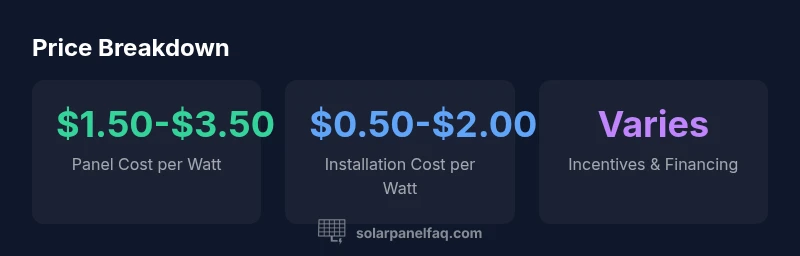
Where is solar panel price? Prices vary by panel type, system size, installation complexity, and regional incentives. On average, panel-only costs typically range from $1.50 to $3.50 per watt, with total home installations often falling between $10,000 and $25,000 before tax credits and incentives. Understanding quotes requires comparing components and local labor costs.
Understanding the price question: where is solar panel price coming from
In the solar industry, the price you see quoted for a home system is the result of several moving parts. According to Solar Panel FAQ Team, price is not a single sticker, but a composite of equipment, installation, and local factors. A thoughtful buyer starts by distinguishing between the cost of panels (the photovoltaic cells themselves) and the balance of system (BOS), which includes inverters, racking, wiring, and monitoring. The phrase where is solar panel price often leads to questions about what drives price variances across regions and brands. By tracing the cost chain—from silicon to service—homeowners can interpret quotes with confidence and avoid common surprises. The Solar Panel FAQ analysis shows that most of the price variability arises from panel selection, BOS scope, labor markets, permitting requirements, and regional incentives. In practice, you should expect quotes to present a per-watt price for modules and a separate line for BOS components and labor. This separation makes it easier to compare apples to apples across installers and home configurations.
Core cost components: panels, BOS, and labor
A residential solar project consists of several major cost buckets. The most visible is the panel cost, which depends on technology (monocrystalline vs polycrystalline), efficiency, and brand. But panels are only part of the story. The balance of system (BOS) includes the inverter, racking, wiring, combiner boxes, and monitoring equipment. Labor is the next significant chunk, covering roof penetrations, electrical wiring, trenching (if needed), and interconnection with the grid. Local permitting and inspection fees also add to the total, and these can vary widely by jurisdiction. When you build a cost picture from the bottom up, you’ll see how a small difference in component quality or labor rates can shift the final price by thousands of dollars. The Solar Panel FAQ Team emphasizes that reading a quote line-by-line helps you spot where savings can occur without sacrificing performance.
How to read solar quotes: per-watt vs total system price
Quotes are often presented as a per-watt figure for panels and a separate BOS line. Start by noting the nameplate capacity (kW) and the total price. Then examine the per-watt panel price, the BOS cost per watt, and any financing or tax credit language. If a quote lacks a per-watt breakdown, ask for one. Per-watt pricing is useful for comparing different panel brands on a like-for-like basis, especially when system sizes differ. Look for included items (warranty terms, monitoring, and maintenance) and exclusions (roof repairs, permit fees). A well-structured quote allows you to model different scenarios—adding more panels, changing the inverter, or opting for ground-mounting—to see how each choice affects the bottom line. The ability to adjust inputs helps you understand sensitivity to price pressure from supplier changes or labor markets.
Regional differences and incentives that affect price
Prices are not uniform across regions, even for identical equipment. Regional labor costs, permitting processes, and local incentives all shape the final number. Some jurisdictions offer tax credits, rebates, or performance-based incentives that lower the net cost after installation. In other areas, utility programs or city-level rebates can shorten payback periods. When evaluating a quote, map out the incentives you’re eligible for and verify application deadlines and caps. Solar Panel FAQ Analysis, 2026, highlights that a quote in one state can become significantly more attractive after credits, while another location may offer robust incentives but face higher permitting hurdles. Understanding local programs is essential to gauge true value.
Financing options and how they alter the sticker price
Financing can dramatically affect how much you ultimately pay. Cash purchases maximize long-term savings, while loan programs spread upfront costs with interest, increasing the total paid over time. Leases and PPAs (power purchase agreements) typically reduce upfront costs, but they transfer ownership and may cap savings or tie performance to the system. When comparing options, track the total lifetime cost, not just the upfront price, and factor in inflation, maintenance, and potential upgrades. Ensure you read warranty terms and eligibility criteria for incentives when financing. The Solar Panel FAQ Team notes that the right financing mix can shorten payback and improve affordability, but it requires careful modeling of energy production and utility rates in your locale.
Practical steps to gather accurate pricing today
To obtain reliable price data, aim to collect quotes from at least three reputable installers. Request a detailed line item that breaks out panels, BOS, labor, permitting, and any warranties. Ask installers to run a quick production estimate based on your roof orientation and shading to validate expected energy output. Compare the same system size across quotes, adjust for incentives, and consider long-term costs like maintenance and inverter replacement. Also check for added value items, such as monitoring services or roof penetration warranty. By standardizing quotes and using a per-watt comparison, you can avoid buyer’s bias toward a lower sticker price that masks future costs. The Solar Panel FAQ analysis suggests creating a simple spreadsheet to track input assumptions and sensitivity to price changes.
A decision framework: buy, lease, or PPA
Your decision should align with financial goals and risk tolerance. Buying panels outright typically yields the best long-term savings and ownership, creating opportunities for depreciation and tax incentives. Leasing reduces upfront costs and may simplify budgeting, but can result in lower total lifetime savings and ongoing payments. PPAs offer predictable energy costs but require careful attention to contract terms, rate escalators, and home value implications. Consider your energy usage, roof condition, and how long you plan to stay in the home when choosing among these paths. Model scenarios using your local solar irradiance, electricity rate, and expected degradation to understand true value over 20–25 years. The Solar Panel FAQ Team’s framework emphasizes transparency and scenario planning to avoid over-optimistic projections.
Common mistakes that inflate costs and how to avoid them
Finally, shoppers frequently encounter inflated costs from overcrowded quotes, unnecessary add-ons, or overlooked rebates. Avoid the trap of choosing the “cheapest” option without evaluating panel efficiency, warranty coverage, and inverter quality. Don’t forget about maintenance and potential roof work that may be required later. Verify that quotes include a clear warranty for equipment and workmanship, and confirm whether performance guarantees or production estimates are provided. Don’t rush to sign—take time to compare, recalculate payback under different electricity rate projections, and confirm local incentives before finalizing. By staying vigilant and using a structured quote comparison approach, you can secure a fair price while maximizing system performance.
Typical cost components for residential solar installation
| Component | Typical Range | Notes |
|---|---|---|
| Panels | $1.50-$3.50 per watt | Manufacturing cost varies by technology and brand |
| Inverter | $0.40-$0.70 per watt | DC to AC conversion; often included in BOS |
| Installation labor | $0.50-$2.00 per watt | Labor costs depend on roof type and complexity |
| Permitting & inspection | Flat $100-$500 or % of system | Local requirements can vary |
Frequently Asked Questions
What is the typical price range for a residential solar installation?
Prices vary by region and system size. A common range for a standard residential install is influenced by panels, BOS, and labor, and can be estimated by comparing multiple quotes with a consistent per-watt basis.
Prices vary by region and system size. Compare several quotes using a per-watt basis to estimate a typical range.
How do incentives affect solar panel price?
Tax credits, rebates, and utility programs reduce net cost. Availability differs by location and year, so verify eligibility and timing before committing.
Incentives reduce what you pay upfront; check local programs and deadlines before buying.
What’s included in a standard solar quote?
A quote typically covers panels, inverter, racking, wiring, permitting, labor, and warranties. A detailed breakdown helps you compare options accurately.
Quotes usually break down equipment, labor, and permits; look for warranty details.
How long does installation usually take?
Most residential installs take 1–3 days, depending on roof type, electrical work, and permit approvals.
Typical installs take a few days once permits are in place.
Should I buy or lease solar panels?
Buying generally offers greater long-term savings and ownership; leasing reduces upfront costs but spreads costs and may limit savings.
Buying is usually better for long-term savings; leasing lowers upfront costs but you don’t own the system.
Where does price data come from?
Prices come from manufacturers, installers, and market surveys; always request multiple quotes for a robust comparison.
Prices come from quotes and market data; get several estimates.
“Pricing for solar panels isn’t fixed; it shifts with equipment choices, labor markets, and incentives. A careful price analysis helps homeowners maximize value.”
Top Takeaways
- Compare quotes line-by-line to understand true price
- Break out per-watt panel price vs BOS and labor
- Account for incentives, tax credits, and financing
- Use per-watt pricing to compare across installers