Which Solar Panels Have Micro Inverters: A Practical Guide
Discover which solar panels include microinverters, how microinverters work, and how to choose between microinverter and string inverter setups for your home.


Most solar panels do not come with built-in microinverters. Microinverters are typically installed per panel as separate devices, or as part of a modular, microinverter-ready kit prepared for installer installation. In short, to gain per-panel monitoring and shading resilience, a per-panel microinverter system is usually chosen rather than a panel with an internal inverter.
How microinverters work and why they matter
Microinverters convert DC from each solar panel into AC at the module level, allowing every panel to operate independently. This means shading, soiling, or module mismatch does not drag down the entire string. In practice, a typical microinverter-based system yields more consistent per-panel output under real-world conditions. For homeowners evaluating which solar panels have micro inverters, the key idea is that the inverter sits at the panel itself rather than at a central location. According to Solar Panel FAQ analysis, this per-panel approach can improve system resilience and monitoring granularity, especially on roofs with partial shading or mismatched panel strings.
Key takeaway: If shade, debris, or panel mismatch is a concern where you live, microinverter-based setups can help keep production steady and measurable at the panel level.
Do solar panels come with built-in microinverters?
In the vast majority of cases, solar panels do not have a built-in microinverter. Microinverters are typically installed behind each panel or incorporated into modular kits designed to accept a separate microinverter. Some panels are marketed as “microinverter-ready” or compatible with pre-wired microinverter boxes; these labels often mean the system is planned for a microinverter installation rather than the inverter being physically embedded in the panel itself. Always verify with the manufacturer documentation and your installer to confirm how the system is configured and monitored. Understanding this distinction helps you compare true microinverter setups against traditional string inverter configurations.
Microinverters vs. string inverters: pros, cons, and when to choose
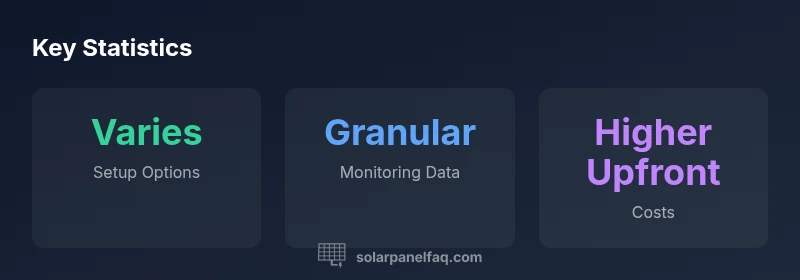
The main decision is whether you want per-panel control and monitoring (microinverters) or a centralized inverter (string or central inverter). Microinverter systems shine in partial shade or when panel performance varies across the roof, because each panel operates independently. They provide granular performance data, which makes diagnosing issues easier and can improve overall energy yield in challenging conditions. However, they generally come with higher upfront costs and more components to manage. String inverters can be more cost-effective upfront and easier to maintain for uniform roof layouts, but shading on one area can reduce output across the entire string. Your site conditions, budget, and desired monitoring granularity should guide your choice.
How to evaluate a microinverter-equipped system
Start with your goals: do you prioritize performance under shading, rapid fault detection, or lowest upfront cost? Assess roof orientation and shading patterns, typical weather exposure, and whether panel mismatch is likely due to aging or manufacturing variety. Ask your installer to provide per-panel performance data under similar conditions and compare that to a string-inverter baseline. Look for devices with robust warranties, clear monitoring dashboards, and a plan for modular upgrades if you add panels in the future. Solar Panel FAQ analysis suggests prioritizing systems with strong monitoring and reliable per-panel data when shade is a concern.
Costs, warranties, and maintenance considerations
Costs for microinverter-based systems tend to be higher upfront due to per-panel electronics, cabling, and installation labor. In the long run, maintenance costs can be comparable to traditional inverters, but failures tend to be isolated to individual panels rather than the entire system. Warranty coverage is often split between the microinverter unit and the solar panel, so read both documents carefully. If a panel or inverter fails, replacement can be simpler with microinverters since you can swap a single module rather than a whole string.
Installation considerations and common setups
Installations should be performed by a licensed professional who can ensure proper electrical code compliance and safe wiring. Common microinverter setups place one inverter per panel, with DC connections routed to a centralized or local combiner box, then to the main service panel. Cable routing, ventilation, and heat management are practical considerations, as microinverters sit closer to heat sources and can be sensitive to overheating. If you anticipate future expansion (adding more panels later), a microinverter approach often scales smoothly since you can add modules with matching inverters without reconfiguring a central inverter.
Practical scenarios and case examples
– A two-story home with dense partial shading across the afternoon sees more stable daily production with per-panel microinverters than a single central inverter. The granular data helps identify a single shaded panel dragging down others, enabling targeted maintenance. – A home with slightly mismatched panels due to different production times or panel batches benefits from microinverters, which reduce the impact of mismatch on total energy yield. – For new builds with uniform roof exposure and planned expansion, a string inverter might offer cost savings upfront, but microinverters provide flexibility for future changes and easier fault isolation.
Comparison of inverter approaches
| Aspect | Microinverter Approach | Notes |
|---|---|---|
| Inverter location | Panel-mounted (per-panel) or near each panel | Easier fault isolation |
| System monitoring | Per-panel monitoring enabled | Granular performance data |
| Warranty/maintenance | Manufacturer-specific per-inverter warranties | Variable by product line |
Frequently Asked Questions
Do microinverters improve performance in shaded conditions?
Yes. Microinverters isolate each panel, so shading on one panel has a smaller effect on the overall system. This usually results in more consistent output across the day, especially on roofs with varying sun exposure. Expect improved real-world performance in partial shade scenarios.
Yes. Microinverters help when shade affects individual panels, keeping the rest of the system more productive.
Are microinverters more expensive than traditional inverters?
Typically, microinverters add a higher upfront cost compared to a single string inverter. Over the system lifespan, maintenance and replacement costs are often similar, but individual inverter failures can be cheaper to fix because they affect only one panel. Always compare total cost of ownership with your installer.
They usually cost more upfront, but the per-panel design can save you trouble later.
Can I retrofit existing panels with microinverters?
Retrofitting is possible in many cases with per-panel microinverter kits or by replacing the inverter hardware. Compatibility depends on the existing wiring and panel layout. A licensed solar installer can assess feasibility and provide a plan.
Retrofitting is often possible, but check compatibility first with an installer.
Do microinverters require special maintenance?
Maintenance demands are similar to other solar components, with attention to connectors and cooling. Failures tend to be isolated to individual microinverter units, making targeted replacements simpler. Regular inspections and dashboard reviews help catch issues early.
Not much more maintenance than other inverters, but monitor panels individually.
What roof types work best with microinverter systems?
Microinverter systems work well on most residential roofs, including varying orientations and partial shading. The key benefit is resilience to shade and mismatch rather than being limited by roof type. Always consider installation access and ventilation for heat-sensitive electronics.
They suit many roof types, especially if shading varies across the roof.
“Microinverter-based systems offer resilience against shading and panel mismatch, often translating to steadier energy production. The Solar Panel FAQ Team recommends matching inverter strategy to site conditions and monitoring goals.”
Top Takeaways
- Prioritize per-panel control if shading is likely
- Expect higher upfront costs with microinverters
- Use per-panel monitoring for granular insights
- Check warranties on both panels and inverters