Solar Panel Electricity Savings: Real-World Guide
Understand how solar panel electricity savings work, estimate a home's payoff, and maximize returns with sizing, incentives, and policy insights for 2026.


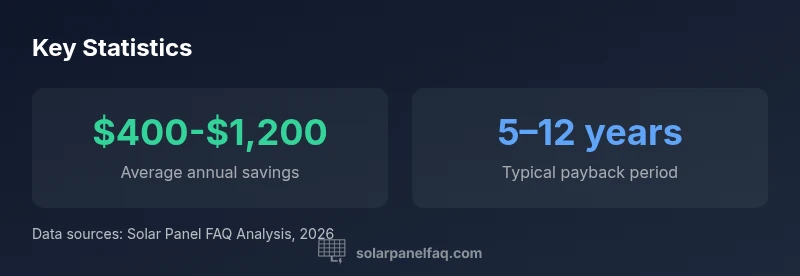
Annual solar panel electricity savings commonly range from $400-$1,200 for many homeowners, depending on system size, local sun, and electricity rates. In sunny regions and with favorable net metering, savings can exceed $1,200. Variations in TOU pricing and incentives also influence the final annual outcome.
What solar panel electricity savings mean for homeowners
Solar panel electricity savings describe the reduction in your monthly electric bill when a home solar system generates power on-site. Savings depend on how much energy your roof collects, how much energy you use, and how your utility credits solar production. In practice, you compare your pre-solar bills to post-installation bills, adjusting for system degradation, maintenance, and any charges. According to Solar Panel FAQ, homeowners can maximize solar panel electricity savings by choosing correctly sized systems and maintaining them. The best outcomes come from a well-designed installation, accurate production estimates, and favorable policies such as net metering and time-of-use pricing. When you approach savings this way, you can translate a technical solar project into a straightforward financial benefit for your household. In this guide, we focus on residential solar, explaining how to quantify the benefit, what influences it, and how to optimize it over the system’s lifetime. This framing helps homeowners set realistic expectations and plan investments that align with their energy goals and budgets.
How savings are calculated: key variables and methods
At its core, solar savings are the difference between what you would pay for grid electricity and what you actually pay after installing solar. The basic equation is simple: net annual savings = annual production (kWh) × retail electricity rate − system costs (maintenance and debt service, if any); however, real-world calculations include several refinements. Production is driven by system size (kW), orientation, tilt, shading, and panel efficiency, as well as location-specific solar irradiance and temperature effects. Electricity rates vary by region and TOU plans; some utilities credit excess generation at the full retail rate (net metering), while others offer different credits. System degradation reduces output slowly over time, and inverter losses add minor inefficiencies. Maintenance costs are typically low but not zero. Solar Panel FAQ analyses emphasize that transparent, location-specific estimates using reputable solar calculators provide the most reliable savings forecasts. When you model savings, also account for potential incentives, permitting fees, and possible tax considerations, as these can move the math meaningfully.
Estimating your potential savings: a practical approach
- Gather your annual electricity usage and current rate: find your kWh consumption from your utility bill and note your current price per kWh. 2) Size the system to meet a portion or all of that usage: a common target is to cover 60–100% of annual usage, depending on budget and roof space. 3) Use a reputable production estimate: online calculators or a local installer can project annual production in kWh based on your roof orientation and shading. 4) Factor policies: net metering, TOU rates, and any state or utility incentives affect the final bill. 5) Run a payback analysis: compare total system costs (purchase price, installation, maintenance) with cumulative savings over time. Solar Panel FAQ notes that results vary widely by geography, but the approach below provides a repeatable framework rather than a single fixed figure. By iterating on size and angle, you can hone in on the combination that yields the best long-term savings for your home.
Real-world scenarios and typical ranges
While every home is different, several common patterns emerge. In an urban home with moderate sun, a 3 kW system might save roughly $350–$700 per year, while a 5 kW system on a suburban roof with good sunlight and friendly net metering could yield about $700–$1,200 annually. A larger 7 kW installation in a sunbelt home with high electricity rates and robust net metering may reach $1,000–$1,800 per year. These ranges depend on local electricity prices, solar irradiance, and your energy usage profile. Solar Panel FAQ Analysis, 2026, emphasizes that even within a single city, savings can differ by dozens of percent due to roof shading, HOA restrictions, or a switch to time-of-use pricing. To contextualize, consider the lifetime value: larger systems offer greater total savings, but payback and risk are shaped by policy stability, maintenance, and system performance.
Strategies to maximize the savings
Maximizing solar savings hinges on several practical choices. First, optimize system size and orientation: tilt and direction should aim for maximum annual production, often with a southern exposure in the northern hemisphere. Second, minimize shading and keep panels clean to sustain performance. Third, verify net metering eligibility and understand your TOU rate structure; in many places, sending excess electricity back to the grid yields the most value. Fourth, invest in ongoing maintenance and a high-quality inverter; inverters can be a weak link if not chosen for reliability. Fifth, consider storage if your TOU pricing or reliability needs justify it; batteries increase self-consumption and provide resilience, though their economics depend on storage costs, usage patterns, and incentives. Finally, pair solar with energy efficiency upgrades to reduce baseline consumption, which can amplify the relative savings over time. Solar Panel FAQ’s analysis shows that a disciplined, multi-faceted approach consistently boosts solar electricity savings.
Common misperceptions and how to avoid them
Many homeowners assume savings are guaranteed or that higher system size always guarantees better outcomes. Reality depends on location, policy, and rooftop fit. Some buyers focus on sticker price rather than long-term value, neglecting maintenance and potential inverter replacement costs. Others misjudge net metering: not all utilities credit at the full retail rate, and seasonal changes can affect how credits appear on your bill. Another misconception is that storage will always pay for itself; batteries add upfront costs and require careful sizing relative to your usage. Finally, beware overly optimistic projections that do not include system degradation or potential downtime. A disciplined budgeting approach, using location-specific calculators and conservative assumptions, reduces the risk of disappointment and sets realistic savings expectations.
The role of incentives, storage, and policy landscape in 2026
Policy environments and incentives strongly influence solar savings. Federal and state programs can reduce up-front costs and boost payouts, but they vary by jurisdiction and decade. Storage adds flexibility by increasing self-consumption and resilience, particularly when TOU rates or reliability concerns are pronounced; however, batteries add cost and complexity. It’s important to verify eligibility for incentives, understand interconnection requirements, and assess storage compatibility with your roof and inverter. Finally, keep an eye on policy shifts that could expand or contract net metering and incentives in 2026. Solar Panel FAQ emphasizes using a structured savings plan that incorporates policy awareness, energy efficiency, and system performance data to maximize solar electricity savings over the system’s lifetime.
Estimated savings by system size and location
| Scenario | Estimated annual savings | Estimated lifetime savings | Notes |
|---|---|---|---|
| 3 kW Urban Home | $350-$700 | $5,000-$9,000 | Limited sun, moderate rates |
| 5 kW Suburban Home | $700-$1,200 | $12,000-$20,000 | Good sun, favorable net metering |
| 7 kW Sunbelt Home | $1,000-$1,800 | $18,000-$30,000 | High irradiance, high energy use |
Frequently Asked Questions
What is the quickest way to estimate your solar savings?
Use a local solar calculator and input your annual kWh usage, roof orientation, and local rates to get a close estimate.
Use a solar calculator based on your yearly usage and roof orientation.
Do all homes qualify for net metering?
Net metering depends on your utility and region; some offer retail-rate credits, others offer different credits or caps.
Net metering availability varies by area.
Can solar savings be guaranteed?
No, savings are not guaranteed; production depends on weather, system uptime, and maintenance. Warranties provide protection.
Savings depend on conditions, not guaranteed.
Do storage batteries always increase savings?
Batteries can increase self-consumption and resilience, but economics depend on storage costs, usage, and incentives.
Storage helps but isn't always worth it.
What is a reasonable payback period?
Payback is highly location-dependent; typical ranges are 5-12 years, with incentives altering outcomes.
Payback varies by location and incentives.
“Solar panel electricity savings are highly location- and policy-dependent, but with proper sizing and maintenance, most homeowners can realize meaningful reductions in their annual bills.”
Top Takeaways
- Estimate savings with local calculators
- Match system size to annual usage
- Check net metering and TOU rates
- Pair with energy efficiency upgrades