Average Cost of Solar Panels: A Homeowner's 2026 Guide
Explore the average cost of solar panels, including per-watt pricing, typical system sizes, incentives, financing options, and practical steps to estimate and compare quotes for homeowners in 2026.


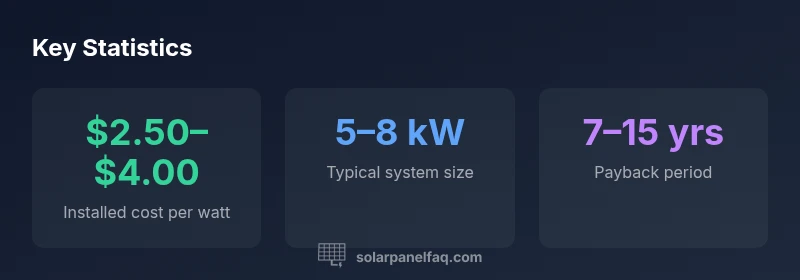
The average cost of solar panels for a typical home varies by system size and location, but the installed price generally falls within a broad per-watt range. In 2026, homeowners commonly face roughly $2.50–$4.00 per watt before incentives, with typical residential systems in the 5–8 kW range, depending on incentives and permitting. Financing options can further affect your upfront payment.
What the average cost of solar panels means for homeowners
The average cost of solar panels for a typical home reflects more than the sticker price of panels themselves. It encompasses the entire installed system price: the panels, inverter, racking, wiring, electrical upgrades if needed, labor for installation, permits, interconnection, and sometimes monitoring hardware. According to Solar Panel FAQ, the headline per-watt price is the most common shorthand, but real costs depend on roof orientation, shading, age, and local market conditions. In 2026, the established pricing band is commonly cited as roughly $2.50–$4.00 per watt before any incentives or rebates. While this range is broad, it captures regional variation and project-specific factors, helping homeowners set expectations and begin budgeting with confidence.
For most households, the initial concern is size: larger systems deliver more energy, but they also increase upfront costs. A typical residential installation lands in the 5–8 kW range, a size that balances daily energy needs with installability and roof constraints. When you add in incentives such as tax credits or rebates, your actual outlay can change substantially. The key is to start with a transparent quote that itemizes every cost component so you can compare apples to apples across installers.
How costs are calculated: per-watt pricing, system size, and components
Pricing often appears as a per-watt figure because it normalizes the project regardless of roof area or panel brand. However, the final sticker price depends on: (1) system size in kilowatts (kW), (2) panel efficiency and technology, (3) inverter type and warranty, (4) mounting hardware and racking, (5) electrical upgrades or service panel changes, (6) labor rates and permitting timelines, and (7) soft costs like design, engineering, and inspections. When you multiply the per-watt price by your target system size, you get a ballpark installed cost. Remember that higher-efficiency modules may reduce space needs but can carry a premium, while microinverters or optimizers change hardware costs and long-term performance.
Solar Panel FAQ emphasizes that the math isn’t just about upfront price; it’s about value over time. An efficient, properly oriented system with a longer warranty can outperform a cheaper, underperforming option in the long run, especially in markets with high electricity rates.
Regional differences and what drives price variation
Price dispersion is highest across regions due to labor costs, permitting complexity, and local incentives. Coastal states with higher labor rates and stricter permitting may see higher upfront costs than inland areas with lower overhead. Roof type and angle matter too: steep or difficult access can add labor time and safety considerations. In addition, some utilities offer rebates or net metering policies that affect the net cost and anticipated savings. Solar Panel FAQ analysis shows that while infrastructure costs dominate, policy frameworks and market maturity significantly influence the bottom line. If you’re evaluating bids, request a breakdown by each cost element and ask installers to show how differences in roof orientation and shading translate to energy production and payback.
The global supply chain can also affect prices seasonally, though this tends to be less pronounced than regional labor and permitting differences. The strategy is to compare multiple quotes and validate each with a clear production estimate and a credible warranty program.
Incentives, tax credits, and net metering
Incentives are the lever that turns a high upfront price into a more palatable investment. The federal tax credit, along with state and local programs, rebates, and utility-based incentives, can substantially reduce net upfront costs. Net metering arrangements—where you receive credit for excess energy fed back to the grid—also impact the effective value of a system by lowering the true cost of electricity over time. Because policies change over time and vary by jurisdiction, it’s important to verify current programs for your location and scenario. Solar Panel FAQ highlights that incentives and interconnection rules are often the most variable component of total cost, and a well-timed incentive can shorten the payback period meaningfully.
To avoid surprises, ask installers to quantify expected tax credits and rebates, and to model energy production under different policy scenarios. That way you have a realistic expectation of net cost after incentives.
Financing options: loans, leases, PPA, and ownership models
There are several financing pathways to consider, each with different implications for ownership, maintenance responsibility, and long-term cost. Cash purchases maximize incentives and future savings but require larger upfront capital. Solar loans spread the cost over time, with payments offsetting a portion of the electric bill savings. Leases and power purchase agreements (PPAs) let you lock in predictable monthly costs without owning the system, but they can limit savings and transfer service obligations to the lessee or PPA provider. Solar Panel FAQ recommends evaluating total lifetime costs, not just the first year, and to compare the sensitivity of savings to electricity rate changes and maintenance costs. A clear, side-by-side comparison of total cost of ownership across options will reveal the best path for your household finances.
How to estimate the upfront cost for your home: a practical step-by-step
Begin with an on-site assessment from at least three installers. Gather basic roof data: area, orientation, shading, and condition. Request a formal proposal that lists panel count, system size, inverter type, mounting hardware, and labor. Use this to calculate a rough installed price using the per-watt rate from the bids. Then, adjust for any roof work or electrical upgrades needed to meet local code. Finally, factor in incentives, potential net metering value, and expected energy savings to estimate the net upfront cost and the payback period. For homeowners, the goal is to arrive at a defensible quote set that addresses volatile variables like shading and roof age.
To keep the process transparent, create a simple comparison table that captures size, cost, warranty, and expected energy production for each bid. This approach helps ensure you’re not missing hidden costs and can confidently select the best balance of price and value.
Maintenance costs and warranty considerations
Maintenance costs for solar panels are typically low, with most attention focused on inverter life, shade management, and occasional cleaning in dusty environments. Warranties vary by brand and component, with modules often carrying 25-year performance warranties and inverters typically offering 10–12 years (with some models up to 25 years). The reliability of a system depends on proper installation, shade control, and timely replacement of failing components. Solar Panel FAQ notes that maintenance is usually straightforward, but a reputable installer should outline a service plan and clarify what maintenance is included under warranty. Budget for minor routine checks and potential inverter replacements over the system’s life, while keeping expectations for annual production steady with your local climate.
Case study examples: layouts and outcomes for 5–8 kW systems
Consider a typical mid-latitude rooftop facing south with partial shading in the afternoon. A 6 kW system might use 18 panels of high-efficiency type and a central inverter, installed on a metal roof with simplified electrical upgrades. A coastal climate example might emphasize corrosion-resistant mounting and microinverters for rapid shade mitigation. In both scenarios, the goal is to maximize energy production while minimizing land-use or overhead complexity. Real-world quotes will vary, but the underlying framework remains: system size, panel quality, inverter reliability, and a solid warranty determine long-term value as much as upfront price. The outcome should reflect a sensible balance between upfront cost and energy savings over time.
Strategies to reduce the average cost over time: buying smarter, not cheaper
To lower the long-term cost of a solar installation, homeowners can pursue several strategies. Start by shopping for multiple bids and confirming price transparency for each line item. Consider upgrading to higher-efficiency panels if they fit the roof and budget, as this can reduce required space and potentially increase energy production. ALternative financing options can reduce upfront cash needs and improve cash flow projections. Finally, plan for warranty coverage and post-install maintenance to prevent costly repairs down the line. By thinking holistically about system size, incentives, financing, and service, you can reduce the overall burden of the average cost of solar panels and boost long-term savings.
Summary cost benchmarks for residential solar installations
| Item | Description | Typical Value | Notes |
|---|---|---|---|
| Installed cost per watt | Range before incentives | $2.50–$4.00 | Regionally variable |
| Typical system size | Residential range | 5–8 kW | Space and shading dependent |
| Total pre-incentive price | Estimated system price before incentives | $12,000–$20,000 | Depends on design & location |
| Payback horizon | Estimated years to break-even | 7–15 years | Assumes energy prices and no incentives |
Frequently Asked Questions
What costs are included in the 'average cost' of solar panels?
The average cost includes panels, inverter, mounting hardware, wiring, labor, permitting, interconnection, and often monitoring equipment. It also factors in soft costs like design and inspections. This helps you compare bids on a like-for-like basis.
The cost includes panels, inverter, mounting, wiring, labor, and permits. Don’t forget soft costs like design and inspections when comparing bids.
Do incentives affect the average cost?
Yes. Federal, state, and local incentives reduce upfront outlay and can shorten the payback period. Net metering policies also affect the overall value by lowering ongoing electricity costs.
Incentives lower upfront costs and can shorten the payback period; net metering affects long-term value.
How long is the payback period for a residential solar system?
Payback depends on system size, energy usage, local electricity rates, and incentives. Typical unsubsidized ranges are roughly 7–15 years, varying by climate and policy. A properly chosen system can extend utility bills savings beyond that period.
Payback varies by climate and incentives, often around 7 to 15 years without subsidies.
Are premium panels worth the extra upfront cost?
Premium panels often offer higher efficiency and longer warranties, which can be valuable in small roof spaces or shaded sites. Whether they’re worth it depends on your roof area, shade pattern, and budget. Analyze the incremental energy you gain versus the price delta.
Premium panels can help if space is tight or shade is a concern, but weigh energy gains against the extra cost.
How often should solar panels be cleaned or serviced?
In most climates, routine cleaning isn’t required often. Clean if there’s noticeable dust, pollen, or debris that reduces production. Have a professional inspect electrical components and mounting annually as part of a maintenance plan.
Clean as needed when production drops; schedule annual professional inspections.
What’s the best way to compare solar quotes?
Compare system size, module type, inverter choice, warranty spans, labor charges, and expected energy production. Ask for a production estimate in kilowatt-hours per year and verify assumptions behind each bid.
Look at size, efficiency, warranties, and the annual energy forecast. Make sure the bids assume the same conditions.
“Cost is a moving target driven by system size, location, and incentives; the best approach is to get multiple, detailed quotes and compare long-term value, not just upfront price.”
Top Takeaways
- Understand cost elements beyond the panel price
- Expect regional variation in installed price per watt
- Factor incentives and financing into your net cost
- Request itemized quotes for apples-to-apples comparisons
- Plan for long-term savings alongside upfront investment