Can One Solar Panel Charge Two Batteries? A Practical Guide
Explore whether a single solar panel can charge two batteries, including wiring options, controller sizing, and practical setups for home solar systems.


Can one solar panel charge two batteries? Yes, with proper balancing and a controller. A single panel can feed two batteries, but you must size the controller, choose compatible chemistries, and wire in a way that prevents cross-charging. The exact setup depends on panel wattage and battery type.
Can One Solar Panel Charge Two Batteries? Feasibility and Core Concepts
A single solar panel can charge two batteries, but only when the configuration maintains balance and prevents cross-charging. In most home setups with two 12-volt batteries, you’ll wire the bank in parallel to keep the voltage at 12V while increasing available capacity. This approach requires a controller sized for the total current your panel can produce and for the total bank you’re charging. If you connect the batteries in series to form a higher voltage, you’ll need a higher panel voltage and a controller that supports that configuration, but this is less common for typical 12V storage. The chemistry matters: lead-acid and lithium batteries behave differently when tugged by the same source, so matching chemistries and temperatures can prevent uneven aging. Monitoring is essential: watch voltage, state-of-charge, and temperature, and avoid letting one battery become overcharged while the other lags.
Practical takeaway: start with two matched 12V batteries wired in parallel for a straightforward setup, then scale as needed with a properly sized MPPT controller.
Safe Wiring Practices and Controller Sizing
- Use a true MPPT charge controller that can handle the total current and bank voltage. - Size the controller to accommodate both the panel’s maximum current and the battery bank’s charging demands. - For two identical 12V batteries, parallel wiring keeps voltage at 12V while increasing capacity; always include proper fusing and gauge wiring. - If you need a higher bank voltage (24V or more), design for series configuration only if your panel output and controller support it, and ensure all batteries share the same chemistry and age. - Temperature sensing and battery monitoring are essential; uneven temperatures can distort charging balance. - Avoid cross-charging by selecting a controller with built-in balancing and by keeping the batteries matched in age, capacity, and chemistry.
Battery Chemistry Considerations and Real-World Scenarios
Different chemistries behave differently under the same charging source. Lead-acid types (flooded, AGM) tolerate certain charging profiles that LiFePO4 cells may not, and Li-ion packs require strict voltage and current limits. When pairing two batteries with a single panel, match chemistry, capacity, and age as closely as possible. If you mix chemistries, use a system with individual monitoring for each battery and consider separate banks or a controller that can manage distinct charging profiles. Real-world setups often favor two identical batteries wired in parallel with an MPPT controller sized for the combined current. Be mindful of temperature effects and voltage drop over long cables, which can skew the balance between batteries.
Troubleshooting and Maintenance
- Regularly monitor charging voltage and battery temperatures to catch imbalance early. - Check connectors, fuses, and wiring for corrosion or loose terms that can create resistance and heat. - If one battery consistently charges slower or shows higher voltage when the other is near full, consider rebalancing or replacing one bank member. - Use a battery monitor that can display each battery’s SOC independently, not just the system average. - If you must disconnect one battery for maintenance, ensure the other remains isolated from charging to avoid backfeeding.
Charging configurations for one panel feeding two batteries
| Configuration | Voltage (nominal) | Typical Benefits | Typical Drawbacks |
|---|---|---|---|
| Parallel two 12V batteries | 12V | Balanced charging; easier SOC matching | Potential cross-charge if controller inadequate |
| Series to 24V | 24V | Higher voltage can reduce conductor losses | Not suitable for mismatched chemistries or capacity |
| Dedicated controller per battery | Independent control | Maximum flexibility; easier balancing | Higher cost and more complex wiring |
Frequently Asked Questions
Can one solar panel charge two batteries at once?
Yes, with proper wiring and a controller that balances the two batteries. Parallel wiring for 12V banks is common, while series wiring requires higher voltage and a compatible controller.
Yes—use a controller and matched batteries to balance two batteries from one panel.
What size charge controller do I need for two 12V batteries?
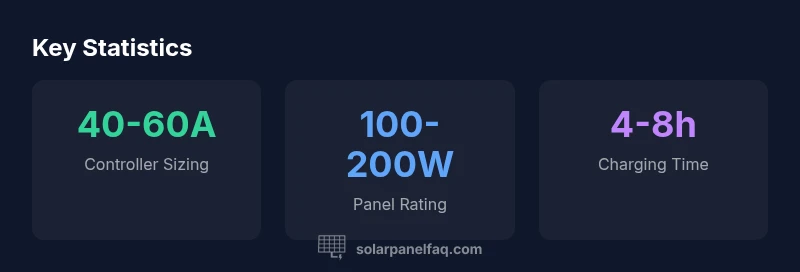
For typical 200–400W panels, a 40–60A MPPT controller is a common starting point, but sizing depends on your panel and total bank capacity.
A 40–60 amp MPPT is a typical starting point for two 12V batteries.
Is it safe to mix battery chemistries when charging two batteries from one panel?
Mixing chemistries is generally not recommended. Different chemistries have different charging profiles, which can lead to imbalance or reduced lifespan.
Mixing chemistries is usually not recommended; keep the batteries the same type.
Can I charge different capacity batteries from the same panel?
Yes, but the larger battery will dictate charging behavior. Use a controller with per-battery monitoring or ensure both packs have similar SOC and capacity.
Yes, but monitor both batteries to keep them in balance.
How long does it take to charge two batteries with one panel?
Charging time depends on sun hours and panel rating. Under peak sun, expect several hours to reach full SOC for both batteries.
Charge time varies with sun; expect several hours in strong sun.
What are signs of imbalance or overcharging?
Signs include one battery heating up, venting, or showing consistently higher voltage than the other. Regular monitoring helps catch issues early.
Watch for heat, swelling, or uneven voltages indicating imbalance.
“Charging two batteries from a single panel is feasible when the system is properly sized and monitored. The right controller and matched batteries are essential.”
Top Takeaways
- Connect two batteries in parallel for simplicity and balanced 12V charging
- Choose an MPPT controller sized for panel output and total bank current
- Match battery chemistries, capacities, and ages to prevent imbalance
- Monitor voltage, temperature, and SOC to avoid overcharging or cross-charging