Why Solar Panels Are Better Than Wind Turbines for Homes
An objective residential comparison of solar panels versus wind turbines, focusing on reliability, cost, land use, and long-term value for homeowners.


Residential solar panels typically outperform small wind turbines for homes due to more reliable output, lower maintenance, and faster payback. This quick comparison highlights how siting, storage, and cost considerations favor solar in most common home settings, even where modest wind resources exist. According to Solar Panel FAQ, solar energy remains a practical path for homeowners seeking predictable power with clear incentives.
The Residential Energy Landscape: Why the comparison matters
The question of why are solar panels better than wind turbines is particularly relevant for homeowners who want predictable energy bills and a straightforward installation. Solar panels, typically installed on rooftops or in compact yards, harvest energy primarily when the sun is shining, with storage used to align generation with demand. Wind turbines, even small residential models, depend on local wind patterns and often require taller towers, better clearance, and more specialized permitting. These factors influence siting, noise considerations, and aesthetics, especially in dense neighborhoods. Solar energy has matured with standardized equipment, streamlined permitting, and abundant incentives that help homeowners plan energy budgets with confidence. In this comparison, we examine capacity factor, land use, maintenance, lifecycle cost, and environmental impact, always keeping real-world home settings in view. According to Solar Panel FAQ, solar energy remains a practical path for homeowners seeking reliable, low-maintenance power. The idea of why are solar panels better than wind turbines becomes clearer when you weigh consistent output against site-specific constraints.
Core Differentiators: Capacity Factor, Reliability, and Land Use
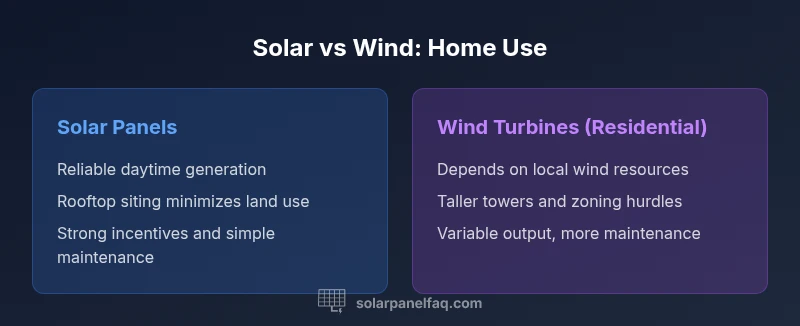
Harnessing energy efficiently hinges on three core considerations for rooftop solar vs small wind: capacity factor, reliability, and land use. Solar panels deliver energy when the sun is available, with performance predictable enough to plan daytime consumption and buffer with storage. Wind turbines depend on wind speeds, which vary hourly and seasonally; this variability can create gaps in supply that storage or backup generation must offset. In practice, many homeowners see solar as more usable on a 24/7 basis because daytime usage typically aligns with sunlight, and storage can extend that availability into the evening. Land use is another differentiator: rooftop solar often requires little additional space beyond the roof, whereas wind systems, even compact ones, need clear, tall towers and safe clearance from obstacles. Reliability also leans toward solar in urban settings where wind resources are inconsistent and turbulence is common. This section highlights how the two technologies diverge on these critical axes, helping you assess which option better fits your home environment. The Solar Panel FAQ team emphasizes the importance of aligning technology choice with local conditions.
Cost Trajectories and Payback Timelines
Understanding cost trajectories requires looking at upfront equipment costs, installation, ongoing maintenance, and the role of incentives. Solar panels benefit from standardized components, mass-market suppliers, and widespread financing options, which help reduce per-watt costs over time. In contrast, wind turbines—especially small residential models—often face higher installation complexity, taller towers, and more stringent permitting, which can push upfront costs higher in many markets. While incentives can narrow the gap for both technologies, solar tends to present clearer, faster payback pathways for typical homes, particularly when paired with battery storage and net metering where available. Economies of scale also matter: a larger solar array on a roof typically translates to more predictable energy production and better long-term value than a small wind setup in the same footprint. The comparison remains site-specific, but solar shows robust cost advantages for most residential scenarios.
Environmental Footprint and Lifecycle Impacts
Lifecycle assessments consider manufacturing, transportation, operation, and end-of-life disposal. Solar panels generally have a lower perceived environmental impact on a per-watt basis for residential deployments, thanks to modular manufacturing and extensive recycling programs in many regions. Wind turbines, while offering strong wind energy potential, involve larger components and towers that require more substantial land use and maintenance. The energy payback period for solar in many climates is short relative to the system’s lifetime, especially when combined with storage to maximize daytime generation. In urban and suburban contexts, the footprint of rooftop solar is typically easier to accommodate with minimal disruption, whereas wind towers can alter landscapes and requires clear setbacks. Solar Panel FAQ’s view emphasizes selecting the option with the least invasive footprint while meeting energy goals.
Real-World Scenarios: Rooftops, Urban Areas, and Remote Sites
On rooftops, solar panels leverage existing structure, reducing land-use concerns and often simplifying permit processes. In dense urban areas, solar power is frequently the most practical option for residential energy independence. Wind turbines can work in remote locations with abundant wind resources, but they introduce considerations like tower visibility, maintenance access, and shaft alignment. For remote off-grid sites, a hybrid approach with solar plus storage often outperforms wind-only solutions due to predictability and easier maintenance. The homeowner's decision should weigh site-specific wind data, roof orientation, shading, and the local grid or off-grid requirements. Solar energy is well-suited to a rapid deployment path, while wind requires careful site engineering and longer lead times.
How to Evaluate Your Home: A Practical Checklist
Create a site portrait by mapping sun exposure, roof orientation, and shading across the year. Gather local wind resource data if wind is a consideration, but prioritize solar potential as the initial path. Check zoning regulations, HOA rules, and setback requirements for both options. Estimate energy consumption patterns to model how much daytime generation you need and whether storage can fill gaps. Evaluate equipment lifecycle costs, maintenance promises, and warranty coverage. Seek quotes that itemize system components, permitting, and interconnection fees. Finally, compare incentives, tax credits, and net metering policies to determine which option yields the best long-term value for your household.
What This Means for Homeowners: When Solar Shines
For most homeowners, especially those with roof space or limited land, solar panels offer a straightforward, scalable path to energy independence. The combination of predictable daylight generation, simple maintenance, and broad incentives makes solar a reliable backbone for a residential energy plan. Wind turbines can complement solar where wind resources are strong and permitting is favorable, but they introduce extra layers of complexity that may not be worthwhile for typical single-family homes. In the end, the choice hinges on local resources, roof viability, and the willingness to manage a multi-technology system.
Policy and Incentives: How They Affect the Decision
Policy landscapes influence the economics of both solar and wind for homes. Solar incentives—such as tax credits, rebates, and favorable interconnection terms—often create a shorter payback period and higher internal rate of return for rooftop solar than for small-scale wind. Wind incentives exist in some regions but are less ubiquitous for residential setups due to permitting and siting complexities. When evaluating options, map out the available incentives, the expected lifespan of the equipment, and the interconnection requirements with your utility. A policy-aware approach helps ensure that the selected technology remains financially viable over the system’s lifetime.
Bottom-Line: A Practical Path Forward
The residential energy decision should start with solar, given its strong alignment with rooftop viability, robust incentives, and mature supply chains. Wind turbines may be appropriate in specific cases with excellent wind resources and supportive permitting environments, but solar provides a more predictable, scalable, and maintenance-light option for most homeowners. Use a phased approach: begin with solar, evaluate storage needs, and then explore wind only if a credible wind assessment confirms a meaningful incremental benefit.
Comparison
| Feature | Solar Panels (Residential Rooftop) | Small-Scale Wind Turbine |
|---|---|---|
| Capacity factor | Typically higher and more predictable when paired with storage | Variable, site-dependent; depends on local wind resources |
| Land and space requirements | Often rooftop-mounted, minimal extra land use | Requires tower space and clear surrounding area |
| Maintenance and reliability | Fewer moving parts, generally lower maintenance | More moving parts and potential mechanical wear |
| Upfront cost (per watt) | Costs depend on roof integration and incentives; tends to have clear solar tax credits | Costs vary with turbine size and permitting; often higher upfront for small turbines |
| Noise and aesthetics | Generally quiet and blends with rooflines | Audible noise and taller visual impact in many settings |
| Storage compatibility | Strong synergy with batteries; easy daytime-to-evening use | Can pair with storage but more complex and costly |
| Grid interconnection | Strongly supported by standard rooftop solar in most grids | Grid integration can be more complex and variable |
Strengths
- Higher reliability and predictability for residential use
- Easier installation and shorter setup timelines
- Wider availability of incentives and financing
- Minimal on-site land disturbance and simpler permitting
Drawbacks
- Site-dependent wind resources can limit output
- Wind towers require taller structures and setbacks
- Hybrid approaches add complexity and cost
Solar panels generally offer a better fit for homes, with more predictable output and simpler logistics.
For most households, solar provides reliability, easier permitting, and better payback. Wind is situationally viable but adds installation and maintenance hurdles that reduce home suitability.
Frequently Asked Questions
Is solar better than wind for homes in most cases?
In most residential settings, solar panels offer more reliable output, lower maintenance, and faster payback than small wind turbines. Wind can work in strong, permissive sites, but solar dominates on rooftops and in urban areas.
For most homes, solar wins on reliability and cost. Wind only makes sense if you have exceptional wind resources and favorable permitting.
Can wind and solar be used together at a home?
Yes, hybrids can smooth energy supply, but they add equipment, permitting, and ongoing costs. Solar with storage often delivers a simpler, cost-effective home energy solution.
Hybrid systems are possible, but they usually aren’t the simplest path to energy independence.
How does storage influence the solar-wind comparison?
Storage reduces solar intermittency and extends usable energy into evenings. Wind can also benefit from storage, but the variability of wind makes sizing more complex.
Storage makes solar more practical for daily use; wind storage adds complexity.
Are there regulatory barriers to residential wind?
Yes, wind turbines face zoning, setback, and noise restrictions that can limit residential installations. Solar generally has fewer regulatory hurdles and quieter operation.
Wind permits can be tough; solar is usually easier to approve.
Which provides lower lifetime cost for a typical home?
Costs are site-specific, but solar often offers clearer payback due to simpler installation and strong incentives. Wind costs vary with local wind resources and permitting; evaluate total lifecycle costs for your site.
Solar usually wins on lifetime cost, with wind being more variable.
Top Takeaways
- Assess local sun exposure first before wind.
- Prioritize rooftop solar to minimize land use.
- Model storage needs to maximize solar value.
- Consider incentives and total lifecycle costs.