Solar Panel or Wind Turbine: A Practical Homeowner's Comparison
This objective guide compares solar panel and wind turbine options for homeowners, highlighting cost ranges, performance notes, and installation considerations to help you decide.


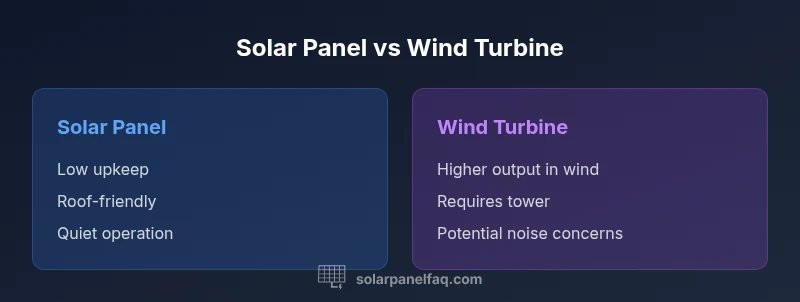
According to Solar Panel FAQ, solar panel options typically cost less upfront and fit most home sites, while wind turbines perform best in consistently windy areas but face more permitting and maintenance. In short, solar is usually cheaper to install; wind is more variable and site-dependent. The best choice depends on local sun and wind, roof or yard constraints, and incentives.
Understanding the Decision: solar panel or wind turbine
Choosing between a solar panel or wind turbine system for a home hinges on resource availability, space, and local regulations. The Solar Panel FAQ team emphasizes that while both technologies deliver clean energy, the key difference is the resource you rely on most: sun or wind. In many climates, solar panels maximize daytime generation on rooftops or ground mounts with minimal noise and low maintenance, making them a straightforward first choice for homeowners. Wind turbines, by contrast, exploit wind resources to generate electricity, often offering more consistent output in windy zones but requiring taller structures and more complex permitting. By starting from your site’s sun exposure and wind profile, you can estimate potential energy production patterns and align them with your electricity usage. This framework is especially useful if you’re evaluating hybrid setups or pursuing off-grid goals.
When evaluating a solar panel or wind turbine, consider not only the raw resource but also the practical constraints of your property, including roof orientation, available land, and nearby structures. A well-planned assessment helps decide whether a solar-dominated approach, a wind-forward strategy, or a balanced hybrid will give you the best long-term value. The goal is to align system design with daily energy needs, seasonal fluctuations, and local incentives to maximize return on investment and reliability.
Cost Structures and Incentives for Solar Panel or Wind Turbine
Cost considerations form the backbone of planning. Solar panels typically have lower upfront hardware costs and faster installation timelines, which translates into quicker payback in sunny regions with accessible incentives. Wind turbines often involve higher initial investments due to tower costs, foundations, and control systems, plus potential permitting and setback requirements. Both options can benefit from federal, state, or utility programs that offset purchase or installation expenses, though availability varies by jurisdiction.
In a Solar Panel FAQ analysis, you’ll often see emphasis on lifecycle costs rather than sticker prices alone. Maintenance, insurance, and potential repairs contribute to the total cost of ownership for either technology. Battery storage adds another layer of cost but can substantially improve reliability, especially in off-grid or hybrid configurations. When comparing solar panel and wind turbine options, it’s useful to run a forward-looking financial model that includes tax credits, net metering values, and expected degradation of equipment over time. This helps to identify the most cost-effective path given your site conditions and goals.
Performance and Climate: How Sunshine and Wind Shape Output
Performance is where solar panel or wind turbine projects diverge most. Solar panels deliver predictable daytime generation on sunny days, with output affected by shading, orientation, and temperature. In temperate climates with strong sun, solar can provide a reliable baseline that pairs well with daytime loads and storage. Wind turbines, meanwhile, respond to wind speed distributions; they tend to produce power when solar output declines (e.g., at night or during cloudy spells) if wind is reliable. The combination of solar and wind can smooth generation, reducing seasonal dips and improving the odds of meeting daytime or peak loads. For homeowners, the choice often reflects which resource dominates your site’s energy profile. By analyzing hourly or daily resource data—sunlight hours and wind speeds—you can estimate how each option would perform relative to your electricity demand and seasonal patterns.
Site Considerations: Roof, Ground, and Zoning Realities
Installing a solar panel or wind turbine is as much about the site as the technology. Roof-mounted solar is typically simpler, faster, and less visually intrusive, especially on homes with adequate roof exposure. Ground-mounted solar can unlock space for larger installations when roof space is insufficient, but it requires fencing and more land area. Wind turbines demand even more space and usually require taller towers to reach practical wind speeds, as well as setbacks from buildings and property lines. Zoning, homeowners association rules, and noise considerations can influence feasibility. In urban or suburban settings, solar often presents fewer regulatory hurdles, while rural or open locations may be better suited to wind-powered systems. Site engineering, structural compatibility, and electrical interconnection challenges should be addressed early in the planning process.
The Solar Panel FAQ team highlights that a professional site assessment is essential to understand constraints like roof angle, shading from trees or chimneys, wind exposure, and allowable heights. If you’re aiming for a hybrid approach, plan the layout to minimize interference between components and ensure safe electrical integration with the grid or storage.
Maintenance Demands: Longevity, Wear, and Servicing
Maintenance is a practical lens on the long-term viability of solar panel or wind turbine installations. Solar panels typically require little ongoing maintenance beyond periodic cleaning to remove dust or debris, with inverter replacement and module warranties providing long-term protection. Wind turbines introduce more moving parts—blades, gears, and generators—requiring scheduled inspections, lubrication, and occasional component upgrades. Both systems benefit from monitoring software that tracks output and detects performance anomalies. Noise, vibration, and mechanical wear are additional considerations for wind systems, which may necessitate more frequent professional inspections. In climate zones with heavy freezing or icing, both technologies can face localized challenges, so selecting equipment rated for your environment is prudent.
From a maintenance perspective, solar panels generally offer lower ongoing costs and simpler service tracks, making them easier to manage for most homeowners. If you choose wind, budget for targeted maintenance and service contracts to keep performance steady over time.
Grid Integration and Storage: Batteries, Net Metering, and Reliability
Connecting a solar panel or wind turbine system to the grid or an off-grid arrangement requires careful planning around power quality, safety, and storage. Net metering arrangements can significantly influence the economic viability of solar, particularly in regions with favorable export credit or buy-back terms. Wind systems often pair with energy storage to align generation with demand or to provide resilience during outages. Battery storage can smooth variability, reduce peak demand charges, and improve reliability, but it also raises upfront costs and the need for battery management. For homeowners pursuing energy independence, a hybrid approach that includes both renewable sources and storage can offer robust resilience and more consistent electricity supply. In any case, ensure your inverter or controller is properly sized, and that your electrical service can accommodate peak generation and storage use without overloading circuits.
The choice between solar panel or wind turbine gains clarity when you model how each option integrates with existing panels, batteries, and the grid. A well-designed storage strategy can transform intermittent generation into dependable power for critical loads.
Environmental Impact and Sustainability: Lifecycle Thinking
Environmental impact encompasses extraction, manufacturing, installation, operation, maintenance, and end-of-life disposal. Both solar panels and wind turbines offer substantial carbon reductions compared with fossil fuels when properly deployed. The Solar Panel FAQ team emphasizes lifecycle thinking: consider manufacturing footprints, transportation distances, the durability of materials, and the availability of recycling channels for end-of-life components. Location-specific factors—such as the need for tall towers in windy sites or the urban heat island effect in cities—also influence overall environmental benefits. While neither technology is a perfect green solution, a properly planned Solar panel or wind turbine project reduces emissions, supports local energy resilience, and contributes to long-term energy independence when integrated with storage and smart-grid controls.
Real-World Scenarios: Climate, Geography, and Home Type
Urban roofs with strong sun and good shading control tend to be ideal for solar panel installations, particularly when tinkering with a grid-tied system and selective storage. Rural properties with open land and reliable wind resources can benefit from wind turbines, especially for off-grid or hybrid configurations. Suburban homes that enjoy a mix of sun and wind may find a hybrid approach most effective, using solar to cover daytime loads and wind to fill gaps during nighttime or extended overcast periods. In coastal regions, wind resources are often robust, but salty air can affect turbine components; protective housings and corrosion-resistant materials are essential. The Solar Panel FAQ team notes that by matching technology to local climate and property, homeowners can maximize energy yield while minimizing costs and disruption to daily life.
Decision Framework and Next Steps: A Practical Roadmap
To move from concept to installation, start with a resource assessment for both sun and wind, followed by a grid interconnection check and a cost-benefit analysis. Hire licensed professionals to perform structural assessments and obtain necessary permits. Request quotes that clearly separate hardware, permitting, foundation work, and storage options if storage is part of your plan. Compare incentives, tax credits, and net metering policies in your area, and consider a phased implementation if budget is a constraint. Finally, create a long-term maintenance plan and a monitoring dashboard to track performance. With a structured approach, you can navigate the decision between solar panel or wind turbine and choose the path that best aligns with your energy goals and property realities.
Comparison
| Feature | Solar panel | Wind turbine |
|---|---|---|
| Typical upfront cost | lower upfront cost | higher upfront cost |
| Operating cost per year | low | moderate |
| Capacity factor | lower (sun-driven) | higher in windy locations |
| Space required | rooftop/compact | larger footprint or tower |
| Maintenance effort | low | higher (moving parts) |
| Noise | negligible | audible during operation |
| Permitting complexity | generally simpler | often more complex (local rules) |
| Best climate | sun-rich regions | consistent wind areas |
| Best use case | rooftop solar, grid-tied | off-grid or hybrid with wind |
Strengths
- Low maintenance and long lifespans for solar panels
- Wind turbines can provide daytime and nighttime generation in windy sites
- Modular expansion allows scaling over time
- Grid-tied systems with storage improve reliability and resilience
Drawbacks
- Sun dependence can cause gaps without storage
- Wind turbines require space, height, and can face zoning restrictions
- Both systems depend on local incentives and interconnection rules
Solar panel is generally the better starting point for most homes, with wind turbine as a strong supplementary option where wind resources are robust.
For typical homes, solar panels offer lower upfront costs, simpler installation, and strong payback where sun is abundant. Wind turbines shine in locations with reliable wind but require more space and permitting. A hybrid approach may provide the best balance in mixed-resource sites.
Frequently Asked Questions
What factors determine choosing between solar panel or wind turbine?
Site resources (sun and wind), available space, permitting, and incentives largely determine the best option. A professional site assessment helps quantify expected energy production and return on investment for each technology.
Key factors are sun, wind, space, and permits — get a site assessment to compare options.
Are there incentives for solar panel or wind turbine installations?
Many locales offer incentives for renewable energy projects, including tax credits, rebates, and net metering programs. Availability varies by jurisdiction, so check with local utilities and government agencies.
There are often incentives, but they vary by location—check local programs.
How long does installation take for solar panel vs wind turbine?
Solar installations are typically quicker, often measured in days to weeks depending on roof access and permitting. Wind turbine projects can take longer due to permitting, foundation work, and, if needed, tower installation.
Solar installs faster; wind turbines can take longer because of permitting and foundations.
What maintenance is required for each system?
Solar panels require periodic cleaning and inverter checks; wind turbines need routine inspections of moving parts, lubrication, and potential part replacements. Storage adds additional maintenance considerations for both.
Solar is low-maintenance; wind needs more regular service checks and parts maintenance.
Can I run solar and wind together on the same property?
Yes, you can combine solar panels and wind turbines to diversify generation and improve reliability. A well-planned hybrid system integrates storage and smart controls to balance output.
Hybrid setups are possible and can improve reliability when designed properly.
What is the typical payback period for these systems?
Payback varies with resource quality, incentives, and energy use. Solar installations often achieve shorter payback in sunny regions; wind can extend payback in wind-rich locations, especially with storage.
Payback depends on sun, wind, and incentives—get a custom calculation.
Top Takeaways
- Assess local sun and wind before choosing
- Solar panels usually cost less and install faster
- Wind turbines require space and permitting but can fill gaps when wind is strong
- Consider storage to smooth intermittent generation
- Incentives and grid policies significantly affect economics