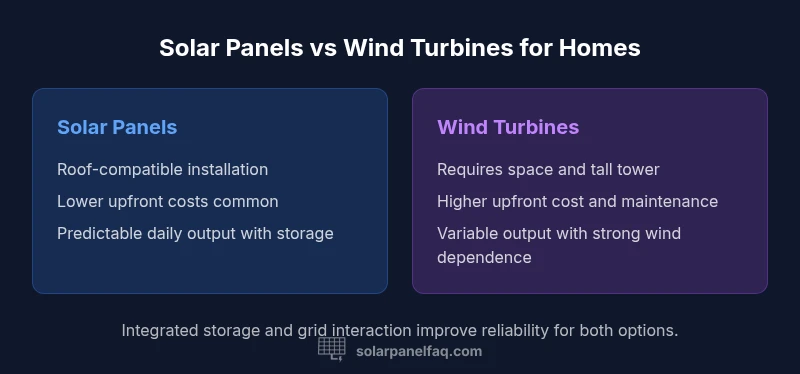
Solar Panels vs Wind Turbines for Homes: An Analytical Comparison
A detailed, analytical comparison of solar panels vs wind turbines for homes, covering space, cost, permitting, maintenance, and storage to help homeowners decide the best residential energy setup.


For most homes, solar panels are the more practical starting point when comparing solar panels vs wind turbines for homes. Solar offers simpler permitting, lower maintenance, and proven rooftop installation, while wind turbines require more space, higher upfront costs, and more variable output. If you have consistent sun and limited space, solar wins; wind is best where wind is abundant and zoning allows.
Solar panels vs wind turbines for homes
In this guide we examine the core question many homeowners ask: how do solar panels compare to wind turbines when the goal is reliable, on-site energy for a single residence? According to Solar Panel FAQ, homeowners should start by mapping sun exposure and wind resources before choosing between solar panels and wind turbines for homes. The decision hinges on site characteristics, local regulations, and long-term energy goals. This section sets the stage by defining what each technology can realistically deliver in a typical suburban or rural setting, and why the two options are often not interchangeable. We will use the exact phrase of the comparison to emphasize the decision context and tailor recommendations to common home layouts, roof and ground space, and budget constraints. The takeaway is simple: neither option is universally best, but the best choice is highly site-specific and depends on consistent access to resources and sensible integration with storage and the grid.
Space and installation considerations
Residential solar panels typically install on rooftops or ground mounts with relatively compact footprints compared to wind turbines. The installation is usually straightforward for a standard home, with many kits designed for retrofit onto existing roofs. Wind turbines, even at small residential scale, require a taller tower, a clear setback from structures and neighbors, and more complex foundations. Zoning and HOA approvals can be more burdensome for wind, especially in densely populated neighborhoods. The practical implication is space efficiency: solar tends to fit on typical roofs, while wind needs extra land or yard space and careful siting to minimize noise and shadowing. Aesthetics and roof integrity should be considered—missing solar shade or wind turbine height limits may affect long-term performance and homeowner satisfaction.
Performance and reliability: what to expect
Solar output is predictable on a daily cycle—peak during midday with clear skies—which makes it highly amenable to storage integration and net metering. Wind energy, even at low heights, can vary significantly with weather systems, seasonal patterns, and local topography. For homes in windy but intermittently calm areas, wind can deliver complementary generation during different times, but the variability adds complexity for sizing storage and managing the overall energy mix. Storage solutions, such as batteries, are often used to smooth discrepancies for both technologies, yet the cost and lifecycle of storage must be weighed against the value of continual grid power. Grid-tied systems with smart inverters are increasingly common for both options, allowing you to export excess energy during peak periods and pull from the grid when needed.
Costs and financing (upfront and operating)
Upfront costs are driven by hardware, installation complexity, and permitting. Solar panel systems tend to have lower initial outlays and more mature financing options due to a large installer network and widespread incentives in many regions. Wind systems at residential scale typically incur higher capital costs because of towers, foundations, and specialized components, plus more stringent installation requirements. Ongoing operating costs for solar are relatively predictable: routine cleaning and occasional inverter replacement. Wind systems may incur higher maintenance costs due to moving parts like blades and gearboxes, and the potential for more frequent service needs after severe weather. Financing strategies, incentives, and maintenance planning should be weighed together to estimate total cost of ownership.
Permitting, zoning, and neighbor considerations
Permitting for solar panels is widely established in many jurisdictions, with standard processes for rooftop or ground-mounted arrays. Wind turbines face more variable regulations, with location-specific setbacks, noise limits, and neighbor concerns. HOA covenants can also restrict turbine installation or require additional approvals. It is essential to engage early with local building departments and HOA boards to avoid delays. In rural areas with fewer restrictions, wind turbines may be more feasible, but rural grid interconnection policies and turbine siting still demand careful planning. A proactive permitting strategy reduces risk and accelerates project timelines.
Maintenance and durability
Solar panels are known for low maintenance when properly installed: periodic cleaning, inspection of mounting hardware, and inverter replacement after several years. Wind turbines require more active upkeep due to moving parts, blade maintenance, gearbox checks, and potential anchor or foundation monitoring. Storm exposure and corrosion can influence both options, but wind systems often demand more frequent service visits and component replacements. Durability considerations should include the expected life span of components, warranty terms, and the availability of qualified technicians in your region. Regular maintenance schedules help maximize system longevity and performance.
Energy storage and grid interaction
Both solar and wind systems benefit from energy storage and smart grid integration, enabling you to store excess generation for cloudy or calm periods. Batteries add upfront cost but can improve reliability, reduce peak demand charges, and enhance resilience during outages. Grid-tied configurations with net metering allow you to sell surplus energy back to the grid, improving the financial case for both technologies. For solar, storage tends to be more straightforward due to the predictable daily pattern. Wind storage can be effective but requires careful sizing to accommodate night-time or low-wind episodes.
Which scenarios favor solar or wind? (Practical guidance)
In residential settings with steady sun, solar panels are typically the first and most practical energy option due to space efficiency and established permitting. Wind turbines excel in sites with consistent, high wind resources and ample land, such as rural properties with minimal neighbor impact. A hybrid approach—solar plus a smaller wind turbine—can complement each other in certain climates, but it also increases system complexity and maintenance. Realistic energy goals, local regulations, and the ability to install sufficient storage determine which path delivers the best return on investment.
How to assess your site: a practical checklist
- Map sun exposure on your roof or site for at least 6-8 hours of peak sun each day.
- Evaluate available land or roof space for wind turbine clearance, setback, and maintenance access.
- Check local permitting, HOA rules, and neighborhood acceptance for both options.
- Consider storage options and how you’ll integrate with the grid or a backup power plan.
- Estimate rough payback by aligning energy needs with available incentives, utility rates, and storage costs.
- Consult multiple installers to compare system designs, warranties, and service quality.
- Plan for future expansion, such as adding more panels or a larger battery bank, if your site allows.
Real-world case patterns and takeaways
Across diverse climates, homeowners consistently prioritize solar panels for urban and suburban homes due to roof integration, lower upfront costs, and easier permitting. Wind turbines often remain a niche choice reserved for rural properties with robust wind resources and fewer regulatory barriers. The best outcomes come from a clear site assessment, thoughtful storage integration, and a scalable plan that aligns with local rules and utility programs. In all cases, ongoing maintenance and system monitoring are essential for maximizing long-term performance.
Comparison
| Feature | Solar panels for homes | Residential wind turbine |
|---|---|---|
| Space requirements | Roof-mounted or ground-mounted within existing property footprint | Tall tower(s) with separate lot or large space; setback required |
| Upfront cost | Typically lower initial hardware cost and simpler installation | Higher initial investment due to tower, foundation, and turbine components |
| Output reliability | Daylight-driven output with predictable cycles; affected by clouds | Wind-driven output that can be highly variable; strong at windy times |
| Permitting and zoning | Widely established permitting in many regions; HOA-friendly in many areas | More complex zoning and potential noise concerns; more regulator variance |
| Maintenance needs | Low maintenance; inverter replacement and occasional cleaning | Higher maintenance due to moving parts, blades, and gearbox checks |
| Noise and aesthetics | Silent operation at typical residential distances | Potential noise and visual impact; height and placement matter |
| Storage integration | Easier to pair with storage and net metering applications | Storage feasible but adds complexity and cost |
| Lifespan and warranties | Long-lasting panels with solid warranties; inverters may need replacement | Turbines have variable lifespans and specialized component warranties |
Strengths
- Lower upfront costs and easier financing for solar
- Easier permitting and HOA acceptance for rooftop systems
- Broad installer network and mature service options
- Predictable daily output with storage integration potential
- Seamless grid interconnection and net metering opportunities
Drawbacks
- Output depends on sun exposure and weather patterns
- Limited by roof space and shading conditions
- Storage adds cost and adds system complexity
- Wind turbines can face noise, aesthetics, and zoning challenges
- Wind resource variability can complicate sizing and resilience
Solar panels generally outperform wind turbines for most homes, with wind reserved for suitable wind-rich rural sites.
For urban and suburban homes, solar panels offer easier permitting, lower upfront costs, and dependable daily output, especially when paired with storage or grid tie. Wind turbines can be viable where wind resources are consistently strong and land is available, but regulatory and maintenance considerations often limit practicality.
Frequently Asked Questions
Can a home use both solar panels and a wind turbine?
Yes. A hybrid system can combine solar panels with a small wind turbine to balance generation, but this adds hardware, maintenance, and storage requirements. Careful system design and a larger storage plan are needed to realize reliable benefits.
Yes, you can combine solar and wind, but you’ll need careful design and storage planning to make it worthwhile.
What are the main cost considerations for each option?
Solar typically has lower upfront costs and broader financing options, while wind involves higher capital expense for towers and foundations. Ongoing maintenance and potential storage costs should be included in the total cost of ownership for both.
Solar usually costs less upfront; wind costs more upfront and may need more maintenance, plus storage considerations.
What permitting and HOA issues should I anticipate?
Solar permits are common, with many jurisdictions supporting rooftop installs. Wind turbines face more variable zoning rules, noise limits, and stricter HOA scrutiny. Start conversations early with authorities to avoid delays.
Permits for solar are common; wind permits can be trickier, so check local rules early.
Which is better for urban homes with limited space?
Solar panels are generally better for space-limited urban homes because they fit on roofs and require less land and setup. Wind is usually less practical unless you have ample land and consistent wind.
Solar is usually the better fit for cities, wind needs more space and wind reliability.
How do storage needs differ between solar and wind?
Both benefit from storage, but solar-based systems often have more predictable daily patterns that simplify sizing. Wind storage must address greater variability, making sizing more complex and potentially more costly.
Storage helps both, but solar storage tends to be easier to size and predict.
Top Takeaways
- Assess sun exposure and roof space before deciding
- Check local permitting and HOA policies early
- Plan for storage to smooth intermittent generation
- Expect solar to be simpler; wind to require more space and approval
- Think long term: warranties and service availability matter