What Size Solar Panel for a 100Ah Battery: A Practical Guide
Learn how to size a solar panel for a 100Ah battery, with practical calculations, controller considerations, sun-hour impacts, and real-world tips for homeowners and solar buyers.


what size solar panel for 100ah battery
Sizing a solar panel for a 100Ah battery begins with understanding that the battery capacity (Ah) is not the same as the charging current a panel can deliver. A 100Ah battery stores energy, but the rate at which you can safely replenish that energy depends on the panel’s current output under sun conditions, the system voltage, and the charge controller. According to Solar Panel FAQ, the sizing process should start with the system voltage (usually 12 V for small setups), the desired charge rate (in amps), and the typical daily sun hours in your location. By combining these factors, you can estimate a panel wattage that will reasonably recharge the battery on sunny days while leaving room for losses.
How a 100Ah battery relates to charging current
A 100Ah battery has a nominal capacity of 100 amp-hours at a given voltage. If you want to recharge it in a day, you’ll need to supply roughly 100 Ah divided by the number of sun hours you expect. Real-world charging currents vary with sun intensity, temperature, and shading. A practical rule of thumb is to target a charging current of about 0.5–1C (50–100% of the battery capacity per hour) when conditions are ideal, then dial back for less-than-ideal days. This section explains how to translate that rule into panel selection and wiring choices.
Step-by-step sizing method for a 100Ah battery
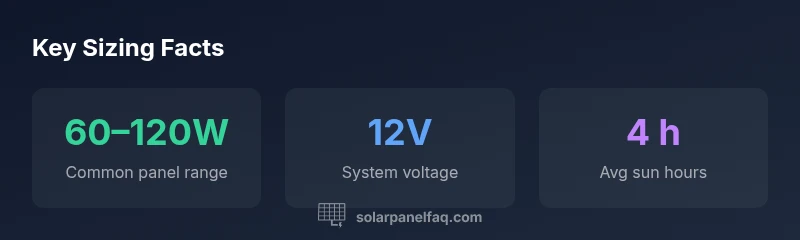
- Determine system voltage (usually 12 V for off-grid setups). 2) Decide a realistic daily charging window based on your location’s sun hours (e.g., 4–5 hours of peak sun). 3) Choose a target charging current (0.5–1C correlates to 5–10 A for a 12 V system). 4) Compute panel wattage: panelWattage = (targetChargeRate * systemVoltage) * 1.25 to include a buffer for losses. 5) Round up to a standard panel size (60, 80, 100, or 120 W).
Scenario-based sizing examples
- Moderate sun (4 hours/day): For a 12V, 4 A target, panelWattage ≈ (4 A * 12 V) * 1.25 = 60 W. A 60–80 W panel is typical.
- Strong sun (5 hours/day): For a 6 A target, panelWattage ≈ (6 * 12) * 1.25 = 90 W. A 90–100 W panel fits well.
- Shaded or cold days: Increase buffer to 1.5x or more, or split across two panels for redundancy. These rules help keep charging even when conditions aren’t ideal.
Real-world factors that affect sizing
Sun hours vary by season and location. Panel orientation, shading from trees, dirt on panels, and wiring losses all reduce actual output. Temperature can also reduce panel efficiency, especially in very hot climates. When sizing, use conservative estimates and add a buffer to the calculated wattage to compensate for these factors.
Choosing a charge controller and wiring
A modern MPPT controller maximizes energy harvest by adjusting the panel’s operating voltage to track the battery’s voltage, improving efficiency in real-world conditions. For a 12 V system charging a 100Ah battery, ensure the controller amp rating meets or exceeds your target charging current, and verify wire gauges are suitable for the distance between panel and battery. Always follow local electrical codes.
Example calculations
Example 1: Target 5 A at 12 V with 4 hours of sun. PanelWattage = (5 × 12) × 1.25 = 75 W. Choose a 80 W panel. Example 2: Target 8 A at 12 V with 5 hours of sun. PanelWattage = (8 × 12) × 1.25 = 120 W. A 120 W panel works well, assuming good conditions and a capable MPPT controller.
Maintenance, safety, and best practices
Keep panels clean and free of debris; inspect connections for corrosion. Use a properly rated fuse or breaker between the panel, controller, and battery. Monitor battery voltage and charging current to avoid overcharging; never bypass the controller. Periodically verify that the system works as expected and recalibrate sizing if your load or sun conditions change.
Practical recommendations and next steps
Start with a conservative panel size (60–80 W) for a 12 V, 100Ah setup. If daily sun hours are higher than average or if you use a daisy-chained array, consider scaling to 100–120 W. Pair with a reliable MPPT controller and check compatibility with your battery chemistry. Plan to monitor performance over several weeks to confirm you’ve chosen a robust size.