Solar Panel vs Solar Cell: Key Differences for Projects
This guide compares solar panels and solar cells, with definitions, efficiency basics, cost considerations, and guidance for homeowners evaluating solar installations.


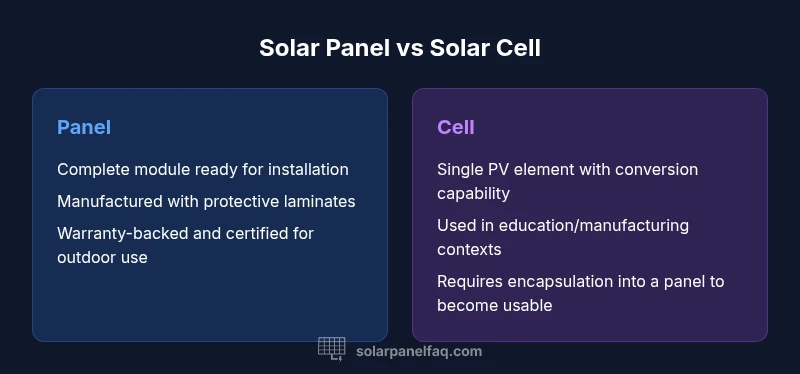
In a nutshell, solar panels are complete modules made of many solar cells, ready for installation, while a solar cell is a single photovoltaic element that converts light to electricity. For most residential projects, you’ll buy panels as ready-to-install units; solar cells are primarily used in manufacturing, education, or research. When deciding, consider scale, reliability, and maintenance needs in the context of a home installation vs. a lab or demonstration setup.
What is a solar cell and how it fits into solar technology
A solar cell, or photovoltaic cell, is the fundamental device that converts sunlight directly into electricity through the photovoltaic effect. It is the smallest functional unit in a solar power system. In a typical commercial or residential setup, many solar cells are interconnected and then encapsulated with protective layers to form a solar panel. The phrase solar panel vs solar cell is often used to describe the difference between assembling individual cells into a functional module and using standalone cells in an experimental or educational context. According to Solar Panel FAQ, understanding this distinction helps homeowners appreciate why systems are designed the way they are and what constraints govern efficiency, durability, and cost. This distinction also underpins decisions about scale, installation, and maintenance for real-world projects.
In practical terms, a single cell alone produces limited voltage and current; a panel stacks thousands of cells and adds optical, thermal, and electrical protections to produce usable power. The while-you-cool-down moment comes from recognizing that modern solar technology relies on both elements: the cell for conversion, and the panel for capture, protection, and power delivery. The end-to-end impact on a system’s performance is shaped by materials, manufacturing quality, and how cells are arranged and interconnected within a panel.
How a solar panel is built from individual cells
A solar panel is not just a bundle of cells; it is a carefully engineered system designed to maximize energy output while withstanding environmental exposure. The construction typically includes: a rigid backsheet for support, encapsulants to protect the cells from moisture, a tempered glass front for durability, a frame for mounting, and busbars and wiring to connect cells in series or parallel. Cells are arranged in a grid pattern to balance voltage and current with the panel’s overall dimensions. The encapsulation and lamination process helps inhibit corrosion and mechanical damage, extending the life of the module. In a laminated panel, multiple layers are sealed to form a weatherproof unit that can be installed on rooftops or ground mounts. This integration of cells into a single, robust panel is what enables practical, long-term solar energy generation for homes and businesses.
For readers investigating the topic, the contrast between a modular approach (panels) and a raw cell component matters daily in design choices, warranty expectations, and maintenance planning. Panels provide a finished product ready for installation, while exploring cells offers insights into efficiency limits, manufacturing processes, and laboratory research.
Efficiency and performance: cells vs panels
Efficiency is a central theme when comparing solar cells and panels, but it operates on two levels: device efficiency (cell-level) and system efficiency (panel-level). A single solar cell has the potential to reach higher conversion efficiency in controlled laboratory conditions because it lacks the cumulative losses present in a module. Real-world panel performance, however, reflects many additional factors, including manufacturing tolerances, connections between cells, shading effects, temperature sensitivity, and the protective layers that reduce reflectivity and degrade with time. The practical takeaway is that while cell-level tests can show optimistic efficiency, a module installed on a rooftop is designed to deliver reliable, durable power for decades. For homeowners, this means that a high-quality panel that is properly installed often provides better expected energy output over the life of the system than a set of cells used outside of a complete module.
Understanding these nuances helps set realistic expectations for energy production, warranty coverage, and long-term value.
Cost, pricing, and lifetime value
Cost implications play a major role in any solar decision, and the distinction between panels and cells shapes budgeting. Solar panels are sold as assembled units, with manufacturers offering various efficiency ratings, warranties, and frame materials. The cost-per-watt for panels typically reflects the completed product, including manufacturing, encapsulation, glass, and mounting hardware. By contrast, solar cells are often purchased as components for larger manufacturing processes or for demonstration purposes in classrooms and labs. Because cells require encapsulation, protection, and assembly into a module to function in the real world, the path from raw cell to delivered power includes additional costs for materials, wiring, and containment. For homeowners, the most direct path is to choose a panel-based system that aligns with warranty terms and local installation standards.
When evaluating options, don’t focus solely on upfront price. Consider expected energy production, system longevity, maintenance needs, and the value of an integrated warranty. The goal is to maximize lifetime energy output within a budget that fits your roof and climate.
Installation considerations and system design
Installation considerations differ markedly between panel-based systems and lab or educational setups that use individual cells. Panels are designed for rooftop or ground installation and come with mounting frames, connectors, and weatherproof seals. System design involves calculating the array size, orientation, azimuth angle, and shading analysis to optimize annual energy output. When you work with panels, you benefit from standardized electrical safety practices, certified inverters, and monitoring solutions that track performance. If you were to use raw solar cells outside of a panel, you would encounter significant protection challenges, including moisture ingress, thermal cycling, and mechanical stress. These challenges illustrate why panels are the dominant choice for home installations while cells are generally confined to manufacturing, research, or demonstration contexts.
For homeowners, the takeaway is clarity: panels deliver a turnkey, compliant solution with warranties and service networks, whereas cells alone do not meet typical residential installation requirements.
Use-case scenarios: residential rooftops vs educational demos
Residential rooftops are designed for systems built from pre-assembled panels that integrate seamlessly into building codes, warranties, and financing programs. Panels provide reliable energy generation with long warranties, performance guarantees, and easy maintenance. In contrast, solar cells are best suited for educational demonstrations, prototype research, or manufacturing environments where researchers experiment with material properties, cell architectures, and new PV concepts. The distinction influences decisions about equipment, training, and budgeting. In practical terms, homeowners seeking a straightforward, protected, and install-ready solution should favor panels. Researchers and educators, however, may leverage cells to explore new materials, test configurations, or illustrate energy conversion principles in a controlled setting.
Manufacturing, durability, and warranty implications
Durability and warranty are central to solar equipment decisions. Panels are designed to endure weather, temperature fluctuations, and mechanical loads, with protective laminates and tempered glass engineered to resist hail, wind, and UV exposure. Warranties typically cover product quality and performance, offering a predictable framework for return on investment. Solar cells, when used within a finished panel, inherit these protections, but as standalone units they require additional protective measures and testing. Understanding the lifecycle of a panel—from production through installation and operation—helps buyers evaluate maintenance needs, replacement timelines, and the financial implications of failure modes. For this reason, residential projects almost always rely on panels rather than loose cells, yielding practical, dependable PV performance.
If your project involves education or advanced research, cells used in demonstrations can illuminate material science topics without committing to a full system deployment.
Environmental impact and recycling considerations
The environmental footprint of solar energy is shaped by manufacturing processes, material choices, and end-of-life handling. Panels are designed for long lifespans, and many programs facilitate recycling at the end of their useful life. This reduces waste and allows for the recovery of materials such as glass, metals, and encapsulants. Solar cells, when embedded in panels, contribute to the same recycling streams, but when used as standalone units in experiments or prototypes, they may not reach the end-of-life processing that a commercial module would. Understanding these pathways helps buyers and researchers evaluate sustainability, regulatory compliance, and resource stewardship. The overarching message is that responsible selection and end-of-life planning matters for both panels and cells, but panels provide a clearer, more scalable path to large-scale solar adoption.
Common myths and misconceptions
A frequent misconception is that solar cells are inherently superior to panels in all settings. In reality, laboratory cell efficiencies do not translate directly to real-world energy output because modules add protection and optimize performance under field conditions. Another myth is that more cells equal more power; while more cells can increase voltage and current, system design and shading determine actual energy production. Misunderstandings like these can lead to misaligned expectations and disappointing results. By comparing panels and cells directly, you can avoid oversimplification and make decisions rooted in the realities of installation, warranty coverage, and lifecycle costs.
For most homeowners, panels remain the practical choice due to their ready-to-install nature and proven track record.
How to choose between panels and cells for a project
Choosing between panels and cells begins with identifying your project goals. For a home installation, panels provide a turnkey, code-compliant solution with warranties and manufacturer support. If your aim is education, demonstration, or research into new PV materials, cells offer valuable insights when used within proper protective assembly or within a lab setting. Consider factors such as budget, expected energy output, space availability, and the required level of durability. A simple decision framework is: (1) define the scale and purpose, (2) assess climate and shading, (3) evaluate warranties and service availability, (4) compare total cost of ownership over the system’s lifecycle. This approach minimizes risk and aligns your choice with practical outcomes.
Future trends in PV technology related to panels and cells
PV technology continues to evolve toward higher efficiency, lower costs, and improved durability. Advances in cell technologies—such as passivated contacts, multi-junction architectures, and perovskites—are pursued in research labs and some industrial pilots. These developments influence panel design, manufacturing methods, and system integration, potentially altering the traditional cost-benefit analysis between cells and panels. For homeowners and installers, staying informed about these trends helps anticipate shifts in warranty terms, certification requirements, and installation best practices. The core takeaway is that the distinction between panels and cells will remain central as the industry pushes toward more efficient, more affordable solar energy solutions.
Practical decision framework: quick steps to decide
- Define your project scope: residential roof, commercial installation, or educational demo.
- Evaluate space, climate, and shading to estimate feasible energy output.
- Prioritize turnkey panels for installation speed, warranties, and service availability.
- Consider end-of-life recycling options and local disposal regulations.
- If exploring research or teaching, plan to use cells within a protected assembly or classroom setup to avoid exposure and damage.
- Consult certified installers or educators who can translate these concepts into actionable specifications for your site.
Comparison
| Feature | solar panel | solar cell |
|---|---|---|
| Definition | A complete photovoltaic module made of many interconnected cells, encapsulated and framed for installation. | A single photovoltaic element that converts light to electricity, used mainly in research, education, or manufacturing contexts. |
| Typical use | Residential rooftop or commercial arrays composed of ready-to-install panels. | Standalone cells used for demonstrations, labs, or as components within larger manufacturing processes. |
| Efficiency and conversion | Panel efficiency reflects device efficiency plus system losses; optimized for real-world output. | Cell efficiency can be higher in controlled conditions but requires protection and integration to function as a usable power source. |
| Cost structure | Cost per watt for finished panels includes manufacturing, encapsulation, glass, and mounting hardware. | Cells are sold as components; full system cost requires additional materials and assembly into a panel. |
| Durability and warranty | Panels come with long warranties and certified installation methods. | Standalone cells rely on external protection; in practice, cells are rarely sold alone for field use. |
| Best for | Best for homeowners seeking ready-to-install, warranty-backed energy. | Best for education, research, or manufacturing contexts where cells are studied or assembled into modules. |
Strengths
- Clarifies whether to buy a finished module vs. educational components
- Helps align project scale with equipment complexity
- Supports budgeting by focusing on total system costs
- Useful for educational programs and research contexts
Drawbacks
- Can be confusing for non-technical buyers without context
- May require extra explanation to translate cell concepts into real-world decisions
- Limited immediate applicability for DIY roof installs if raw cells are considered
Panels are generally the best fit for typical residential solar projects; cells are most useful for education, research, or manufacturing contexts.
For homeowners, panels provide a turnkey, warranty-backed solution with practical deployment. Cells are valuable for learning and experimentation but require significant protection and assembly to function in real-world energy systems.
Frequently Asked Questions
What is the difference between a solar panel and a solar cell?
A solar cell is the basic photovoltaic unit that converts sunlight to electricity. A solar panel is a finished module that contains many cells, encapsulated and mounted for outdoor use. Panels provide a complete, install-ready solution with warranties.
A solar cell is the tiny electricity maker; a panel is many cells packaged into a ready-to-use module.
Are solar cells more efficient than panels?
In controlled lab settings, individual cells can reach higher efficiencies than complete modules. In practice, panels incorporate protective layers and system design that optimize real-world performance, so panels often deliver steadier, more reliable energy over time.
Lab cells can show higher efficiency, but panels perform better in real-world conditions.
Can I install solar cells by themselves on a roof?
Residential roofs are designed for panels that meet building codes and warranties. Standalone cells require protective housings and power conditioning equipment to function safely, which is why panels are the standard in most homes.
Homes usually use panels; cells need special housing for safe roof use.
What about the lifespan of panels vs cells?
Solar panels are designed for decades of use with warranties and durability. Cells, when part of a panel, share that lifespan, but standalone cells have fewer protections and shorter practical lifetimes without proper encapsulation.
Panels last decades; cells require protection to reach similar lifespans.
Is there any scenario where solar cells are the better choice?
Cells are valuable for education, prototyping, or specialized manufacturing contexts where researchers want to study or test new PV materials. For typical home installations, panels are the practical choice.
Cells are best for learning and testing, not standard home installs.
Top Takeaways
- Choose panels for ready-to-install home systems
- Use cells mainly for education or manufacturing contexts
- Evaluate total cost of ownership, including protection and installation
- Understand the lifecycle and recycling options for both options
- Leverage professional guidance to map your project needs to equipment