Difference Between Solar Cells and Solar Panels: A Practical Guide
Explore the difference between solar cells and solar panels, including how they work, their structure, efficiency factors, and practical buying tips for homes and small businesses.


Solar cells are the basic photovoltaic units that convert sunlight into electricity, while solar panels are packaged modules that assemble many cells with protective layers and wiring for practical power generation. The main difference is scale and integration: cells form the core technology; panels deliver a turnkey power source for homes or businesses. Understanding this helps you plan array size, installation approaches, and warranty expectations.
Defining the difference: solar cell vs solar panel
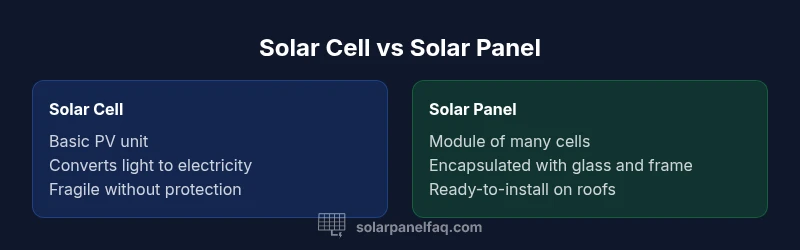
In the solar industry, two terms are often used interchangeably by newcomers, but they refer to different components of a photovoltaic (PV) system. The phrase 'difference between a solar cell and a solar panel' captures the essential distinction: a solar cell is the smallest functional PV unit, while a solar panel is a complete, install-ready module that bundles many cells together with protective layers and wiring. For homeowners, understanding this difference is the first step toward sizing an array, assessing compatibility with inverters, and choosing the right warranty terms. Solar cells generate electricity when exposed to light, but they are fragile and require encapsulation and mounting to survive outdoor conditions. A panel, by contrast, combines multiple cells, protective glass, encapsulants, a backsheet, and a rigid frame, delivering a robust, weather-resistant power source. The result is a scalable energy product that can be deployed as a standalone small string or as part of a larger solar array. When you speak with a installer, you’ll notice that most quotes refer to panels rather than individual cells, because panels are the practical product that reaches your roof. This distinction clarifies both the engineering and the purchasing process for your home project. The phrase difference between a solar cell and a solar panel is frequently asked by homeowners seeking clarity before buying, sizing, or installing.
How a solar cell converts light into electricity
A solar cell relies on the photovoltaic effect. When light hits the cell, photons excite electrons in the semiconductor material, creating electron-hole pairs. If an electric field at the cell’s junction guides these charge carriers toward an external circuit, a current flows. The efficiency of this conversion depends on material quality, junction design, and how much light actually reaches the active layer. Real-world cells face losses from recombination, surface reflections, and temperature effects, so manufacturers continually optimize cell architectures to maximize voltage and current under typical conditions. While a single cell produces limited power, many cells connected in series and parallel configurations on a panel aggregate to higher voltages and currents, making PV systems viable for homes and businesses.
The structure and materials of a solar panel
A solar panel is a layered, weatherproof assembly designed for outdoor use. It typically includes a front protective glass, an encapsulant layer to protect each cell (often EVA or PVB), a backsheet for insulation, a rigid frame for mounting on rooftops, and a junction box with bypass diodes for safety. The active layer comprises many solar cells made from silicon (monocrystalline, polycrystalline, or thin-film types in some designs). The lamination process bonds these cells into a durable module that can tolerate UV exposure, temperature swings, and wind uplift. The result is a modular power source that can be combined into strings and arrays, wired to an inverter, and connected to a system’s balance-of-system components.
Efficiency, degradation, and performance factors
Cell-level efficiency describes how well a single cell converts light into electricity under standard test conditions. Panel-level efficiency reflects the combined effect of encapsulation losses, optical losses, and interconnections. In practice, panel efficiency is a holistic measure of how much usable power a module produces in real-world conditions, which vary with temperature, sunlight angle, shading, soiling, and inverter performance. Over time, PV components degrade, reducing output. Temperature increases can reduce voltage, while shading or soiling can dramatically lower available power. Effective system design considers these factors, using microinverters or optimizers when necessary and selecting high-quality modules and trustworthy installers to maintain performance over the years.
Cost considerations and value proposition
Understanding the cost implications begins with recognizing what you’re paying for: the core PV cells, protective packaging, installation hardware, wiring, and warranties. Cells alone are not a final product for home use; packaging and mounting add substantial value but also cost. Panels, as ready-to-install modules, typically represent the bulk of upfront expenditure but also come with predictable warranties and on-roof performance assurances. The long-term value comes from energy production, system longevity, and the availability of service and replacement parts. When comparing options, consider not just upfront price per watt but also the reliability of the manufacturer, the panel’s expected lifespan, and post-installation support. A well-designed system will balance high-quality cells with robust encapsulation and framing to maximize durability and keep maintenance needs minimal.
Applications and installation scenarios
Cells and panels serve different planning scenarios. In most residential and commercial installations, panels are the practical choice because they come as turnkey modules with mounting hardware, wiring, and warranties. Cells are more common in research, prototyping, or specialized products where customization or very small form factors are required. For off-grid or portable applications, panels sized to match inverter capacity and battery storage may be paired with energy storage to deliver steady power. The advantage of using panels is speed and reliability; the advantage of leveraging cells directly is flexibility and customization when standard modules don’t fit a unique roof geometry or usage requirement.
Assessing needs: a quick decision framework
To decide between the broader concepts of cells versus panels for your project, start with three questions: What is your energy target? Which roof orientation and shade profile do you anticipate? Do you prefer a turnkey install with warranty, or a custom configuration that may require more hands-on management? If convenience, warranty coverage, and guaranteed performance are priorities, panels are typically the best fit. If you need a highly customized form factor or are conducting a technical study, working with cells or small-cell modules could be appropriate. Finally, consult with a local installer to verify roof load, electrical codes, and permit requirements before committing to any purchase.
Common myths and misconceptions
A frequent misconception is that cells are inherently superior to panels in efficiency. In practice, while some advanced cell technologies can achieve higher lab efficiencies, the panel’s overall performance depends on encapsulation, wiring, and routing losses. Another myth is that all panels are equally durable; in reality, the quality of materials, lamination, frame construction, and weather sealing determine longevity and shade tolerance. Some buyers assume panels must be heavy or bulky; modern designs include lighter frames and flexible solutions for limited roof space or non-traditional mounting, but these may come with trade-offs in durability or warranty coverage. Understanding how cells become part of a panel helps separate notable differences from marketing claims.
Practical buying checklist
Before purchasing, create a practical checklist: confirm your target energy output and roof space, compare module efficiencies and warranties, verify the inverter compatibility, assess mounting options and roof type (flat, pitched, or tile), check vendor reliability, and understand maintenance requirements. Ask for a system performance estimate under typical sun exposure and potential shading. Clarify warranty terms for both the panel and the inverter, and ensure service availability in your region. Finally, obtain a detailed quote that itemizes cells, panels, mounting hardware, labor, and any monitoring equipment. A transparent quote helps avoid overpaying for features you don’t need and ensures you understand how the system will perform over time.
A note on future-proofing your solar investment
Technology advances quickly in photovoltaics, with ongoing improvements in cell efficiency and panel durability. When planning, consider the scalability of your installation and the availability of compatible components in the future. A modular panel-based approach often offers smoother upgrades and easier replacement of damaged components, while a cell-focused strategy may support niche applications or experimental setups. Engaging with reputable installers and referencing the latest guidelines from recognized institutions can help you choose a path that remains cost-effective and reliable as technologies evolve.
Comparison
| Feature | solar cell | solar panel |
|---|---|---|
| Definition | The basic photovoltaic unit that converts light to electricity | An assembly of many cells laminated together with protection and wiring |
| Composition | Monocrystalline or polycrystalline silicon (or thin-film in rare cases) | Multiple cells, encapsulants, glass, backsheet, and frame |
| Typical efficiency | Lab-cell efficiencies vary by technology | Panel efficiency reflects cell performance plus packaging losses |
| Cost trend | Lower per-unit material cost when sold as discrete cells | Higher upfront cost for ready-to-install modules with framing |
| Use case | Research, prototyping, or custom, small-form-factor builds | Residential and commercial power generation with turnkey installation |
| Durability & warranty | Requires external encapsulation and protection | Typically sold with 20–25 year warranties and standard service |
| Installability | Unencapsulated cells require additional assembly and protection | Pre-assembled modules with mounting hardware for roofs |
| System integration | Part of experimental or custom configurations | Designed for direct integration with inverters and balance-of-system components |
Strengths
- Clarifies how components affect system cost and performance
- Helps plan for roof space, mounting, and energy goals
- Supports better warranty and maintenance expectations
- Facilitates appropriate selection for turnkey vs. custom projects
Drawbacks
- Abstract concepts may feel tricky without numbers
- Cell-level performance does not directly translate to final module output due to packaging
- Understanding requires cross-checking with installers and manufacturers
Panels win for turnkey home solar; cells win in customization or research.
For most homeowners, panels offer reliable performance with warranties and easier installation. Cells serve specialized needs or experimental setups where customization is essential, but they require additional protection and integration work.
Frequently Asked Questions
What is the primary difference between a solar cell and a solar panel?
A solar cell is the individual photovoltaic unit that converts light into electricity. A solar panel is a finished module that packs many cells together with protective layers and wiring for ready-to-use power generation.
A solar cell is the tiny electricity-maker, while a solar panel is the ready-to-use module made from many cells.
Can solar cells operate without being assembled into panels?
In theory, cells can function, but they need encapsulation, framing, and wiring to withstand outdoor conditions and to be safely integrated into a system. Panels provide that protection and a practical connection to inverters and storage.
Yes, but cells need protection and wiring to work safely outdoors; panels give you a complete, install-ready product.
Why are panels generally more expensive upfront than individual cells?
Panels carry costs for encapsulation, glass, framing, and manufacturing that protect the cells and enable installation. This bundled design also includes warranties and testing, which add to the price but improve long-term reliability.
Panels cost more upfront due to protection, frames, and warranties, but they save effort and risk in installation.
Are solar cells more efficient than panels?
Some cells may have higher intrinsic efficiency, but panel efficiency accounts for losses in materials and packaging. In practice, a high-quality panel with good conditions can deliver solid, reliable power matching system goals.
Cells can be efficient, but panels reflect overall performance after protection and wiring.
What should I look for in a solar panel warranty?
Look for a duration that covers both performance and product defects, terms about power output guarantees, and what counts as a warranty claim. Also check for coverage of the inverter and mounting hardware in the overall system.
Check duration, performance guarantees, and what’s covered for both panels and the system.
Is it possible to upgrade later if I start with panels?
Yes. Panels are modular and scalable, so you can add more capacity later. Ensure your inverter and wiring setup can accommodate expansion, and keep an eye on any changes to local codes.
You can usually expand with more panels, just verify compatibility with your inverter and wiring.
Do maintenance needs differ between cells and panels?
Panels require periodic cleaning and inspection, especially after debris or snow. Cells, if used outside of a panel, need protective measures and professional handling due to fragility.
Panels need occasional cleaning; cells need careful handling when used outside of a panel.
Top Takeaways
- Identify the difference: cells are the PV unit; panels are the assembled module.
- Choose panels for turnkey installations with warranties and on-roof reliability.
- If customization or research is needed, consider working with cells within a tailored solution.
- Always verify warranties, installation requirements, and future scalability.