Solar Panel vs Photovoltaic: A Practical Comparison
Explore the differences between solar panels and photovoltaic modules. This analytical guide clarifies terminology, performance factors, costs, and installation implications for homeowners and buyers.


TL;DR: In practice, 'solar panel vs photovoltaic' refers to the same device—the module that converts sunlight into electricity. The label matters less than performance, warranty, and installation context. For budgeting and planning, focus on wattage, efficiency ratings, temperature coefficients, and system design rather than terminology. Understanding the distinction is mainly about clear communication with installers and lenders.
What this comparison covers and why it matters for homeowners
This article examines the terms solar panel and photovoltaic (PV) in the context of home solar systems. While many buyers treat them as synonyms, the distinction is mostly linguistic. The core concern for homeowners remains the same: can a given module meet your energy needs with reliable performance? This comparison seeks to demystify the jargon and translate it into actionable guidance for choosing modules, evaluating installers, and budgeting for a roof-mounted system. Throughout, we reference principles from Solar Panel FAQ analysis and align with best practices in the broader solar industry. By the end, you should be able to evaluate modules on real-world criteria—wattage, efficiency, warranty, and compatibility—rather than being swayed by labels or marketing.
Terminology and Definitions: Solar Panel vs PV Module
In everyday conversations, people use solar panel and PV module almost interchangeably. Technically, a photovoltaic (PV) system converts sunlight into electricity using PV cells, and the assembled unit that you install on a roof or ground is commonly called a solar panel or PV module. The practical takeaway is that the terminology rarely affects performance. What matters more are the specs from the manufacturer: rated wattage, efficiency at standard test conditions, temperature coefficients, degradation rate, and warranty terms. For homeowners, this block clarifies how vendors may present the same product with different labels and why you should compare apples to apples.
The Technology Core: How PV Cells Become Usable Electricity
PV cells are the building blocks that convert photons into electrons. A PV module bundles many cells, along with protective glass, encapsulant, and a backing, into a weather-resistant unit. When exposed to sunlight, electrons flow through an external circuit, generating direct current (DC) electricity. An inverter then converts DC to alternating current (AC) for home use. Whether called a solar panel or a PV module, the device’s behavior is governed by cell material, cell architecture (monocrystalline vs polycrystalline), and module design. This section emphasizes that the functional difference is not the label but the engineering that determines efficiency, reliability, and long-term output.
Design and Rooftop Integration: Placement, Orientation, and Limits
Installation decisions influence how well a PV module performs in real life. Roof orientation, tilt, shading, and mounting hardware all play a role in energy yield. The terminology differences (solar panel vs PV module) do not alter these practical considerations. When evaluating options, homeowners should compare real-world performance estimates, which consider geographic location, typical weather patterns, and roof obstructions. In addition, pay attention to the listing of compatible inverters and mounting systems, since system-level efficiency can surpass the module’s label-based ratings. This section helps translate product specs into a feasible rooftop layout and expected monthly energy production.
Performance Metrics: Efficiency, Degradation, and Real-World Output
Efficiency is a key metric but not the only one to watch. A module with high efficiency under standard test conditions might perform differently in hot climates or with partial shading. Degradation rates indicate how performance declines over time, typically shown as a percentage per year. Temperature coefficients reveal how performance drops with rising temperatures—the sunniest days can be less productive if the system overheats. When comparing solar panel labels to PV module claims, assess the combination of efficiency, temperature response, and degradation, rather than assuming that a higher nameplate rating guarantees more energy for your home.
Cost, Warranties, and Lifecycle Considerations
Cost discussions often focus on upfront price per watt, but total cost of ownership includes warranties, maintenance, and potential replacement costs. Warranties vary by manufacturer and may cover product material, performance, or both for 20–25 years in typical residential products. Remember that the label on a module does not automatically imply a longer warranty or better long-term reliability. This section explains how to read warranty terms, what to expect from certified installers, and how to factor in potential maintenance across the system’s life. In short, prioritize value indicators like long-term performance, durability, and service support over flashy marketing terms.
Practical Buying Guide: A Shopper’s Checklist
To avoid terminology traps, use a consistent evaluation checklist. Confirm target system size (watts), predicted annual energy production, and the inverter compatibility. Verify the module’s electrical characteristics, including open-circuit voltage and short-circuit current, to ensure safe, code-compliant installation. Look for independent test certifications and real-world performance data from credible sources. Request system modeling that accounts for shading and seasonal variation. Finally, compare warranties and post-sale service options. This practical framework helps translate the abstract labels into a tangible plan for your home.
Common Misconceptions and Terminology Traps
A frequent misconception is treating PV as a separate technology from a solar panel, when in fact most residential products combine PV cells into a module that is then installed as a panel. Marketing materials may blur lines by using terms like “PV module,” “solar panel,” and “PV panel” without explaining how each descriptor maps to the same device. Understanding this helps you focus on the metrics that truly matter: electricity output, cost per watt, durability, and the installer’s quality. This section equips you to separate marketing language from engineering reality.
Decision Framework: When Terminology Seems Important
If you encounter a supplier who insists that one label guarantees superior performance, treat that claim with scrutiny. Ask for independent performance data, comparable test results, and a transparent bill of materials. The long-term value of a solar installation comes from the synergy between modules, inverters, racking, and local incentives—not from the word used on the box. Use a simple framework: verify watts, verify efficiency at your location, verify warranty terms, and verify the supplier’s service capabilities. This approach minimizes confusion and maximizes return on investment.
Closing Thoughts: Synthesis and Next Steps
The solar panel vs photovoltaic discussion is largely about clear communication and consistent evaluation criteria. For homeowners, the practical path is to compare modules by real-world performance, warranty coverage, and total installed cost rather than by terminology. By focusing on the core metrics and confirming system compatibility, you can select a reliable solution that aligns with your energy goals in 2026 and beyond. Solar Panel FAQ’s guidance emphasizes disciplined due diligence and informed decision-making as the best path forward.
Comparison
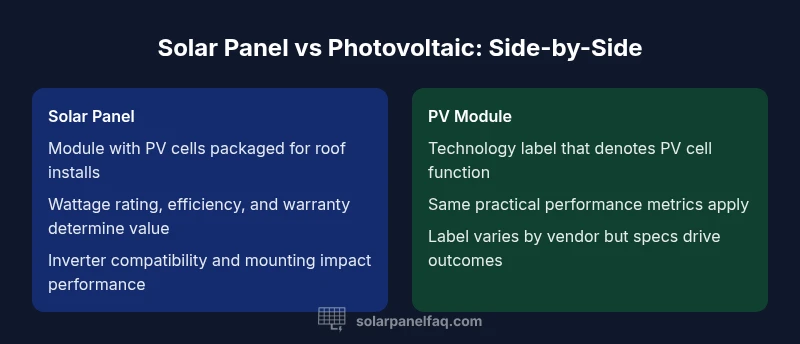
| Feature | Solar panel | Photovoltaic (PV) module |
|---|---|---|
| Definition | A packaged module used on rooftops to convert sunlight into electricity | A PV module—the same device, often labeled PV for technical clarity |
| Core technology | Monocrystalline or polycrystalline PV cells surrounded by protective layers | PV cells configured into a module with same protective layers; label varies by vendor |
| Output characteristics | Wattage rating and performance under standard test conditions | Wattage rating and performance claims are meant to reflect same electrical output under measurement |
| Efficiency | Measured as module efficiency at standard conditions | Measured similarly; efficiency labels may appear under different marketing terms |
| Warranty & durability | Typically 20–25 year warranties on product and performance | Similar warranty structures apply; labeling does not inherently change warranty rights |
| Cost context | Upfront cost per watt and installation is key | Cost considerations follow wattage, brand, and system design, not terminology |
| Best use case | Residential rooftops with good sun exposure and space | Residential or commercial sites where PV modules are specified by installers |
Strengths
- Clarifies terminology to avoid confusion during discussions
- Helps align expectations on cost, efficiency, and installation
- Improves decision-making for ROI and payback period
- Supports clearer budgeting by focusing on specs rather than labels
Drawbacks
- Terminology overlap can still confuse homeowners
- Regional standards and labeling can vary by market
- Marketing blur may persist without careful evaluation
Terminology aside, PV modules and solar panels are effectively the same device for home solar purchases.
Focus on real-world specs such as wattage, efficiency, warranty, and installation quality rather than labels. Use a standardized evaluation checklist to compare options and confirm compatibility with your roof, inverter, and energy goals.
Frequently Asked Questions
What is the difference between solar panel and photovoltaic (PV) module in practical terms?
In practical terms, solar panel and PV module refer to the same device. PV is the underlying technology, while solar panel is the common product label. Focus on performance specs, not labels.
Solar panel and PV module basically mean the same thing. What matters are the numbers, warranties, and how well it fits your roof.
Are solar panels and PV modules truly interchangeable when shopping for a home system?
Yes, for most buyers they are interchangeable terms. The critical aspects are wattage, efficiency, degradation, and warranty. Always compare the same metrics across options.
They’re usually interchangeable; just compare the real specs and warranties.
Does terminology affect the warranty or performance of the system?
Terminology does not inherently affect warranty or performance. Warranties are defined by the manufacturer and model, not by whether the product is labeled PV or solar panel.
The label doesn’t change how well it lasts or how much it costs; the specific model and warranty do.
Can I mix PV modules with different labels on the same system?
You can, but ensure electrical compatibility and that the array design accounts for variations in Voc, Isc, and temperature behavior. Consult the installer for proper stringing and safety margins.
Mixing is possible if specs line up; check with your installer first.
Which terminology should I trust when evaluating warranties or certifications?
Trust the product-specific certifications and the manufacturer’s warranty terms rather than the label. Ask for test results and independent performance data.
Warranties come from the product, not the name on the box.
Why do some marketers blur PV with solar panels?
Marketing teams may use PV terms to emphasize technology, but this should not influence your buying decisions. Look past labels and verify actual performance and costs.
Marketing can blur terms; focus on specs instead.
Top Takeaways
- Prioritize performance specs over terminology
- Assess warranty terms and long-term serviceability
- Evaluate installation compatibility and system design
- Use a consistent, data-driven comparison checklist