Solar Panel or Module: A Practical Comparison for Homeowners
A detailed, objective side-by-side look at solar panel vs module terminology, definitions, and practical buying guidance for homeowners and solar buyers.


According to Solar Panel FAQ, the terms solar panel and module often refer to the same PV unit, but usage varies by market. For homeowners, focus on the specs, warranty, and compatibility rather than labels. This quick comparison clarifies practical differences and guides you to choose the right unit for your roof, inverter, and energy goals.
Defining the Core Terms: solar panel or module
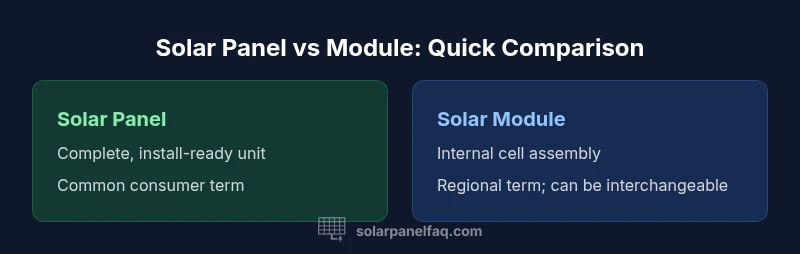
In everyday residential solar conversations you will hear the phrases “solar panel” and “solar module” used almost interchangeably. Both refer to photovoltaic devices designed to convert sunlight into electricity, packaged into a protective frame and housing. When the term solar panel is used, most homeowners picture the finished, install-ready unit that arrives from a manufacturer and is mounted on a roof or racking system. The phrase solar module, conversely, is common in manufacturing and B2B catalogs, where the same underlying technology is described as a module rather than a panel. The key point for homeowners: the physical product you install is typically a complete unit that contains cells, encapsulation, a protective front glass, and an electrical junction box. The label you see on a quote may vary by region, but the functional unit—your power-producing device—remains the same. In this article we treat the terms as two sides of the same coin, with emphasis on how to compare specs, warranties, and compatibility rather than the wording itself, i.e., the practical meaning of solar panel or module matters most for your installation design and long-term performance.
Terminology in Practice: When the terms differ
Terminology differences between regions and suppliers can create confusion during quotes or catalogs. In some markets, “panel” is the consumer-facing term, while “module” appears on technical datasheets and factory shipments. In other regions, both words describe the exact same unit, and the distinction is largely semantic. For a homeowner evaluating bids, the critical takeaway is not the label but the specifications behind it: cell technology (monocrystalline vs polycrystalline), rated efficiency, temperature coefficient, and degradation rate over time. Brand naming conventions may also influence how warranties are stated; a module warranty might emphasize the module’s performance over 25 years, while a panel warranty could stress materials and workmanship coverage. Always map terms to the actual performance data in the spec sheet and ask for the same data format across quotes.
Technical Distinctions That Matter
While many panels and modules are built with similar layers—glass, encapsulant, EVA, a backsheet, and a frame—their performance can differ based on cell technology, coatings, and packaging. The core components are the same: PV cells convert light into electricity, interconnections route the current, and protective materials shield against environmental exposure. When comparing solar panel or module options, scrutinize the following: cell type (e.g., mono- vs polycrystalline), efficiency, temperature coefficient (how performance changes with heat), spectral response, and degradation rate. The terminology alone does not determine performance; the microarchitecture and manufacturing quality do. To maximize system reliability, your comparison should translate every quoted term into a measurable spec: power rating under standard test conditions, expected output at your site’s climate, and the fair wear terms of the warranty.
How to Choose for Your Home: A Decision Framework
Choosing between a solar panel or module for your home should start with your energy goals and roof constraints. Follow a practical 6-step framework: 1) Define your annual energy target and available roof area; 2) Gather complete specs from suppliers, not just marketing claims; 3) Compare efficiency, heat tolerance, and shade tolerance; 4) Check warranty length, coverage, and claims process; 5) Verify compatibility with your inverter, mounting hardware, and electrical code requirements; 6) Consider total cost of ownership, including installation, maintenance, and potential tax incentives. Throughout this process, reference the primary keyword solar panel or module to ensure you are aligning terminology with actual product specs rather than just labels. In every quote, insist on a uniform data sheet format so you can compare apples to apples, not labels to labels. The goal is a decision grounded in performance, reliability, and value, not nomenclature.
Installation and Compatibility: Where terms meet hardware
Installation constraints influence whether you should classify a unit as a solar panel or module. The mounting rails, orientation, framing, and reach to the inverter input are all critical. A roof’s pitch, shading patterns, and structural load affect how much electricity a panel or module will produce over a year. If you’re replacing an existing array, verify that the new unit’s electrical characteristics align with your current inverter and microinverter configuration. In many cases, installers will require a match in electrical parameters rather than a strict adherence to the term solar panel or module. Because the physical unit is mounted in the same way regardless of label, the installation process hinges on the electrical compatibility, mounting standards, and warranty terms, not the marketing name. When in doubt, ask for a side-by-side spec comparison that shows each unit’s current-voltage (IV) curve, temperature behavior, and degradation trajectory.
Cost, Warranty, and Maintenance Considerations
Understanding the cost implications of solar panel or module choices requires looking beyond sticker price. The long-term value depends on durability, performance under heat, and how the warranty is applied. Most residential products offer a warranty that covers materials and workmanship, along with a separate performance warranty that guarantees a minimum output across the warranty period. What matters is how the warranty handles environmental exposure, shading, and degradation, as well as how to file a claim and who provides service. Maintenance for solar panel or module setups is generally minimal: regular cleaning to remove dust and debris, periodic inspection for microcracks or loose hardware, and monitoring of electrical outputs to catch performance anomalies early. By focusing on the reliability track record of the manufacturer and the clarity of the warranty terms, homeowners can avoid future disputes and ensure sustained energy production.
Real-world Scenarios: Residential vs Commercial
In residential contexts, the choice between solar panel or module is typically driven by retrofit feasibility, roof constraints, and budget. Homeowners prioritize ease of installation, aesthetics, and predictable energy savings, and thus prefer units with straightforward warranty and support. In commercial settings, the decision may hinge on scale, supply chain relationships, and long-term service commitments. Regardless of project size, the same disciplined comparison applies: verify performance under local conditions, confirm compatibility with the planned inverter topology, and ensure the contract uses consistent terminology that matches the unit’s technical characteristics. The solar panel or module distinction, while important for clear communication, should not overshadow the essential attributes of cost, reliability, and return on investment. A well-informed decision aligns system design with climate, roof exposure, and energy goals.
Common Misconceptions and Best Practices
A common misconception is that solar panel and module refer to different technologies. In practice, they are often interchangeable terms for the same device. A best practice is to insist on side-by-side data sheets for any quote, focusing on real performance numbers rather than marketing language. Always confirm the exact model name, cell technology, and warranty scope to avoid surprises later. When communicating with installers or suppliers, use a single, precise description (for example, the specific model number) to ensure the product you receive matches what you reviewed. Finally, consider obtaining a third-party efficiency rating or independent lab test where available to validate the claimed performance, particularly if you are comparing brands or regional offerings.
Key Takeaways: Practical guidance for homeowners
- Understand that solar panel or module terms often refer to the same unit; verify data instead of trusting labels.
- Always compare complete specs: efficiency, temperature performance, degradation, and warranty terms.
- Ensure electrical compatibility with your inverter and mounting hardware before purchase.
- Request uniform datasheets across quotes to enable apples-to-apples comparisons.
- Prioritize reliability and service support to maximize long-term energy production.
Comparison
| Feature | solar panel | solar module |
|---|---|---|
| Definition | A complete PV unit intended for installation, including cells, tempered glass, frame, and wiring | An enclosed assembly of PV cells marketed as a module; in many markets interchangeable with a panel |
| Typical components | Cells, tempered glass, aluminum frame, EVA encapsulant, backsheet, junction box | Encapsulated cell group within protective lamination; packaging terminology varies by region |
| Market usage | Common consumer term for a ready-to-install unit | Common in manufacturing catalogs; may be used interchangeably with 'panel' in many regions |
| Warranty focus | Materials, workmanship, and sometimes performance warranties; varies by maker | Aligned with panel warranties in many cases; may reflect module-specific coverage |
| Installation implications | Mounted on racking with wiring to inverter; standard field-installable unit | Same installation path; terminology influences documentation more than hardware |
| Best for | Homeowners seeking turnkey installation with standard terminology | Installers or buyers parsing manufacturer catalogs; if reading datasheets, module-focused wording may appear |
| Cost/value context | Price driven by the complete unit and shipping; varies by brand and region | Module-level pricing can mirror panel pricing in many markets; value tied to specs and warranty |
Strengths
- Promotes clarity by focusing on specs rather than labels
- Helps buyers compare warranties and performance consistently
- Aids procurement decisions for homeowners and installers
- Encourages standardized quoting and contractual language
Drawbacks
- Terminology ambiguity can still cause confusion
- Regional differences may lead to misinterpretation
- Overreliance on labels can obscure important compatibility details
Panel and module are largely interchangeable terms for the same PV unit in most homes; prioritize specs and warranties over labels.
In practice, the terms rarely indicate a different technology. Focus on performance data, warranty terms, and system compatibility to make the best choice for your roof and energy goals.
Frequently Asked Questions
Are solar panels and solar modules the same thing?
In most residential contexts, yes; the terms are often interchangeable and refer to the same PV unit. The difference is mainly terminology rather than function. Always verify specs and warranty details when comparing quotes.
Yes, panels and modules usually refer to the same unit; always check the actual specs and warranty before buying.
Can I mix modules/panels from different manufacturers?
Mixing can be possible if electrical characteristics match and the system is designed for it. Mismatched modules can reduce performance and complicate warranties, so consult a qualified installer before mixing.
Mixing is possible with careful design, but check electrical compatibility and warranties first.
What should I look for in a module warranty?
Look for the duration, coverage scope (materials, workmanship, and performance), and conditions for claims. Ensure the warranty aligns with your local regulations and the expected life of the system.
Check duration, what is covered, and how to file claims.
Are there efficiency differences between panel vs module terminology?
Efficiency is determined by the technology and manufacturing quality, not the terminology. Compare the module's rated efficiency and temperature performance rather than the label itself.
Efficiency depends on the tech, not whether the unit is called a panel or module.
Is maintenance different for panels vs modules?
Maintenance practices are essentially the same for panels and modules: regular cleaning, inspections, and monitoring outputs. The label does not dictate maintenance needs.
Maintenance is the same; keep it clean and monitor performance.
Top Takeaways
- Define terms upfront, but compare specs, not labels
- Verify compatibility with your inverter and mounting hardware
- Prioritize warranty coverage and service support
- Ask for uniform data sheets to enable apples-to-apples comparisons
- Consider long-term energy production and maintenance needs