Solar Panels for Portable Power Stations: A Practical Guide
Learn how to choose, connect, and optimize a solar panel for a portable power station. This educational guide covers compatibility, connectors, safety, and best practices for reliable off-grid charging.


By the end of this guide you will be able to select a compatible solar panel, safely connect it to a portable power station, and optimize charging under real-world sunlight. We’ll cover connector types, cable sizing, weather considerations, and practical safety steps to ensure reliable outdoor use. This approach minimizes risk and maximizes performance across seasons.
Real-world goals when pairing solar with portable power stations
Pairing a solar panel with a portable power station unlocks off-grid power for camping, emergencies, and remote work. The goal is reliable charging without risking device damage or unsafe setups. According to Solar Panel FAQ, a well-matched pairing starts with compatibility between panel output, station input, and connectors. The solar panel for portable power station combination should be easy to deploy, weather-resistant, and portable enough for your lifestyle. In practice, you want a setup that delivers steady charging under typical sunlight while staying safe in wind, rain, or cold. This article walks you through how to select, connect, and optimize your portable solar charging system.
Assessing your portable power station compatibility
Before you buy a panel, review your station’s input specs. Look for the exact input voltage and current range, the type of solar input (whether it supports direct panel connection or requires a charge controller), and the accepted connector style. Solar Panel FAQ analysis shows that real-world performance hinges on matching voltage range and connector compatibility more than wattage alone. If your station lists a 12–24V input with standard MC4-compatible ports, you’ll want a panel that can provide within that range at moderate current. Keep in mind maximum input current and any built-in protections; overspecifying can cause safety shutdowns, while underspecifying will yield slow charging.
Choosing a solar panel that fits your needs
For portable use, look at panels in the range of about 60 to 160 watts, depending on your battery capacity and daily energy needs. Foldable panels offer weight benefits and quick setup, while rigid panels tend to be more durable over time. Consider panel efficiency, weight, size when folded, and how you’ll transport it to your charging site. A compact unit that balances weight and output often yields the best real-world performance for a solar panel for portable power station pairing. Ensure the panel’s form factor fits your mobility and storage constraints.
Understanding connectors and cables
Most portable power stations use standard DC inputs or dedicated solar ports. The most common solar interface is MC4-compatible connectors, but some stations accept barrel or Anderson-type inputs. Verify which connector your power station requires and carry adapters as needed. Use cables with appropriate gauge to minimize voltage drop at higher currents. Always connect the positive lead to the positive terminal and the negative lead to the negative terminal, and avoid shorting the cables during setup.
Safe setup and weather considerations
Weatherproofing is essential for outdoor charging. Ensure the panel and its cables have a protective cover or housing appropriate for rain or dew. Secure the panel so wind cannot topple it, and use a stable stand or mount with non-slip feet. If you anticipate rain or heavy wind, disconnect and store the panel until conditions improve. Remember to check for UV degradation and keep connectors dry when attaching or detaching. These precautions help protect both the panel and the portable power station from weather-related damage.
Practical test and monitoring checklist
Test your setup in bright sunlight with the power station connected. Monitor input voltage and current, ensure you observe stable charging indicators, and verify that the station’s battery percentage increases over time. If the readouts are erratic, recheck connections and consider adjusting the panel’s angle toward the sun. Keep a log of voltage at key moments to gauge performance over multiple days and weather conditions.
Addressing performance gaps and maintenance
If charging is slower than expected, recheck cable gauge, connector integrity, and panel cleanliness. Dirt, shade, or partial obstruction can dramatically affect output. Clean the panel gently with a damp cloth and inspect for cracks or delamination. Regularly verify that the panel still aligns with your power station’s input range, especially after storage or transport. A well-maintained setup yields more consistent results across seasons.
Tools & Materials
- Portable solar panel(Foldable or rigid, aim for 60–160W depending on needs)
- Portable power station(With DC input or dedicated solar port)
- MC4 connectors or adapters(Ensure compatibility with panel and station ports)
- Cables of suitable gauge(Low-voltage drop, minimum 2.0 mm² for longer runs)
- Voltage/current tester(Useful for verifying real-world output in the field)
- Weatherproof mounting stand(Stabilizes the panel and enables angle adjustments)
- Dry cloth and mild cleaner(Keep panel surface clean for optimal efficiency)
Steps
Estimated time: 30-60 minutes
- 1
Verify compatibility
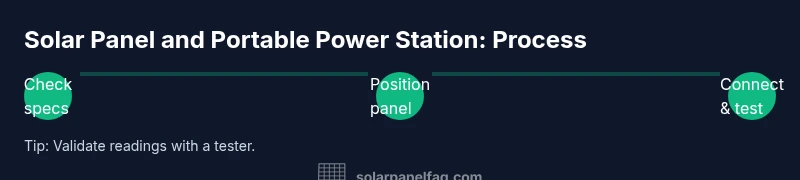
Check your portable power station’s solar input voltage and current range, plus the required connector type. Confirm the panel can provide within that range at typical operating conditions. This prevents damage and ensures efficient charging.
Tip: Always consult the manufacturer manuals for exact specs. - 2
Position the panel for sun
Place the panel so it faces the sun directly, with an unobstructed path. Adjust the tilt toward the sun’s arc to maximize exposure during peak hours.
Tip: Use a stand or stake to maintain a stable angle. - 3
Connect the cables
Attach the panel’s output cables to the power station’s solar input using the proper adapters. Double-check polarity and ensure all connections are snug before opening the circuit.
Tip: Do not touch exposed connectors while live. - 4
Monitor charging indicators
Observe the station’s display or indicator LEDs to confirm charging is active. Note the voltage and current readings to verify they align with expectations for your panel.
Tip: Record readings for trend tracking. - 5
Test under load
Plug in a small device or run a test battery to ensure charging remains stable under real usage. Watch for voltage dips and correct as needed.
Tip: Avoid overloading the station during testing. - 6
Store and maintain
Unplug, coil cables neatly, and store the panel in a dry place. Inspect cables for wear and clean the panel surface periodically.
Tip: Schedule periodic checks to extend lifespan.
Frequently Asked Questions
Can I charge a portable power station directly from a solar panel?
Yes, if the panel’s output matches the station’s input voltage and current, and you use the correct cables or adapters. Check the station’s manual for exact requirements.
Yes, you can charge directly if the panel matches the station’s input specs and you have the right cables.
What wattage panel is suitable for casual camping?
For casual camping, panels in the 60–120W range are common. The exact choice depends on your station’s battery size and daily energy needs.
For casual camping, a 60 to 120 watt panel is typical, depending on your station’s battery size.
Can I use a car charger if it’s sunny outside?
Car chargers can charge while the engine runs, but they’re not a complete substitute for solar. Solar provides off-grid charging when you’re away from a vehicle.
A car charger works when the engine runs, but it isn’t a full substitute for solar off-grid charging.
Is it safe to leave charging unattended?
Generally, avoid unattended high-current charging. Monitor connections, and ensure weatherproofing and safety features are in place.
It’s best not to leave high-current charging unattended; monitor the setup.
How should I store and maintain solar panels?
Store panels dry, clean the surface periodically, and inspect cables for wear. Regular checks help sustain performance.
Store dry, clean the panel, and check cables regularly.
Do I need a charge controller for all setups?
Some stations include a built-in controller; others require an external one. Check your device’s specifications to avoid overcharging or compatibility issues.
Some systems have built-in controllers; others require external controllers. Check specs.
Watch Video
Top Takeaways
- Match voltage and connector types for safety.
- Choose portable, weatherproof options for real-world use.
- Use proper cables and safe handling practices.
- Position panels for optimal sun exposure and monitor performance.
- Follow manufacturer guidance for warranties and maintenance.