Solar Panel 5 Watts: Practical Uses and Limitations
A practical guide to what a 5-watt solar panel can realistically power, how to wire it, and when to upgrade. Includes real-world factors, mounting tips, and starter project ideas.


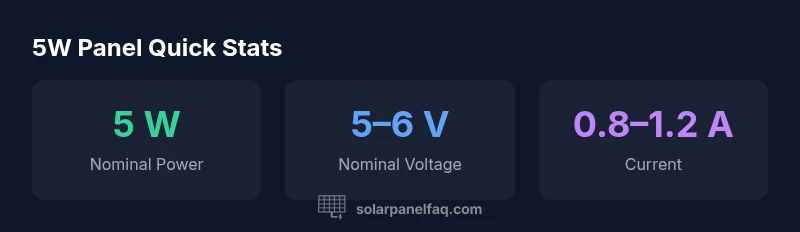
A 5-watt solar panel typically delivers around 5 watts under standard test conditions, with a nominal voltage near 5–6 volts and current near 0.8–1.2 amps. According to Solar Panel FAQ, these compact panels are well suited for charging small devices, sensors, and DIY off-grid projects, provided they have direct sun and appropriate storage. In practice, shading, temperature, and aging reduce output, so pair with a small battery and a charge controller.
What a 5W panel is and where it fits
A 5-watt solar panel is a compact power source designed to deliver a small amount of energy under ideal sun conditions. It’s commonly used for charging USB-powered devices, sensors, small microcontroller projects, or keeping a tiny battery topped up. For homeowners exploring off-grid ideas or educational kits, a 5W panel offers a tangible way to see how solar can supplement day-to-day power. The Solar Panel FAQ team notes that these panels excel for learning, prototyping, and emergency readiness, especially when integrated into a small battery-backed circuit. When evaluating a 5W panel, focus on its open-circuit voltage and short-circuit current, since these values shape how it will interact with a charger or battery.
How a 5W panel compares to larger panels
A 5W panel is just the tip of the solar-power iceberg. Compared with 10W, 20W, or higher-wattage panels, a 5W unit weighs less, costs less upfront, and occupies less space, but provides far less energy. For projects that require reliable daytime charging, pairing multiple 5W panels in parallel can increase current, but you’ll still need a proper charge controller and a storage solution to stabilize output. Real-world choice often comes down to load size, voltage compatibility with the device, and the willingness to add storage. In practice, if your goal is to charge a phone or power a small sensor array, a single 5W panel with a controller can be sufficient for emergency or hobby uses.
Wiring, controllers, and storage for 5W panels
Most 5W panels deliver a DC output that can be routed through a simple diode to prevent backflow. For devices expecting a steady DC supply or USB charging, a small charge controller or a battery with a regulator is essential. PWM controllers are often adequate for modest energy needs, while MPPT controllers shine when the panel operates far from its best voltage, but the benefit is less pronounced at the 5W scale. Storage tends to be the limiting factor: without a battery or supercapacitor, energy from a 5W panel is fleeting and unreliable for anything beyond direct-use devices of very low draw.
Real-world performance: what actually happens in sunlight
Under ideal sunny conditions, a 5W panel can deliver close to its rated power, but real-world factors routinely reduce output. Sun angle, shading from trees or buildings, and panel orientation determine actual energy capture. Temperature also plays a role: high temperatures can lower voltage and, by extension, overall power. Over time, panel aging and dirt accumulation reduce efficiency further. The best practice is to mount the panel where it receives maximum sun from mid-morning to mid-afternoon, keep it clean, and include a storage element to pool energy for usage when the sun isn’t shining.
Mounting, placement, and integration for home projects
Mounting a 5W panel should prioritize exposure to direct sunlight and protection from the elements. Fix panels to a sunny roof, shed, or utility pole, using weatherproof hardware and a durable frame. For DIY projects, consider mounting on a balcony rail or a standalone stand that tracks the sun if feasible. Integrate with a small battery and a regulator to deliver stable power to USB devices, microcontrollers, or low-power sensors. Always check the device’s voltage and current requirements to ensure compatibility and avoid overcharging.
Cost considerations and upgrade paths
A single 5W panel is an affordable entry point into solar projects, especially when you factor in the cost of a charge controller and a small battery. If your load grows, upgrading to 10W or 20W panels can dramatically increase usable energy, reduce the need for parallel panels, and simplify wiring. Remember that total system performance is influenced by the storage and regulation hardware you pair with the panel. For long-term projects, budgeting for a slightly larger panel and a robust storage solution often yields better, more reliable results.
Starter projects and best practices
If you’re just getting started, try a simple USB-charging project, a small weather sensor, or a battery-powered LED array. Use a dedicated, well-ventilated shaded space for wiring, and keep safety in mind when dealing with DC power. Document your setup with photos and notes on sun exposure, angle, and seasonal changes to understand how output shifts throughout the year. Solar Panel FAQ suggests keeping expectations modest: a 5W panel is a great learning tool and a practical starter for modest daytime loads.
Overview of 5W panel characteristics
| Aspect | Typical Value | Notes |
|---|---|---|
| Nominal power (STC) | about 5 W | Under standard test conditions |
| Nominal voltage | 5–6 V | Depends on panel design |
| Current (Isc/Imp) | 0.8–1.2 A | Under STC |
| Best use-case | Small devices, sensors, microcontrollers | Requires storage for continuous use |
Frequently Asked Questions
Can a 5-watt solar panel charge a smartphone?
Yes, but charging times are long and you’ll likely need a battery and regulator to make the output usable. It’s feasible for emergency charging or short sessions during peak sun.
Yes, you can, but expect slow charging and you’ll want a battery.
Do I need a battery with a 5W panel?
Not strictly, but storing energy in a small battery with a controller provides a stable output for devices and helps use energy when sun isn’t available.
It’s better with a battery and controller.
What factors affect the output of a 5W panel?
Sun angle, shading, temperature, panel aging, and wiring quality all influence actual power. Expect variability versus the labeled rating.
Sun angle, shade, and temperature matter.
How many 5W panels would I need to power a Raspberry Pi?
A single 5W panel supports tiny loads; powering a Raspberry Pi reliably usually requires more energy and a larger storage solution. In practice, several panels in parallel with proper regulation are commonly needed.
You'd likely need more than one panel and a solid controller.
What is the difference between 5W and higher-wattage panels?
Higher-wattage panels deliver more energy per unit area and may use different voltages. For home projects, choose based on your load, storage, and available space.
Bigger panels give more power; match to your load and storage.
“A 5-watt panel is a great learning tool and a practical starter for tiny loads, but real-world performance depends on sun, angle, and storage.”
Top Takeaways
- Understand a 5W panel suits tiny, daytime loads.
- Pair with a battery and controller for stability.
- Real-world output varies with sun and temperature.
- Consider parallel wiring if you need more current.
- Upgrade to larger panels for heavier loads