Solar Cells for Sale: A Practical Buyer's Guide
Discover practical tips for buying solar cells for sale. Compare efficiency, price ranges, warranties, and installation options to make an informed, safe investment in solar for your home.


Solar cells for sale come in several types and price ranges, but your best bet is to compare efficiency, warranty, and total installed cost for your roof. According to Solar Panel FAQ, focus on module efficiency, system sizing, and reputable sellers to avoid scams. This quick guide points you to practical choices for homeowners seeking reliable solar cells for sale.
Market Snapshot for Solar Cells for Sale
Solar cells for sale are widely available from manufacturers, distributors, and installers. The market has expanded as homeowners pursue energy independence and rising electricity prices. The Solar Panel FAQ team found that the strongest deals often come from reputable manufacturers or installers who provide performance data and warranties, rather than generic online listings. When evaluating options, start by confirming the cell type (monocrystalline vs polycrystalline), the rated efficiency, and the available warranty. Next, compare the total system cost including mounting hardware, racking, wiring, and permitting fees to avoid sticker shock later. Finally, check shipment timelines and after-sale support, as delayed deliveries or weak customer service can disrupt a home project. This section sets the stage for practical shopping strategies and emphasizes the importance of data-backed decisions when you’re buying solar cells for sale.
How to Compare Efficiency and Cost Across Sellers
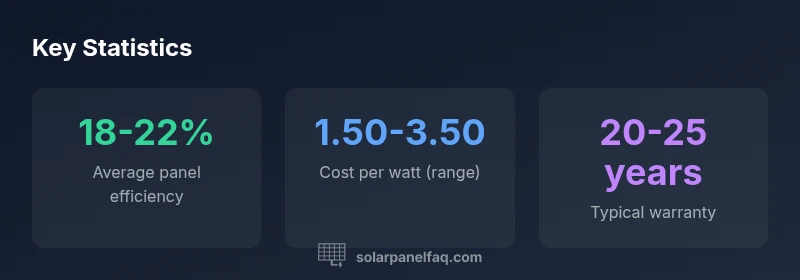
Efficiency matters because it determines how much space you need on your roof and how much energy you generate in low-sun conditions. Typical modules today deliver around 18-23% efficiency, with mono-crystalline cells at the high end. Price per watt can vary widely by brand, form factor, and bulk discounts. When comparing sellers, request a data sheet showing the cell’s performance at standard test conditions, temperature coefficient, and degradation rate. Verify the warranty length and what it covers (materials vs workmanship). Include shipping, handling, and any install-related costs in your per-watt calculation. A simple approach is to compute cost per watt for each option and scale by your expected energy needs and local incentives. Solar Panel FAQ’s analysis shows that a careful, apples-to-apples comparison reduces the risk of overpaying and helps you pick solar cells for sale that actually meet your climate and usage profile.
Cell Technologies: Monocrystalline vs Polycrystalline vs Thin-Film
Monocrystalline cells deliver higher efficiency and a sleeker look but cost more, making them common in space-constrained roofs. Polycrystalline cells offer lower cost per watt but slightly lower efficiency, often suitable for larger installations. Thin-film options are less common for residential systems due to size and efficiency trade-offs but may suit specialized applications. For homeowners, starting with monocrystalline modules provides better performance in real-world conditions. Compare temperature coefficients (how output falls with heat), bifacial capabilities, and warranty terms across brands. In practice, your roof footprint and climate will dictate whether you prioritize maximum efficiency or a lower upfront price. When you see “solar cells for sale,” remember that the underlying technology affects long-term energy yield more than glossy marketing alone.
Warranty, Certification, and Longevity Signals
Always check for third-party certifications (e.g., IEC, UL) and a named warranty on both product and performance. A 20- to 25-year product warranty and a 25-year performance warranty are common baselines. Performance warranties guarantee a certain output decay by year 25. Review transferability if you sell your home. Look for datasheets that show expected annual degradation and performance at standard test conditions. Favor sellers who provide independent test results or lab certifications. These signals help ensure your solar cells for sale aren’t just cheap pieces of glass but dependable energy assets.
Sizing Your System and Roof Considerations
Begin with an energy audit to determine your baseline usage and identify peak demand hours. Translate your usage into a required system size, typically expressed in watts or kilowatts. Your roof area, orientation, shade patterns, and mounting feasibility determine the maximum achievable capacity. A common rule is to aim for a system that covers a portion of your annual usage while ensuring redundancy for cloudy periods. Use shading analysis tools and professional load calculations to avoid oversizing or under-sizing. When shopping for solar cells for sale, consider modules with higher efficiency if you have limited roof space, or lower-cost, larger-area cells if space is plentiful.
Where to Buy: Reputable Channels and Red Flags
Reliable sellers include established manufacturers, authorized distributors, and licensed installers who provide warranties and installation support. Beware of unusually low prices from unknown marketplaces, limited product documentation, or missing certifications. Ask for a formal quote that lists all components, guarantees, and return policy. Check seller reputation through independent reviews and trade associations. Request performance data, test reports, and serial numbers to verify authenticity. In general, buying solar cells for sale from reputable sources reduces risk and ensures compatibility with your chosen installer and roof.
Installation Pathways: DIY vs Professional
Most homeowners pair solar cells for sale with professional installation to meet electrical codes and warranty requirements. A licensed electrician and roofer assess roof integrity, design, and permitting needs. If you opt for a DIY route, be prepared to handle electrical connections, mounting hardware, and safety concerns; ensure you have access to utility interconnection and net metering approvals. Even DIY-oriented projects should include a final inspection and a formal warranty for the installation work. For most homeowners, paying for professional installation yields better performance and peace of mind.
Maintenance, Cleaning, and Real-World Performance
Solar cells require minimal maintenance, but a periodic cleaning and inspections help sustain performance. Remove debris, leaves, and snow that can shade panels; inspect for micro-cracks or discoloration that indicate damage. Keep an eye on system monitoring data to catch underperforming strings. Warranties often require professional servicing and standard cleaning. In practice, sustained energy production depends on both module quality and how well the system is maintained; selecting higher-quality cells for sale reduces the likelihood of performance losses.
Future-Proofing Your Investment
Consider warranties, ease of upgrading, and the potential for efficiency improvements in the coming years. Favor modules with transferable warranties and documented performance data. If you plan upgrades or system expansions, choose a frugal yet scalable design and a reputable installer who can handle future sun exposure and climate variations. As incentives shift and technology advances, Solar Panel FAQ recommends keeping a watchful eye on efficiency improvements and new standards, to protect and maximize the value of your solar cells for sale.
Comparison of common solar cell specs
| Aspect | Details | Typical Range | Notes |
|---|---|---|---|
| Cell Type | Monocrystalline / Polycrystalline | N/A | Choose by budget and roof space |
| Efficiency | 18-23% | N/A | Depends on cell design |
| Cost per Watt | 1.50-3.50 | dollars | Market dependent |
| Warranty | 20-25 years | years | Industry standard |
| Shipping Time | 1-3 weeks | weeks | Supply chain dependent |
Frequently Asked Questions
What does 'solar cells for sale' typically include?
Typically includes cells and modules, sometimes frames and mounting hardware. Inverters or racking may be separate. Verify exactly what’s included and whether performance data is provided.
Look for what's included and ask about inverter compatibility.
How should I compare efficiency and price when shopping?
Compare rated efficiency, temperature coefficients, and degradation rate. Include shipping, warranty, and installation costs in your per-watt calculation. Use cost per watt to assess value across sellers.
Compare efficiency, degradation, and total installed cost.
Are refurbished or salvaged solar cells available and worth it?
Used cells can be cheaper but come with higher risk of reduced performance and shorter remaining life. Only buy refurbished cells from reputable sources with clear warranty terms.
Used cells can be cheaper but come with risk.
What warranties should I expect when buying solar cells?
Look for 20-25 year product warranty and a 25-year performance warranty. Ensure transferability if you sell the home and review terms for power output retention.
Ask for product and performance warranties with explicit terms.
Is professional installation required for most solar cell purchases?
Most installations require licensed professionals due to electrical codes and interconnection rules. DIY options exist but come with higher risk and limited warranties.
Most installations should use a pro.
How can I verify the reliability of a seller?
Check licenses, reviews, and return policies. Request performance data and certifications, and compare quotes from multiple reputable sellers to ensure legitimacy.
Check licenses, reviews, and data sheets.
“Choosing solar cells for sale is about balancing performance with your roof's constraints and your budget. Protect that investment with solid warranties.”
Top Takeaways
- Assess efficiency to fit roof size
- Compare price per watt and total cost
- Verify warranties and transferability
- Buy from credible sellers with data sheets
- Plan for installation timelines and permits