Is Solar Power Similar to Photosynthesis? An Analytical Comparison
An analytical comparison of solar power and photosynthesis, explaining how light energy becomes usable energy, with implications for homeowners and researchers alike.


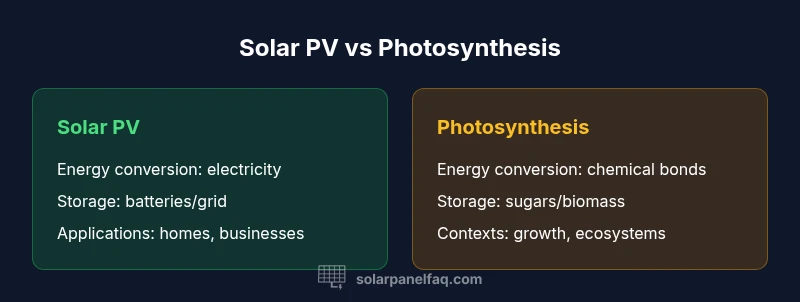
Is solar power similar to photosynthesis? Not literally. The analogy helps people understand energy flow, but the two processes differ in mechanism and scope. Photosynthesis stores energy as chemical bonds in sugars, using pigments to drive electron transport. Solar power, by contrast, converts light directly into electricity via photovoltaic semiconductors, with storage typically via batteries or the grid. The similarity lies in light capture; the methods diverge afterward.
Is solar power similar to photosynthesis? Framing the question
The phrase is a valuable starting point for learners exploring energy conversion, because both natural and human-made systems rely on capturing sunlight to drive some form of energy storage or use. However, the Solar Panel FAQ team emphasizes that the analogy has limits. When you ask, is solar power similar to photosynthesis, you’re really asking about how light becomes useful energy in two very different frameworks: a biological process optimized for growth and a technological process optimized for power export. The best way to use the analogy is to map the input (sunlight) and the broad outcome (stored or usable energy) while avoiding a one-to-one equivalence. This article expands that framing with science-based distinctions and practical implications for homeowners and students alike.
Photosynthesis in nature: a quick primer
Photosynthesis is a biochemical pathway that plants, algae, and some bacteria use to convert light energy into chemical energy. Light reactions capture photons to generate ATP and NADPH, then the Calvin cycle uses those energy carriers to fix carbon dioxide into sugars. The process is deeply integrated with plant metabolism, growth, and environmental regulation. While photosynthesis has evolved to optimize energy flow for biological needs, its complexity exceeds a direct energy-for-use model; it is designed for sustaining life, not delivering electricity.
Solar power: how PV cells convert light to electricity
Photovoltaic (PV) cells rely on semiconductor physics to convert photons into electrical current. When sunlight strikes a PN junction, electrons gain energy and move across the junction, creating an electric field that drives current. Unlike photosynthesis, PV systems do not store energy inherently; storage comes from batteries or the electrical grid. This separation of energy capture and storage is a fundamental design choice that affects efficiency, reliability, and cost over the system’s lifetime. The role of materials science, manufacturing quality, and installation conditions all influence performance.
The energy conversion path: photons to usable energy
In both systems, the starting point is a photon delivering energy. In photosynthesis, energy is funneled into chemical bonds through a cascade of electron transfers in pigment–protein complexes. In PV, photons excite electrons in a solid, creating free carriers that can be collected as electricity. The quantum efficiency of PV cells describes how effectively photons are converted into charge carriers, while in photosynthesis, the dynamics of exciton transfer and enzyme-catalyzed steps determine the rate of sugar production. The common thread is light as the primary energy input, but the downstream processing follows distinct rules.
Storage: sugars vs batteries and grid
Storage decisions reflect the different goals of each system. Plants store energy chemically in complex carbohydrates that fuel growth over days, weeks, or seasons. Solar PV systems typically store electricity in batteries or feed power into the grid for later use. The chemical energy of biomass can be converted back into heat, fuel, or electricity, but this requires additional processing. Homeowners face trade-offs between storage capacity, resilience, upfront cost, and long-term maintenance when choosing a storage approach for solar energy.
Efficiency considerations: frame of reference matters
If you measure photosynthesis by the rate of carbon fixation under ideal conditions, it can appear remarkably efficient for biological purposes. In contrast, PV efficiency is evaluated by the fraction of incident light converted to electricity under standardized testing and can be optimized with better materials and tracking. Real-world performance for both systems depends on temperature, light intensity, angle of incidence, and aging effects. When comparing them, it is crucial to specify whether you are evaluating instantaneous energy capture, energy delivered to load, or energy stored for later use.
Environmental context and sustainability
Photosynthesis supports ecosystems by producing biomass and oxygen, thereby shaping atmospheric composition and nutrient cycles. Solar PV reduces greenhouse gas emissions by displacing fossil-fuel electricity, but manufacturing, installation, and end-of-life handling contribute to its environmental footprint. A balanced view recognizes that both systems operate within broader ecological and industrial systems. The educational value of comparing them lies in highlighting different pathways to sustainable energy, not in equating their ecological roles.
Common misconceptions and educational value
A common misconception is that photosynthesis can be directly replicated to power homes without intermediate steps. In reality, researchers explore artificial photosynthesis and solar fuels to bridge the gap between natural light harvesting and practical energy storage. The analogy is most effective when used to illustrate the concept of light-driven energy storage, rather than to claim exact mechanical equivalence. For teachers and homeowners, acknowledging both similarities and differences helps prevent oversimplification.
Practical implications for homeowners and educators
For homeowners, understanding this comparison supports better communication about solar benefits and limitations. It clarifies why storage matters and why a PV system is not a complete energy solution by itself. For educators, the analogy provides a gateway to topics like band gaps, energy transfer, and chemical energy storage. In either case, pairing the analogy with concrete data on system performance, installation quality, and maintenance expectations yields the most reliable guidance.
Biomimicry and the future of solar fuels
Biomimicry research aims to emulate aspects of natural light harvesting to improve solar technologies. Artificial photosynthesis and solar fuel concepts explore converting sunlight directly into chemical fuels, potentially enabling energy-dense storage without the need for conventional batteries. While promising, these approaches are still under development and are not a substitute for existing PV plus storage solutions today. The long-term potential lies in hybrid strategies that combine rapid electricity generation with advanced storage pipelines.
How to evaluate when discussing this topic with others
When you discuss whether the analogy is apt, specify what you want to compare: light capture, energy conversion, or energy storage. Emphasize that PV systems are engineered to deliver electricity efficiently, while photosynthesis evolved to sustain organisms. Providing concrete examples—such as battery-based energy storage, grid interactions, and seasonal variability—helps ground the conversation in practical terms. This balanced approach makes the topic accessible without over-claiming biological equivalence.
Final practical takeaways for learners and homeowners
If you are teaching or learning about solar energy and photosynthesis, use the analogy to illustrate energy flow, not to assert identical processes. Remember that solar power relies on semiconductor physics and storage technologies, whereas photosynthesis relies on biochemical pathways and biomass production. By focusing on input (sunlight) and output (usable energy), while acknowledging the distinct pathways, you can build a robust mental model that informs both education and decision-making.
Comparison
| Feature | Solar PV (PV panels) | Natural photosynthesis |
|---|---|---|
| Energy source | Sunlight captured by semiconductor cells | Sunlight absorbed by chlorophyll and related pigments |
| Energy conversion medium | Photons excite electrons in a solid-state junction | Photons drive electron transport to synthesize sugars |
| Storage form | Electrical energy (batteries or grid connection) | Chemical energy stored in sugars and other biomass |
| Efficiency framing | Electrical energy conversion efficiency (highly engineering-driven) | Biological efficiency in terms of growth and energy use (ecological context) |
| Maintenance needs | Low ongoing maintenance; requires inverter/battery upkeep | Maintenance tied to plant health and environmental conditions |
| Scalability | Highly scalable with modular panels | Scalability limited by ecological and biological growth constraints |
| End-use energy | Electricity for multiple applications | Biomass, fuel, and energy for metabolic processes |
Strengths
- Clarifies energy capture concepts for non-specialists
- Encourages cross-disciplinary thinking between biology and engineering
- Supports public education on solar energy and sustainability
- Helps frame solar power within natural energy cycles
Drawbacks
- Risks oversimplifying distinct mechanisms
- Could mislead about storage feasibility in PV systems
- Might underemphasize unique advantages of PV technology
The analogy is useful for education but not a literal equivalence
Use the analogy to build intuition about light-to-energy conversion. PV tech and photosynthesis rely on different mechanisms and operate at different scales; practical energy systems rely on PV plus storage rather than biological processes alone.
Frequently Asked Questions
Is solar power essentially the same as photosynthesis?
No, not identical. Solar power uses photovoltaic cells to generate electricity from light, while photosynthesis stores energy chemically in sugars for growth. The comparison helps explain energy flow but does not equate the two processes.
Not exactly. Both use light, but solar power makes electricity while photosynthesis makes sugars for growth.
How efficient is photosynthesis compared to solar panels?
Photosynthesis operates efficiently for biological purposes like growth, but photovoltaic cells are designed to maximize electrical output. Real-world comparisons depend on what you measure—immediate energy capture versus usable energy for tasks.
Biology focuses on growth efficiency, while PV focuses on electricity efficiency.
Can researchers replicate photosynthesis for solar energy?
Researchers are exploring artificial photosynthesis and solar fuels to bridge light capture with chemical energy storage. These efforts aim to create new ways to store sun energy, but they are still developing and not yet a replacement for PV plus storage.
People are experimenting with artificial photosynthesis to create solar fuels, but it’s not yet a replacement for PV.
What does storage look like in the two systems?
Plants store energy as chemical bonds in sugars, while PV systems store electricity in batteries or feed it into the grid. Each storage form has its own trade-offs in durability, cost, and accessibility.
Plants store energy chemically; solar storage is electrical via batteries or the grid.
Why compare solar power to photosynthesis at all?
The comparison helps people grasp basic energy flow concepts and communicates how sunlight becomes usable energy. It also highlights the different design goals of natural vs. engineered systems.
It's a helpful teaching analogy about how light becomes usable energy.
What are the practical implications for homeowners?
Understanding the analogy supports better discussions about storage needs, grid use, and efficiency. For homeowners, the key takeaway is that storage and system design matter as much as light capture.
Storage and system design matter as much as capturing sunlight.
Top Takeaways
- Understand light capture is common ground
- Differentiate mechanical/electrical energy from chemical energy
- Storage approaches differ: batteries vs sugars
- Scale and efficiency dynamics vary greatly
- Biomimicry is a growing field with real potential
- Educate audiences with careful caveats